


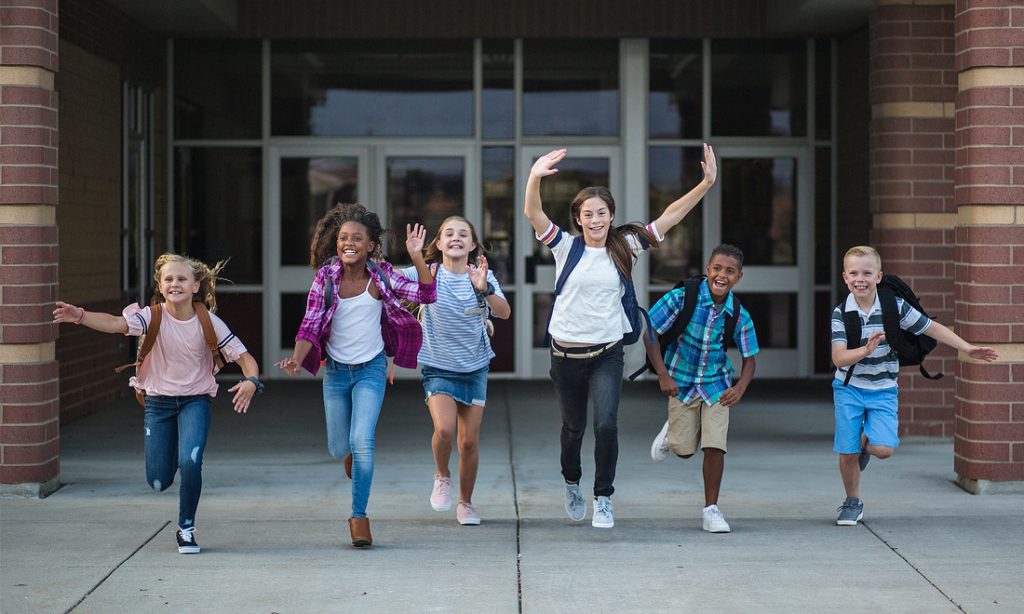
Your child just finished the school year. Backpack is on the floor. Schedule is out the window. And somewhere in the back of your mind, a small, anxious voice is whispering: are they going to forget everything?
That voice is not being dramatic. Summer learning loss — also called the “summer slide” — is real, and the numbers are genuinely sobering. Research from Johns Hopkins University found that children can lose up to one third of their academic progress from the school year over a single summer if they don’t stay mentally engaged. Teachers typically spend the first four to six weeks of autumn just catching up on what was forgotten.
Three months of progress. Gone. In ten weeks.
You might also enjoy:
- Kids Are Reading More in 2026 — Here’s How to Keep the Streak Alive
- What I’m Teaching My Son About Women’s Day (And Why He Once Made Me Almost Cry Laughing — In a Terrifying Way)
- The Heroines Missing From Your Kid’s Bedtime Stories (And Why That’s a Bigger Deal Than You Think)
But here’s the part the panic-inducing headlines always skip: it’s also completely preventable. And the fix doesn’t require turning summer into a second school year. Twenty minutes a day — that’s it. That’s the research-backed dose that keeps the slide from happening.
Why Summer Specifically Wrecks Reading (And What’s Actually Happening)
Reading takes a harder hit than maths over summer — and it’s not random. During the school year, children are reading constantly: instructions, textbooks, worksheets, stories. Their brains are practising decoding, vocabulary, and comprehension every single day. Stop that practice cold and the neural pathways that support those skills start to weaken. Not disappear — weaken. Like a muscle that hasn’t been used in two months.
The children who lose the most ground are those who don’t read at all over summer. According to Parenting Science’s analysis of the research, even a modest reading habit — a few books, a short daily session — is enough to maintain skills and sometimes even improve them. The gap between “reads nothing” and “reads a little” is enormous. The gap between “reads a little” and “reads a lot” is small.
So the goal isn’t to replace school. It’s just to keep the engine warm.
The Fear Every Parent Has (And Why It’s Slightly Misplaced)
Before we go further — Scientific American points out something reassuring: most kids recover summer learning loss pretty quickly once school starts. The brain is not a hard drive that permanently deletes files. It’s more like a muscle memory — it comes back faster the second time. So if your child has a gloriously unproductive summer and slides a bit, it’s not a catastrophe.
That said — why let it happen if twenty minutes a day prevents it entirely?
The parents we talk to aren’t trying to create mini-academics. They’re trying to avoid the September panic, the tears over homework that “used to be easy”, the confidence knock that comes when a child feels behind. That’s worth twenty minutes. Easily.
What Actually Works (According to Research, Not Pinterest)
Let’s be honest: most summer learning advice is either obvious (“read books!”) or unrealistic (“do thirty minutes of structured maths daily!”). Here’s what the evidence actually supports:
Reading beats everything
Every major study points to the same intervention: reading for pleasure. Not assigned reading. Not comprehension tests. Just reading things the child wants to read. Comics, graphic novels, joke books, series novels, choose-your-own-adventure — all of it counts. KQED MindShift’s reporting on the research is clear: voluntary reading is the single most effective summer learning activity available. And it’s free.
Storytelling counts as reading’s cousin
Creating stories exercises the same cognitive muscles as reading them: vocabulary, sequencing, narrative structure, imagination. A child who spends twenty minutes building a story — whether out loud, through an app, or with drawings — is doing meaningful literacy work. Their brain doesn’t know it’s summer. It just knows it’s working.
Conversation is underrated
Talking to your child — really talking, not just logistics — builds vocabulary faster than most formal exercises. Beacon Health System’s summer guidance for 2026 highlights that everyday conversations about what you see, do, and experience are powerful language development tools. Ask your child to explain how something works. Ask them to describe the film they just watched. Ask them to tell you what they’d do if they were in charge. Let them talk. Listen properly.
Cooking, building, exploring
Hands-on activities that seem “not educational” are deeply educational. Cooking involves fractions, sequencing, and reading (recipes). Building involves spatial reasoning and measurement. Exploring a new place involves observation, questioning, and memory. The brain is learning constantly — it just needs interesting input.
The 20-Minute Rule (And Why It’s Enough)
Twenty minutes a day. That’s the threshold most researchers cite for preventing meaningful summer slide. Not two hours. Not a “structured programme”. Twenty minutes of something — reading, storytelling, a conversation, a creative project.
That’s one car journey. One wait at a restaurant. One “quiet time” before lunch. It’s genuinely not a big ask — unless you frame it as school, in which case you’ll have a revolution on your hands and no one will win.
Frame it as something else entirely. “Let’s make up a story.” “Read me something funny.” “Tell me about the most ridiculous thing that could happen at the beach.” Honestly? A ten-minute StoryQuest session at bedtime — where your child creates their own story — ticks the box completely. They think it’s play. Their brain knows it’s practice. Both are right.
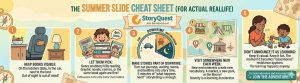
The Summer Slide Cheat Sheet (For Actual Real Life)
- Keep books visible. On the kitchen table, in the car, next to the bed. Proximity creates habits. Out of sight genuinely means out of mind.
- Let them pick. Genre snobbery kills reading. If they want to read the same book for the fourth time, that’s fine. If they want graphic novels, great. Enthusiasm is the only metric that matters.
- Make stories part of downtime. Car journeys, waiting rooms, bedtime. Five minutes of “what happens next?” storytelling is enough.
- Visit somewhere new each week. New environments create new vocabulary. A market, a park they haven’t been to, a library. Novelty is a learning accelerator.
- Don’t announce it as learning. The moment it becomes “educational”, resistance appears. Keep it casual. Keep it fun. The learning happens anyway.
The Bottom Line
Summer learning loss is real. A complete absence of reading or mental engagement over ten weeks will cost a child ground they’ll have to regain in September. But preventing it is neither hard nor joyless — it’s twenty minutes of the right kind of fun, consistently.
The children who thrive after summer aren’t the ones who did workbooks every morning. They’re the ones who read things they loved, told stories, explored new places, and had conversations that stretched their minds. Summer is supposed to be different from school. It just doesn’t have to be empty.
Start tonight. Pick a story to make up together. Or hand them a book and sit nearby with your own. Twenty minutes. That’s your summer sorted.
Frequently Asked Questions
How much learning do kids really lose over summer?
Research from Johns Hopkins University suggests children can lose up to one third of the academic gains made during the school year — roughly the equivalent of three months of progress. Reading skills and maths are most affected. The good news: most children recover quickly once school resumes, especially if the loss was modest.
What’s the minimum effort to prevent summer slide?
Twenty minutes a day of voluntary reading is the most consistently cited threshold. It doesn’t need to be structured or formal. Reading for pleasure — whatever the child chooses — is enough to maintain and sometimes improve skills over the summer.
Does storytelling count as a learning activity?
Absolutely. Creating stories develops vocabulary, narrative structure, sequencing, and imagination — the same skills strengthened by reading. A child building a story in a StoryQuest session is doing meaningful literacy work, even if it feels like play. Especially if it feels like play.
Should I do formal exercises with my child over summer?
Only if your child enjoys them. Forced academic work over summer creates resistance to learning that lasts into the school year. The research consistently shows that voluntary, enjoyable activities outperform reluctant structured ones. Follow the child’s interest and the learning follows automatically.
When should I start worrying about summer slide?
If a child reads nothing and has no mentally engaging activities for the full summer, some slide is likely — particularly in reading. Start simple, early: one book, one story session, one interesting conversation per day. A little, consistently, makes the September return much smoother for everyone.







Leave a comment