


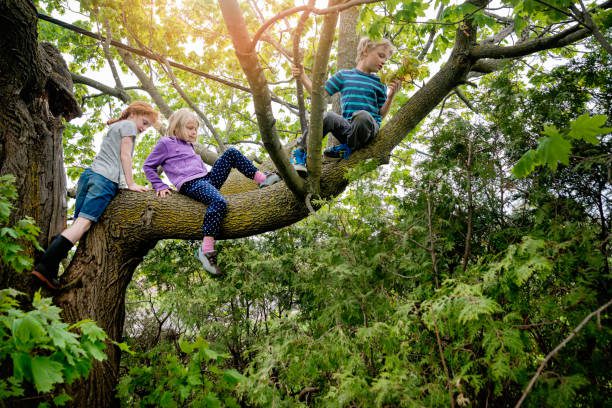
Here’s the terrifying truth nobody puts on the playground sign: the safest thing you can do for your child might be to let them get a little scared.
Risky play — climbing trees, jumping from heights, rough-and-tumble games, exploring alone — is one of the most powerful developmental tools available to children. According to a 2025 scoping review in BMC Public Health, children who regularly engage in risky outdoor play show significantly better resilience, emotional regulation, and self-confidence than children whose play is tightly managed. Not slightly better. Significantly.
And yet most of us are doing everything we can to eliminate that risk. We hover. We catch. We redirect. We build playgrounds with soft rubber floors and rounded corners on everything.
You might also enjoy:
- Kids Are Reading More in 2026 — Here’s How to Keep the Streak Alive
- What ‘1923’ Secretly Teaches You About Raising Resilient Kids 🤠
- The Secret Rules UNICEF Created to Make Screen Time Actually Good for Kids (And How to Use Them at Home)
What Risky Play Actually Is (It’s Not What You Think)
“Risky play” doesn’t mean letting your 4-year-old juggle kitchen knives. Researchers define it as play that involves a real possibility of physical challenge — heights, speed, rough contact, disappearing out of sight, using tools. The key ingredient is that the child feels some uncertainty about the outcome.
That uncertainty? That’s the whole point.
When a child climbs a tree and isn’t sure they can reach the next branch, their brain does something extraordinary. It runs a real-time risk assessment. It weighs ability against challenge. It decides — and then it acts. Repeat that process a few thousand times across childhood and you have an adult who can walk into a difficult meeting, a hard conversation, or an unexpected crisis without completely falling apart.
According to The Conversation’s analysis of the research, children who take managed physical risks learn to regulate emotions like fear, nervousness, and frustration. They don’t just survive those feelings — they get comfortable with them. That’s not a small thing. That’s emotional intelligence, built through falling off a log.
Why Every Parent’s Instinct Is Working Against Their Child
Here’s the part that stings a little. The parental instinct to protect is real, biological, and completely understandable. But the data suggests we’ve overcorrected — badly.
Over the last 30 years, children’s independent outdoor play has declined by over 50% in many Western countries. During that exact same period, childhood anxiety and depression rates have risen dramatically. Coincidence? Researchers don’t think so.
“Children who are restricted from risky play become more fearful and less capable of handling risk as they grow,” writes Dr. Peter Gray, research professor at Boston College and author of Free to Learn. The irony is brutal: by trying to keep kids safe from short-term scrapes and bruises, we may be setting them up for long-term psychological fragility.
One Canadian study found that children would need to spend three hours per day playing outdoors for 10 years before they were statistically likely to sustain an injury requiring medical treatment. Meanwhile, the CBC’s documentary on risky play found that fear of rare events — stranger danger, serious injury — is wildly disproportionate to actual risk.
Our brains are just not good at this math. We’re wired to react to vivid, scary possibilities (what if they fall?) more than to diffuse, statistical ones (they’ll probably be fine). Evolution built that in. But evolution didn’t anticipate rubber-floored playgrounds.
The 8 Things Risky Play Actually Builds
Research consistently identifies eight developmental benefits that come specifically from risky, child-led outdoor play:
- Resilience — bouncing back from setbacks, literal and metaphorical
- Physical competence — spatial awareness, coordination, proprioception
- Emotional regulation — learning to manage fear and frustration without an adult intervening
- Risk assessment — reading a situation and making a judgment call
- Self-confidence — the “I did that” feeling that no participation trophy can replicate
- Social skills — negotiating rules, managing conflict, reading other kids
- Creativity and problem-solving — unstructured environments demand improvisation
- Intrinsic motivation — doing something because it’s genuinely thrilling, not because a screen told them to
That list reads like every parent’s wish list for their child. And it’s available on the nearest climbing frame, if we’d just step back.
How to Let Go (Without Having a Heart Attack)
None of this means dropping your kid at a quarry and wishing them luck. The research supports a middle path — what child development experts call “calibrated risk.” Here’s how to do it without the panic:
Start with height, not speed. Let them climb higher than feels comfortable. Stay close enough to watch, far enough not to hover. The goal is that they know you’re there, not that you’re on standby to catch them.
Resist the urge to narrate the danger. “Be careful!” is the most useless phrase in parenting — children hear it 400 times a day and tune it out completely. Instead, ask: “What do you notice about that branch?” Let their own assessment do the work.
Allow small failures. A scraped knee teaches more than a year of warnings. When they fall and it’s minor — comfort them, then watch them get back up. That moment of getting back up is worth more than you know.
Build a story around it. Children who have a narrative around their own bravery — “remember when you climbed to the top?” — carry that identity forward. StoryQuest families often use the app to create stories where their child IS the brave character. Honestly? Try it the night before a new challenge. It works remarkably well as a confidence primer.
Find a wilder playground. “Adventure playgrounds” — common in Scandinavia and the UK, growing in the US — are deliberately rough: loose materials, heights, fire pits, mud. Children flock to them. Injuries are lower than on conventional playgrounds. Because children calibrate their own risk when they’re allowed to.
What This Means for Storytelling and Imagination
Here’s the connection that surprises most parents: risky physical play and imaginative, creative play use the same neural circuitry. Research from the Children and Nature Network found that natural outdoor environments dramatically increase preschoolers’ creativity in problem-solving and ingenuity — precisely because they offer open-ended challenges that structured environments don’t.
A child who’s learned to navigate physical uncertainty becomes a child who’s comfortable with narrative uncertainty. Who doesn’t need a story to go exactly as expected. Who can hold “I don’t know what happens next” without anxiety.
That child becomes a reader, a writer, a thinker. Not despite the scraped knees — partly because of them.
Frequently Asked Questions
What age is appropriate for risky play?
From toddlerhood onward, in age-appropriate forms. Toddlers can navigate uneven terrain and small heights. School-age children can climb trees, build dens, and roam short distances independently. The key is matching the challenge to the child’s actual (not assumed) capability — and resisting the urge to assume they can’t handle more than you think.
How do I know when a risk is too much?
Ask whether a competent, caring adult would recognise this as normal childhood play. A child climbing a tree: yes. A child climbing a construction crane: no. The research distinguishes between “risky play” (managed uncertainty the child can navigate) and genuine hazards (situations beyond any child’s capacity to assess). Trust your child’s hesitation — they often self-limit more than we give them credit for.
What if my child is naturally cautious?
Cautious children still benefit from risky play — they just need a slower on-ramp. Start with water play, rough terrain, or low heights. Never push or shame. One small, self-chosen challenge that goes well is worth a hundred adult-imposed ones. Offer the opportunity; let them decide the pace.
Does indoor risky play count?
Partially. Rough-and-tumble play, building tall towers, dramatic play with physical elements all provide some benefit. But outdoor, nature-based risky play has unique developmental advantages — unpredictability, sensory richness, genuine consequence — that indoor environments can’t fully replicate. Both matter; outdoor is irreplaceable.
How does StoryQuest support resilience in children?
StoryQuest lets children be the hero of stories where things go wrong and get fixed — where the character faces real challenges, makes decisions, and experiences consequences in a safe narrative space. Paired with physical risky play, it reinforces the same core message: you are capable, brave, and able to handle hard things. Try it tonight and see what story your child chooses to tell.








Leave a comment