


You might also enjoy:
- Is Your Child’s Imagination Atrophying? The Silent Epidemic of Passive Play
- Strengthen Your Bond: Storytelling with Your Child
- The Power of Storytelling: Supercharge the Brain!
Wait, My Kid Only Knows 10 Feeling Words?
Your kid says “mad” when they mean disappointed, embarrassed, and furious, all at once. That’s normal. Most four-year-olds carry around only about ten feeling words in their whole vocabulary. Building a bigger emotional vocabulary is the single skill parenting experts say is defining 2026, and the good news is that story time already teaches it.
Here’s the part that stings a little. Researchers call it “emotion coaching,” and it turns out most of us were never taught how to do it ourselves. So we’re stuck guessing, hoping our kid magically picks it up, and then feeling blindsided when a small disappointment turns into a full meltdown on the kitchen floor. It’s not your fault. Nobody handed you a script for this.
Why “Emotional Vocabulary” Became 2026’s Buzziest Parenting Word
Something shifted this year. Parents stopped treating emotional coaching like a nice extra and started treating it like a core skill, right up there with teaching a kid to read or ride a bike. It’s part of a defining 2026 parenting trend: raising kids who can name what they feel before it takes over their whole body. Big feelings aren’t the problem. Unnamed feelings are.
Think about the last time you felt off but couldn’t say why. Frustrating, right? Now imagine being five and feeling that every single day, with zero words for it. Research on socioemotional skill development keeps landing on the same conclusion: kids who can name their emotions handle stress better, make friends more easily, and bounce back faster from a hard day. Naming isn’t a soft skill. It’s a survival skill.
The Science: Why Naming a Feeling Actually Calms the Brain
Here’s the part that made us go “ohhh.” Brain scientists have found that simply putting a feeling into words quiets down the brain’s alarm system, the part that triggers tantrums and shutdowns. Psychologists call this “affect labeling.” Say the word “frustrated” out loud, and the panic dial actually turns down a notch. No punishment required. No sticker chart. Just the right word, said out loud, at the right moment.
This lines up with what the Gottman Institute’s emotion coaching research has taught parents for years: kids don’t need us to fix the feeling. They need us to name it with them. “You’re disappointed the park closed early” lands very differently than “stop crying.” One shuts the moment down. The other opens it up. Even the American Academy of Pediatrics points to naming emotions as a core building block of early social development, right alongside sharing and taking turns.
Story Time Is a Better Feelings Teacher Than Any Chart
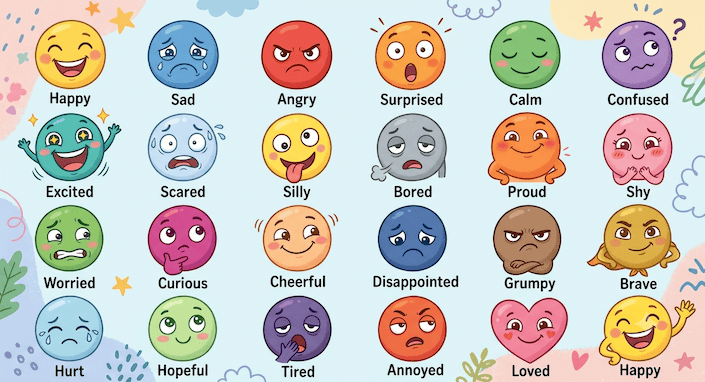
You could buy a laminated “feelings wheel” and tape it to the fridge. Plenty of families do, and that’s fine. But stories do something a chart can’t: they let a kid feel an emotion happen to someone else first, from a safe distance, before they have to handle it themselves. A dragon gets scared. A best friend feels left out. A little sister feels proud. Your child watches it unfold, hears the word attached to it, and quietly files it away for later.
This isn’t just a warm feeling, it’s measurable. Work coming out of the Yale Center for Emotional Intelligence shows that naming emotions inside a story builds the same mental muscle kids need for real-life empathy, sometimes called “theory of mind,” the ability to guess what someone else is thinking or feeling. Stories are basically empathy practice in disguise. Your kid thinks they’re just hearing about a dragon. Their brain is quietly stocking up on feeling words for next Tuesday’s meltdown.
Groups like the Child Mind Institute recommend exactly this kind of narrative practice for building emotional literacy in young kids, precisely because it doesn’t feel like a lesson. Nobody wants to sit through a lecture on feelings, least of all a six-year-old. But everybody wants to know what happens to the dragon.
5 Feeling Words Most Kids Never Hear (Try These Tonight)
Most households cycle through the same four words: happy, sad, mad, scared. Fine start, but kids grow out of them fast. Tonight, try slipping in a few of these while you read or tell a story together:
- Disappointed — smaller than sad, and way more accurate when a plan falls through.
- Nervous — the flutter before something new, not quite “scared.”
- Proud — kids rarely get to claim this one out loud. Let them.
- Overwhelmed — a huge word for a huge feeling, and kids feel it more than we admit.
- Left out — social, specific, and painfully common on playgrounds.
Drop one into your next story. “The knight felt overwhelmed before the big battle” does more for your kid’s emotional vocabulary than any flashcard ever will.
The Easiest Way to Start Tonight
You don’t need a curriculum. You don’t need to become a child psychologist by Friday. Honestly? Try a 10-minute StoryQuest session tonight and just notice how many feeling words show up naturally in the story. Pause when a character feels something. Ask your kid what that feels like in their own body. That’s it. That’s the whole skill, practiced one bedtime at a time.
FAQ: Building Your Child’s Emotional Vocabulary
What age should kids start learning emotional vocabulary?
As early as two or three. Toddlers can learn simple words like “frustrated” or “excited” long before they can explain why they feel that way.
How many feeling words should a five-year-old know?
Experts suggest aiming for 15 to 20 words by kindergarten, well beyond the basic four of happy, sad, mad, and scared.
Does reading fiction really build empathy?
Yes. Studies on narrative engagement consistently link regular story exposure to stronger theory-of-mind skills, the ability to understand what someone else might be feeling.
What if my child refuses to talk about feelings?
Don’t force a conversation. Naming a character’s feelings in a story sidesteps the pressure entirely, since your child isn’t being asked to talk about themselves.
Can building emotional vocabulary reduce tantrums?
Often, yes. A child who can say “I’m overwhelmed” has an alternative to a full-body meltdown. The word becomes the release valve.








Leave a comment