

Here’s the unfair truth no toy advert will ever tell you: the costly light-up plastic gadget your child unwrapped last month is gathering dust, while the cardboard box it came in is now a spaceship, a castle, a cave, and a boat. Your kid already knows what neuroscientists have spent decades proving. The best toy is the one that does nothing — so the child has to do everything.
You might also enjoy:
- Is Your Child’s Imagination Atrophying? The Silent Epidemic of Passive Play
- Risky Play: Why Keeping Kids Safe Is Making Them Fragile
- The “Fire Horse” Energy: Channeling Your Child’s Wild Side into Creativity
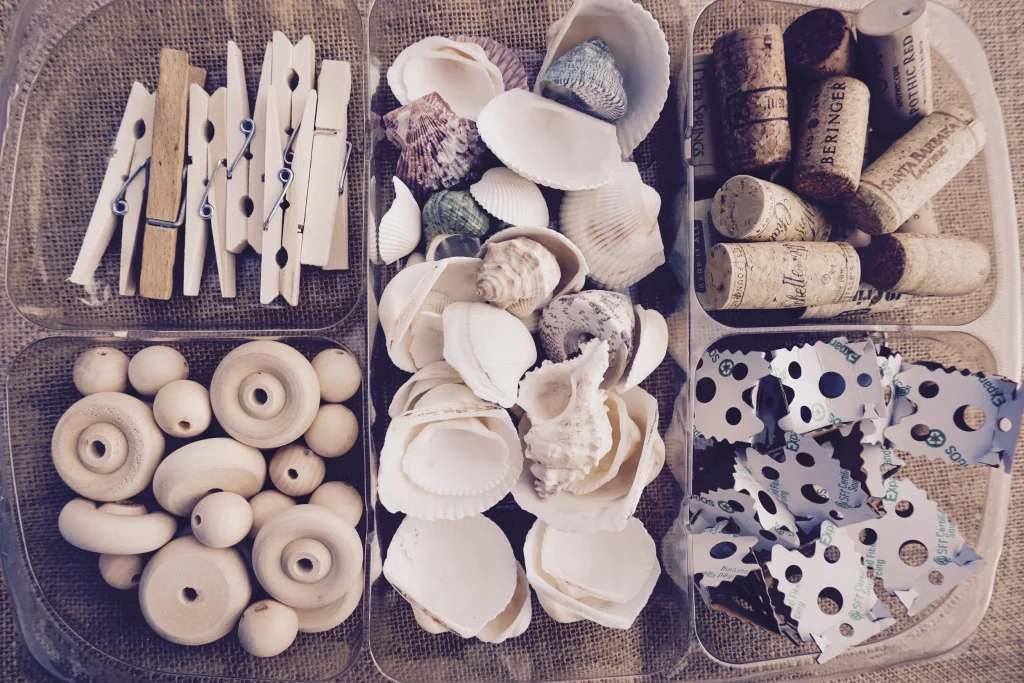
Welcome to loose parts play: the gloriously cheap, slightly messy, brain-building secret that early-years experts can’t stop talking about. Loose parts are open-ended materials with no fixed purpose — pinecones, bottle caps, fabric scraps, pebbles, cardboard tubes, buttons, sticks, old keys. A child can move them, line them up, stack them, sort them, combine them, and turn them into absolutely anything. And that “anything” is exactly where the magic lives.
What Is Loose Parts Play, Really?
The idea comes from architect Simon Nicholson, who proposed the “Theory of Loose Parts” back in 1971. His claim was bold and has held up beautifully: the richness of a child’s play — and their creativity — is directly proportional to the number of variables, the movable bits, available to them. More loose parts, more possibilities. More possibilities, more thinking.
Compare that to a typical modern toy. A toy that sings one song, lights up one way, and does one trick teaches a child a single lesson: press the button, get the reward. Engaging for four minutes. Forgotten by Friday. A basket of pinecones and corks, by contrast, can be a different game every single day, because the child supplies the meaning. Their imagination is the engine. The objects are just fuel.
Why Your Child’s Brain Loves Open-Ended Junk
This isn’t just charming parenting folklore — it’s grounded in how young brains actually grow. When a child decides that a stick is a wand, then a fishing rod, then a microphone, they’re doing something cognitively demanding called symbolic thinking: holding an idea in their head that overrides what’s in front of their eyes. Researchers consider this a foundation stone for abstract reasoning, literacy, and maths.
Open-ended materials also hand children something modern childhood often strips away: control. There’s no “right” way to play with a box of buttons, so there’s no way to fail. That safety to experiment builds problem-solving, persistence, and confidence. According to Community Playthings’ summary of the research, loose parts play supports creativity, fine-motor skills, mathematical thinking, and social negotiation all at once. One basket of odds and ends. Half the developmental curriculum.
The skills hiding inside a pile of pebbles
- Maths: sorting, counting, patterning, comparing sizes and weights.
- Language: narrating invented worlds builds vocabulary and storytelling structure.
- Science: testing what balances, rolls, floats, or fits.
- Social skills: negotiating, sharing, and co-creating rules with playmates.
- Emotional regulation: the calm, absorbed focus of open-ended play soothes busy little nervous systems.
The Best Part: It Costs Almost Nothing
Parents spend billions on toys that promise to make children smarter. The cruel joke is that the most powerful developmental tools are already in your recycling bin, your garden, and the back of your kitchen drawer. The National Association for the Education of Young Children highlights that loose parts are deliberately low-cost and accessible — that’s part of the point. Equity built in.
You don’t need a Pinterest-perfect “play station” either. Honestly? A shoebox of safe odds and ends and twenty minutes of leaving your child alone with it does more than most app-connected toys ever will.
How to Start Loose Parts Play at Home (Without the Mess Taking Over)
Start small and let curiosity lead. Here’s a gentle on-ramp:
- Gather a starter set. Bottle caps, corks, fabric squares, large buttons, cardboard tubes, wooden pegs, smooth stones, pinecones. Check sizes carefully for under-3s — anything that fits through a toilet-roll tube is a choking risk.
- Offer, don’t instruct. Put the basket down and say nothing. Resist the urge to suggest “why don’t you build a tower?” The silence is where their idea is born.
- Add a tray or a rug. Containing the play space contains the mess. A simple boundary makes tidy-up a two-minute job, not a battle.
- Rotate, don’t pile. Swap a few items every week. Novelty re-sparks interest without buying a single new thing.
- Take it outside. Sticks, leaves, mud, and stones are the original loose parts — and free. A garden or park is a treasure trove.
From Loose Parts to Storytelling
Here’s where it gets even better. Loose parts play and storytelling are cousins. When a child lines up three pebbles and announces “this is the mummy, this is the baby, and this one is the dragon,” they’ve just built a story world — characters, relationships, a plot waiting to happen. That same imaginative muscle is the one great readers and writers rely on for life.
You can gently extend it with a question, never a correction: “Ooh, what happens to the dragon next?” Suddenly a pile of stones is a narrative, and your child is the author. If you want to keep that storytelling spark glowing past tidy-up time, a ten-minute StoryQuest session at bedtime lets them build a whole adventure of their own — same creative engine, new playground.
The Bottom Line
Loose parts play is the rare parenting win that’s cheaper, easier, and better than the expensive alternative. It hands your child the one thing flashy toys take away: the job of imagining. So before the next big toy purchase, try the box, the buttons, and the pinecones first. Your child’s brain — and your wallet — will thank you.
Frequently Asked Questions
What age is loose parts play good for?
Every age, with adjustments. Toddlers need larger, choke-safe items like fabric squares and big wooden pieces. Preschoolers and school-age children thrive with smaller, more varied parts — buttons, caps, stones, and craft bits — that invite sorting, building, and storytelling.
Is loose parts play safe for toddlers?
Yes, with supervision and careful sizing. The rule of thumb: if an object fits through a toilet-roll tube, it’s a choking hazard for under-3s. Choose large, smooth, non-toxic items and always stay nearby for the youngest children.
What are good examples of loose parts?
Pinecones, corks, bottle caps, fabric scraps, smooth stones, cardboard tubes, large buttons, wooden pegs, shells, sticks, and ribbon. Natural materials from the garden work beautifully and cost nothing — the original loose parts.
How is loose parts play different from regular toys?
Most toys have one fixed purpose and one way to play. Loose parts have no fixed purpose, so the child decides what they become — a stick is a wand, then a sword, then a bridge. That open-endedness is what drives creativity, problem-solving, and deeper, longer-lasting engagement.
Does loose parts play really help development?
Research supports it. Open-ended play builds symbolic thinking, fine-motor skills, early maths and language, social negotiation, and emotional regulation — often all in a single play session. It’s one of the most efficient, low-cost developmental activities available to families.








Leave a comment