Want a Better Vocabulary? Build an Obstacle Course
Key Takeaways
- Talk with Your Hands: Gestures aren’t just fidgeting; they are the stepping stones to complex vocabulary.
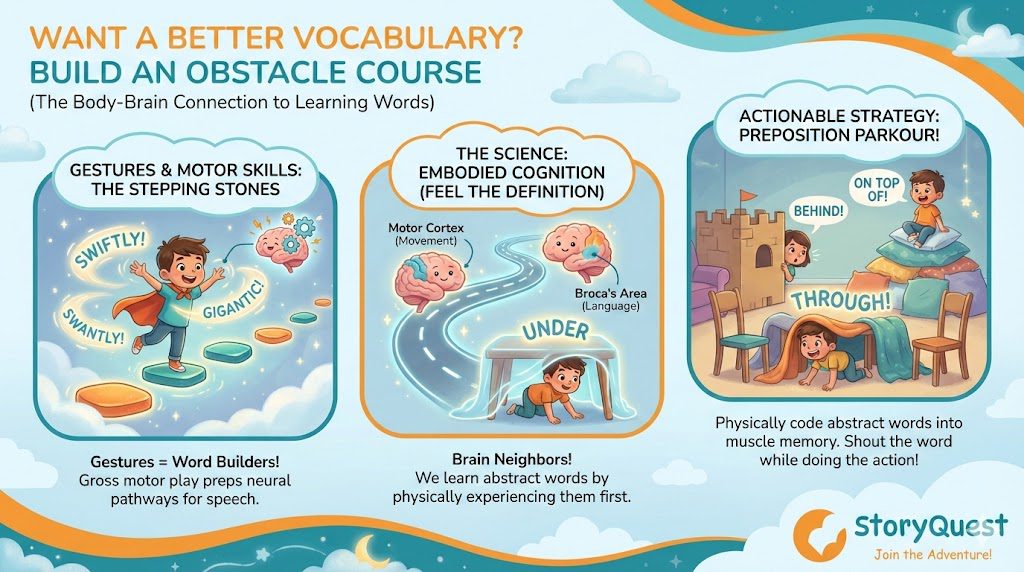
- Embodied Cognition: We learn abstract words (like “under” or “swiftly”) by physically experiencing them.
- Motor Skills = Mouth Skills: Gross motor play preps the neural pathways for speech production.
The Interpretive Dance of the 4-Year-Old
Ever notice that when your child is trying to tell you a really exciting story, their whole body enters the chat? They aren’t just telling you about the dog at the park; they are jumping, waving, and practically re-enacting the scene like a method actor.
That’s not a coincidence. Before we learn to speak with our mouths, we speak with our bodies. If you want to build a better vocabulary, you might need to stop looking at flashcards and start looking at your jungle gym.
The Science (Simplified): Embodied Cognition
Research has long shown a massive highway connecting motor development and language. A study cited by The National Institutes of Health (NIH) suggests that motor delays often predict language delays. Why? because the brain areas that control movement (the Motor Cortex) and language (Broca’s Area) are essentially neighbors who borrow sugar from each other.
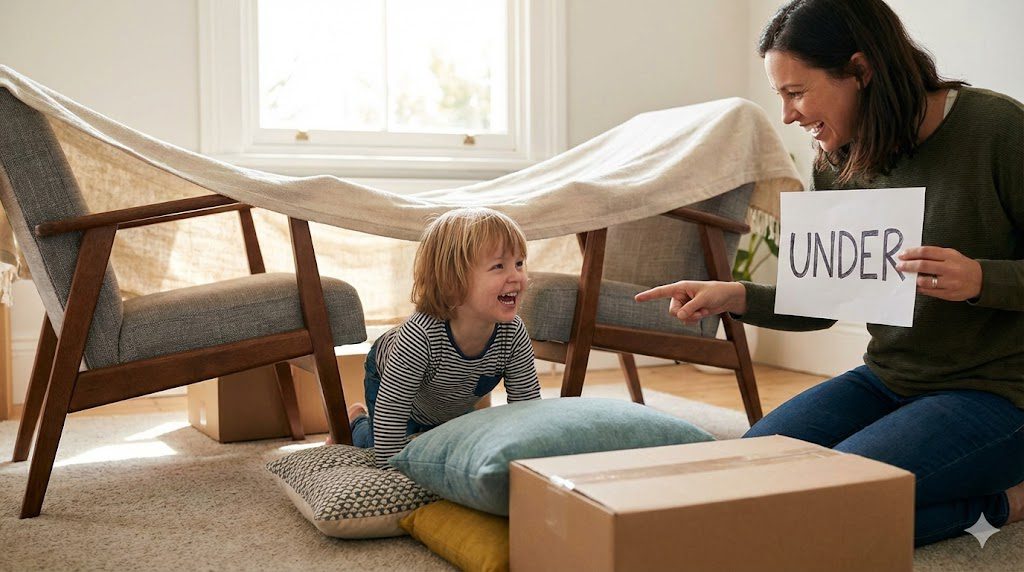
This is called Embodied Cognition—the idea that we think with our bodies. When a child crawls under a table, they are physically mapping the concept of “under” onto their brain. They literally “feel” the definition before they can say it.
- Want to put this science into practice? Try our Active games for high-energy kids to get those motor skills firing.
- If you’re worried about over-stimulation, balance the movement with Quiet-time stories that actually work.
For loud and quiet kids
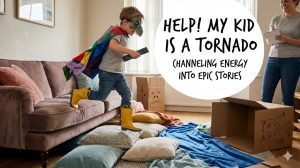
- For the “Loud” Kid: Movement gives context to their rapid-fire thoughts. It allows them to “dump” the information physically when their mouth can’t keep up with their brain.
- For the “Quiet” Kid: Action games allow them to demonstrate understanding without the pressure to speak. They can show you they understand “jump on the red square” even if they aren’t ready to verbalize the sentence yet.
Actionable Strategy: Preposition Parkour
Forget standard Simon Says. We are going to focus on spatial words (prepositions), which are notoriously hard for kids to learn just by listening.
- The Setup: Use a chair, a box, and a blanket.
- The Commands:
- “Crawl through the tunnel (legs).”
- “Hide behind the fortress (chair).”
- “Sit on top of the mountain (box).”
- The Twist: If they get it right, they get to shout the word while doing the action. “I am UNDER!”
You are physically coding the definitions of these abstract words into their muscle memory.
The StoryQuest Solution
Our stories are packed with “action verbs.” We don’t just say “The hero ran”; we say “The hero scrambled up the rocky cliff!” By acting out these specific verbs, your child expands their vocabulary without ever realizing they are learning. It’s a workout for the legs and the lexicon.
FAQ (People Also Ask)
- Q: Can movement help a “Late Talker”?
- A: Yes. Many speech therapists use “gesture-speech integration” because hand movements can help trigger the retrieval of words in the brain.
- Q: What are “action words” for toddlers?
- A: These are verbs that can be physically performed, such as jump, spin, crash, roll, and stomp. These are often easier to learn than nouns because they are dynamic.
- Q: Does fine motor skill affect speech?
- A: Surprisingly, yes. The dexterity required to button a shirt uses similar neural planning to the dexterity required to move the tongue and lips for speech.