


Key Takeaways
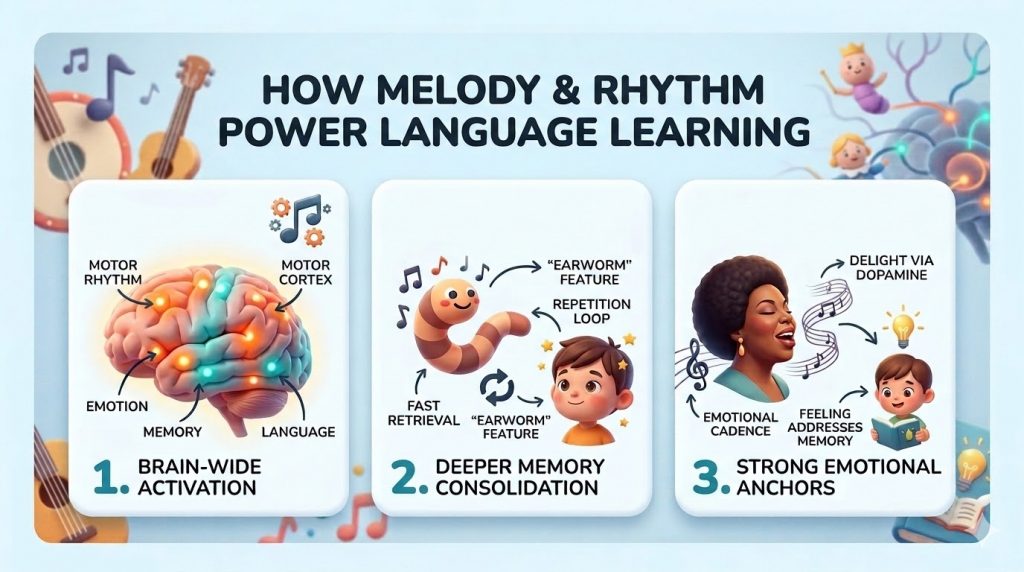
- The Melody-Memory Loop: Songs light up more brain regions simultaneously than almost any other input — language, emotion, memory, and motor rhythm all fire at once. That’s not a coincidence. That’s architecture.
- The “Earworm” Is a Feature, Not a Bug: The reason your kid can recite every lyric of their cartoon theme song but “forgot” you asked them to put shoes on twice is a neurological fact, not a personal attack.
- Narrative + Melody = Retention Superpower: When a story has rhythm, kids don’t just hear it — they feel it. And what the body feels, the brain keeps.
A Voice That Made You Listen
Roberta Flack died in February 2025. She was 88. And within about 24 hours of the news, Killing Me Softly was playing in kitchens and cars all over the world.
There’s a reason for that. Not just grief — though yes, definitely that — but something more specific. That song does something unusual. It tells you a story. There’s a protagonist. An encounter. An emotional arc. A moment of recognition so precise it feels almost embarrassing to listen to. And all of that happens through melody. You don’t read it. You don’t study it. You feel your way through it in about four minutes.
Your kid’s brain works exactly like that.
And if you’re not using melody and rhythm in your storytelling, you’re leaving one of the most powerful learning tools in human history sitting on the table.
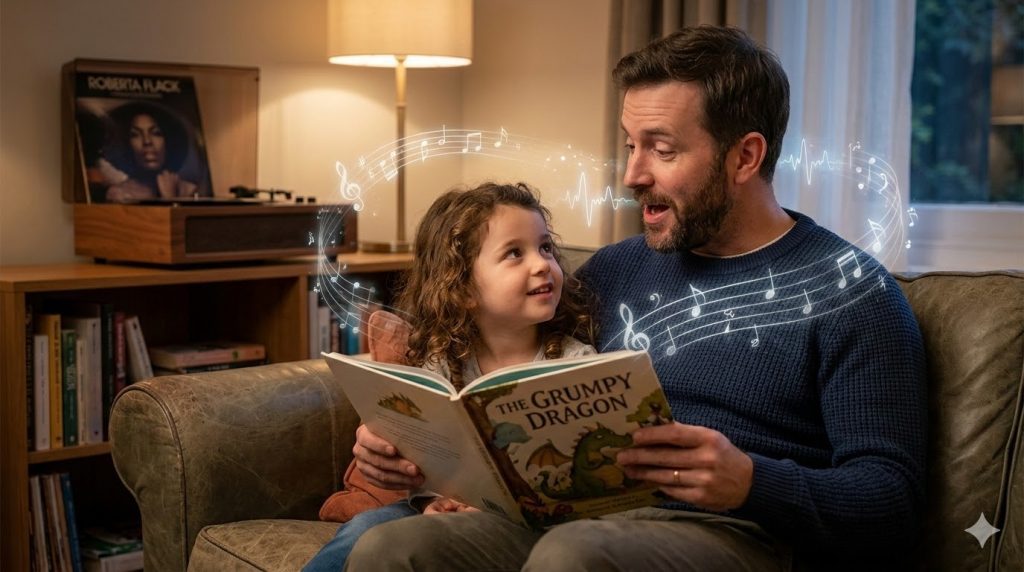
Because here’s the thing — you don’t need a degree in music theory, a ukulele, or a YouTube channel to use this. You just need a voice and a wild story about a dragon with a questionable hat.
🧪 The Science Corner: Why Melody Is the Brain’s Native Language
(Bear with me — I promise it’s worthy!)
Here’s what researchers figured out that musicians and grandmothers already knew: melody and language share a neural superhighway.
A landmark study published in the Proceedings of the National Academy of Sciences found that musical engagement physically reshapes the auditory cortex and strengthens the corpus callosum — the bridge between the brain’s two hemispheres. In plain English: kids who engage with music show stronger language processing, bigger vocabularies, and better reading comprehension. (Source: PNAS)
Then there’s Nina Kraus’s lab at Northwestern — the BRAINVOLTS team, which is, objectively, the best lab name in science. Their research showed that the brain’s responses to music and speech overlap so significantly that musical training is now considered one of the most effective early interventions for language and reading delays. (Source: NIH/NCBI)
And then — the earworm thing. When information is paired with melody and rhythm, it encodes differently — deeper, more durably — into long-term memory. This is the “testing effect” in action: when retrieval is effortful but successful, memory consolidates faster. (Source: PubMed)
It’s why you still know the Alphabet Song from 1987 but cannot, under any circumstances, recall where you left your phone.
The narrative layer makes it even stronger. When a story has a rhythmic or musical quality — think nursery rhymes, oral traditions, or even the cadence of a well-told bedtime story — comprehension and retention go up significantly compared to flat prose delivery. Your kid isn’t just listening. Their whole nervous system is processing.
For a deeper dive into how storytelling activates the brain in general, this is worth a read: The Power of Storytelling: Supercharge the Brain!
Why Does This Work? The Three Mechanisms
Understanding how melody does its magic helps you use it on purpose, rather than just hoping it happens.
1. The Multi-Region Activation Effect
When your child hears a spoken sentence, a relatively contained set of brain regions processes it. But when that same sentence is set to melody? The brain floods with activity. The motor cortex fires (rhythm). The limbic system fires (emotion). The hippocampus lights up (memory encoding). The language centres activate (meaning).
You’ve essentially turned a single-lane road into a motorway. More neural highways means more durable memory.
2. The Repetition Loop
The reason nursery rhymes have survived for centuries isn’t because they’re especially good literature (honestly, Humpty Dumpty is a bit dark). It’s because repetition inside a rhythmic structure forces the brain to predict — and confirming the prediction each time fires a tiny hit of dopamine. Delight as a neurochemical strategy. Sneaky.
3. The Emotional Anchor
Roberta Flack’s genius wasn’t just technical — it was emotional precision. Melody attaches feeling to content. And emotions are the brain’s filing system. That’s why a song can make you cry about a person you haven’t thought about in fifteen years. The feeling is the address label on the memory.
When you tell your kid a story with emotional rhythm — speeding up during the exciting bits, dropping to a near-whisper for the spooky part — you’re not just performing. You’re creating memory anchors.
What This Means for You at 7:45 PM
You don’t need a piano. You don’t need music lessons. You don’t even need to be able to hold a tune (your four-year-old has no critical standards yet, and this is one of the great gifts of parenthood).
You just need to add rhythm and melody to the stories you already tell.
Here are three specific techniques, all tested on actual bedtimes by actual exhausted parents:
🎵 Technique 1: The “Soundtrack” Game
Before you start a story, ask your kid: “What kind of music lives in this world? Fast? Slow? Creepy? Epic?”
Then — and this is the key move — speak the story with that rhythm in your voice. Speed up during the chase. Slow way down during the sad bit. Whisper for the sneaky parts. Your voice is the instrument. You are already equipped.
This isn’t about performance — it’s about giving the brain’s emotional circuitry something to grab onto. Even a slightly exaggerated bedtime voice changes the neurological experience of the story.
🔁 Technique 2: The Repeating Line
Give your story one line that comes back. “And the brave little fox kept going.” Every time it appears, your kid joins in.
This isn’t just cute — it’s exactly how oral storytelling traditions worked for millennia. Repetition + melody + active participation = neural encoding on repeat.
For kids who are more “audience” than “participant”, this is the lowest-friction way to get them into the story. They don’t have to invent anything. They just have to remember one line. Once they’re in, they’re usually in for good.
🎤 Technique 3: The 2-Word Summary Song
After the story, ask your kid to make a tiny made-up song about it. Two words and a melody they invented. “The fox won! The fox won!” (To whatever tune emerges.)
This forces retrieval — which is, according to the research above, one of the most powerful memory consolidation tools we have. You’re not just reviewing the story passively. You’re asking the brain to reach back in, find the information, and express it. That effort is the whole point.
For the kids who already never stop talking, there’s a lot of overlap here with serve-and-return conversation: Why Your Kid Interrupting You Is Actually Genius
A Note on Different Kids
Because not every child responds to rhythm the same way, and that’s okay.
For the quiet ones who absorb more than they output: Melody is a bridge. Music lowers the stakes of speaking because it feels like play, not performance. A shy kid who won’t tell you about their day might happily sing you a story about a dragon. Take the dragon. It’s a way in. More on getting shy kids to open up here: The “Safe Danger” Paradox
For the big talkers who monologue at you: Rhythm can help structure their thinking. The predictability of a musical structure — verse, chorus, verse — helps the brain organise information in a way that free-flowing info-dumps often don’t. Read more on this: The 20-Minute Monologue
For kids with language delays or neurodivergent learners: This one is significant. Many speech-language pathologists already incorporate song and rhythm specifically because the melody pathway can operate more independently than standard language processing. If your child struggles with expressive language, rhythm might be an alternative road in. Understand the bigger picture here: The “Use It or Lose It” Rule
For ADHD brains especially: The predictability of rhythm is soothing to an overactivated nervous system. It’s the same reason people with anxiety often gravitate toward repetitive music. A rhythmic story gives the brain’s threat-detection system something consistent to latch onto, which frees up processing power for the actual content. More on helping ADHD learners: The Bottleneck Effect
The Age Window Question (And Why It’s Not Actually a Window)
Parents often ask: “Is it too late? My kid is already 8.”
The short answer: no. The longer answer: the window between 2 and 7 is when the auditory-language connection is most plastic — meaning most easily shaped. But neuroplasticity doesn’t have a hard deadline.
Research on older children who began musical engagement later still shows meaningful gains in language processing and vocabulary. The brain retains more flexibility than we used to think.
And beyond the neuroscience: there is simply no age at which a child stops responding to a good story told with good rhythm. The pull of narrative + melody is ancient and not going anywhere. Your ten-year-old who seems too cool for bedtime stories? Try adding a voice. You might be surprised.
The Bigger Picture: What Roberta Flack Actually Did
Roberta Flack didn’t just make beautiful music. She told beautiful stories in a language the brain was evolutionarily wired to receive.
Think about it: before books, before schools, before print — human beings transmitted everything important through rhythmic oral tradition. Songs. Chants. Rhythmic stories. The Iliad was probably chanted, not read. Religious texts across almost every tradition incorporate rhythm deliberately. Lullabies predate written language by millennia.
Your kid has that same wiring. It’s been there since before they were born — babies respond to the rhythm of language in the womb. This isn’t a modern pedagogical technique. It’s the original one.
The question isn’t whether melody works. The question is whether you’re using it.
Tonight, before lights out, try adding a little melody to whatever story you tell. It doesn’t have to be good. It just has to be rhythmic. You’re not auditioning for anything. You’re just giving your kid’s brain what it’s been waiting for.
✅ Try This Tonight
Hum a made-up two-second theme song for tonight’s bedtime story character. Ask your kid to add a line. See where it goes. You’ll be surprised by how quickly a “quick bedtime story” turns into the conversation you’ll both remember.
And if you want stories that are already built around this principle — voice-first, rhythm-aware, designed for the way kids’ brains actually work — explore StoryQuest · Google Play.
🔗 Further Reading on StoryQuest
- The Power of Storytelling: Supercharge the Brain
- Why Your Kid Interrupting You Is Actually Genius (Serve and Return)
- The “Use It or Lose It” Rule: Why Output Matters
- The “Safe Danger” Paradox: Shy Kids and Storytelling
- The 20-Minute Monologue: Why Your Child Talks AT You
- The Bottleneck Effect: ADHD and Big Ideas
❓ FAQs
Q: My kid doesn’t seem interested in music. Does any of this still apply?
Yes. They don’t need to love music for rhythm to work on their brain. Even the natural rise and fall of a well-told story activates the same pathways. Just vary your vocal rhythm when you read or tell stories — that alone makes a measurable difference.
Q: What age does this work best for?
From birth, technically. But the window between 2 and 7 is when the auditory-language connection is most plastic. That said, kids who had musical engagement early still show measurable neural benefits well into adulthood.
Q: Do I need to use “educational” music specifically?
No. Any music your kid engages with actively — not just plays in the background — counts. The key word is active. Singing along, making up words, clapping to the beat. Passive listening helps less than engaged listening.
Q: What if I’m a terrible singer?
Statistically, your kid does not care. They care that you’re present and playful. Off-key is fine. Committed is what counts.
Q: Can this help with reading delays?
Quite possibly. The research from Nina Kraus’s lab specifically links musical engagement to improvements in phonological awareness — the ability to hear and manipulate the sounds in words, which is the foundational skill for reading. It’s not a cure-all, but it’s a legitimate head start.
Q: Is there a difference between listening to music and making music?
Yes — active music-making (singing, clapping, making up melodies) engages the motor cortex in addition to the auditory and language systems, which adds another encoding pathway. Listening is good. Doing is better.
— The StoryQuest Team
Start Your Free Story · Google Play
© StoryQuest | storyquest.app




Leave a comment