

Key Takeaways
- The “Family Narrative” Effect: Kids who know their family’s story – the hard parts included – score measurably higher on self-esteem, resilience, and emotional health. Not kidding. There’s a scale for this.
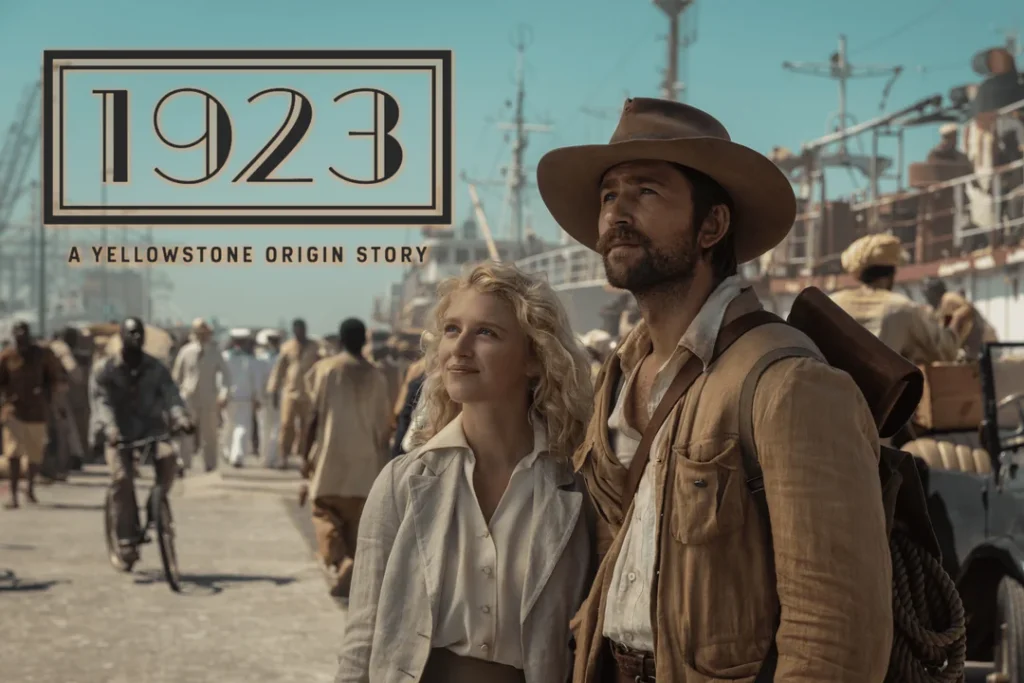
- Harrison Ford Was Right (About Stories): The Dutton family saga isn’t just entertainment. It’s a masterclass in multigenerational identity – and your kid needs the same thing, at whatever scale fits your life.
- You Don’t Need a Ranch: Your family story doesn’t have to be epic to be powerful. The research says the details – even the imperfect ones – are exactly what builds kids who bounce back.
A Frozen Montana Winter and a Very Specific Feeling
Season 2 of 1923 is back, Harrison Ford is back, and if you’ve watched even one episode, you know the feeling: this show is exhausting and beautiful and somehow makes you want to call your grandmother.
That feeling is doing something to your brain. And to your kid’s brain, if they ever catch a glimpse.
Here’s the thing about the Dutton family saga – and about any epic multigenerational story, from Yellowstone to your own family’s messy, imperfect history: it gives people a sense of continuity. Of “I am part of something.” Of knowing that the people who came before them survived hard things, and that therefore, maybe, so can they.
That’s not just a vibe. It’s science.
The power of watching a family navigate impossible circumstances across decades is that it teaches something your kid won’t learn anywhere else: the long view. That problems that feel enormous right now are chapters in a longer story. That your family has survived other impossibilities. That you are, simply by being born into your family, part of something that has already demonstrated resilience. That’s a profound gift.
The Science: Your Family’s Story Is a Psychological Asset
In the early 2000s, psychologist Marshall Duke at Emory University developed something called the “Do You Know?” scale – a simple set of 20 questions to measure how much a child knows about their family history. Things like: Do you know where your parents grew up? Do you know about a time when your family struggled financially? Do you know the story of how your parents met?
The results were striking. Kids who scored higher on the “Do You Know?” scale showed significantly higher self-esteem, stronger resilience in the face of stress, and better overall psychological wellbeing – even when researchers controlled for family cohesion and warmth (source).
Let me say that again: knowing family history predicted resilience independent of how warm or cohesive the current family was. A kid in a somewhat distant family who knew detailed family stories did better than a kid in a warm, close family who didn’t know where their grandparents came from.
The reason, Duke argued, is what he called the “intergenerational narrative” – a sense of self that stretches beyond your own immediate experience. Kids who know that their great-grandmother immigrated alone at 17, or that their dad failed a grade and figured it out, or that their family once lost everything and rebuilt – those kids have an internal resource that kids without that story simply don’t have.
The research on narrative identity backs this up across multiple studies. A child who sees themselves as part of an ongoing story – not just a moment in time – has a more stable foundation for identity and resilience (source).
What’s happening neurologically is this: when a child knows their family’s story, they’re building what neuroscientists call “narrative continuity” – a cognitive framework in which their own struggles and successes fit into a larger pattern. This activates the default mode network, the part of the brain that’s responsible for sense of self and long-term perspective. A child with a strong family narrative doesn’t just weather difficulty – they can contextualize it. “This is hard right now, and my family has been here before.”
Here’s the StoryQuest angle on this: The “Choose Your Own Adventure” Brain – because a kid who knows their family’s story also knows that the next chapter isn’t written yet. That’s agency.
The Science Box
The Intergenerational Narrative Effect: Children who know their family’s history score significantly higher on measures of self-esteem, resilience, and psychological wellbeing than peers who lack family narrative knowledge – even controlling for current family warmth or cohesion. The “Do You Know?” scale (developed by Marshall Duke, Emory University) demonstrated that specific knowledge of family history (where parents grew up, stories of financial struggle or loss, stories of how parents met, etc.) predicted stress resilience independent of current family dynamics. Narrative identity research confirms that children who see themselves as part of an ongoing intergenerational story develop more stable self-concepts and more adaptable stress-response systems. The mechanism involves the brain’s default mode network, which constructs long-term identity and sense of self – activation in this network when recalling or discussing family stories correlates with increased resilience markers and lower anxiety responses to novel challenges.
The Dutton Family Formula (Applied to Real Life)
What makes 1923 so watchable isn’t really the gunfights or the cattle. It’s the continuity. You watch Jacob Dutton (Harrison Ford, being stoic and magnificent) and you understand: this man knows what he’s fighting for because he knows where he came from.
Your kid needs that same anchor. At a much smaller scale. In your kitchen.
Here’s how:
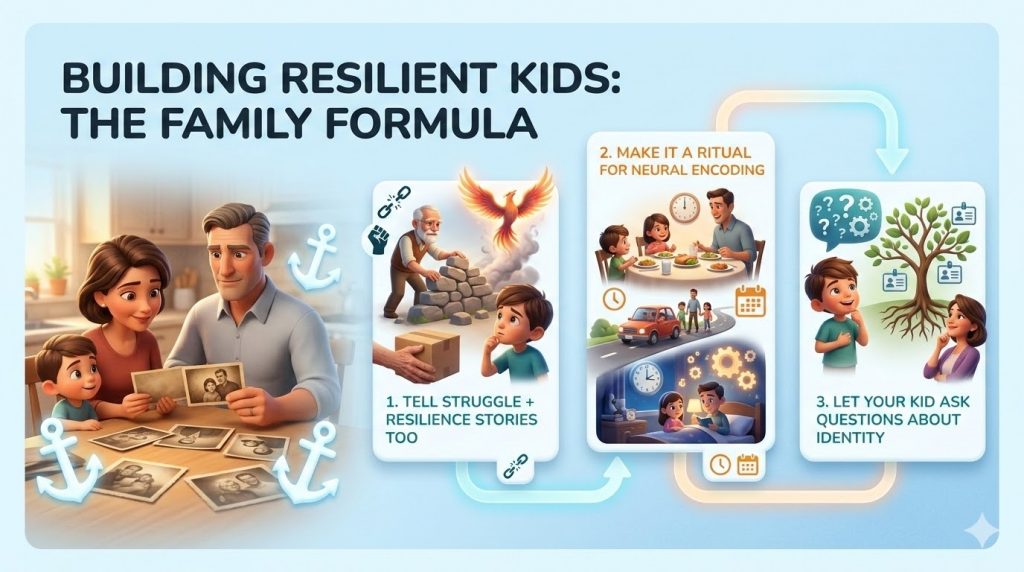
Tell the Hard Stories Too: It’s tempting to only share the wins. “Grandpa built a business from nothing! Amazing!” But research is clear that it’s the struggle + survival stories that build resilience, not just the triumph narratives. “Grandpa lost everything in 2008 and had to start over at 55. And he did.” That’s the story your kid needs.
The reason hard stories work better than triumph stories is counterintuitive: your child doesn’t need to know that your family is invincible. They need to know that your family is resilient. Those are different things. Invincible sounds great until your kid encounters their first real failure, and then the story doesn’t match their experience. Resilient says: “We have been broken. And we figured it out.” That’s the story that transfers.
Make It a Ritual: Duke and his colleagues found that families who regularly told these stories – at dinner, during drives, at bedtime – raised more resilient kids than those who told them only occasionally. Consistency matters more than elaborateness. Even a five-minute “did I ever tell you about the time…” counts.
The ritual part is important for a specific reason: repetition strengthens the neural encoding of the narrative, just as we saw with music and language. A story told once is interesting. A story told consistently over time becomes part of your child’s internal script for how the world works.
Let Your Kid Ask Questions: The most powerful version of this isn’t a lecture. It’s a conversation. “What do you want to know about our family?” The answers will surprise you. And the questions will show you exactly what your kid is trying to understand about themselves.
A child asking about family history is usually asking something deeper: “Who am I, and what am I made of?” When you answer that question with a real story – tot idealized, but honest – you’re giving them material to build their identity with.
For more on why this kind of bonding through storytelling matters, here’s a piece worth reading: Strengthen Your Bond: Storytelling with Your Child
And if you’re wondering how to structure a story worth telling – even a family one – this breaks down the mechanics beautifully: The 4 Stages of a Great Story
The Practical Structure: How to Tell a Family Story
If you’re sitting down to tell your kid a family story and you’re not sure how, here’s a simple structure that works:
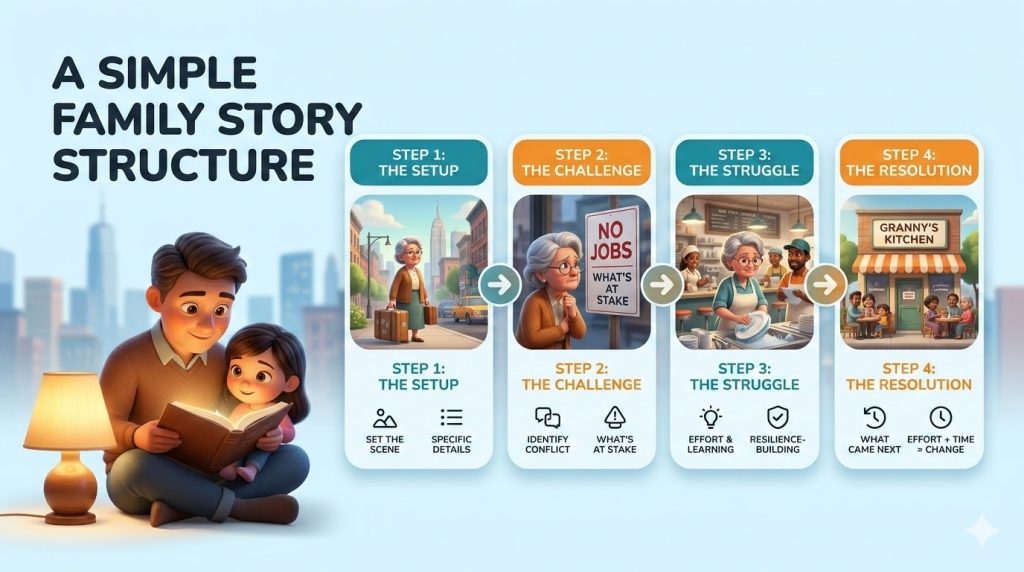
The Setup: “Here’s the situation your [grandparent/parent/aunt] was in.” Be specific. “Your grandmother had just arrived in America. She didn’t speak English. She had $8 in her pocket.”
The Challenge: “And then this happened.” What made it hard? What was at stake? “She needed a job, and nobody would hire her because she didn’t speak English yet.”
The Struggle: “And here’s what she tried.” This is the part that matters most for resilience-building. What did she do? “She took a job washing dishes at a diner, even though it was hard. She worked there and learned English from the other workers. She learned the menu.”
The Resolution (Not the Happy Ending): “And this is what came next.” It doesn’t have to be a triumph. “Eventually she saved enough money to open a small restaurant. It wasn’t fancy, but it was hers.” Or even: “She never opened a restaurant, but she built a life. A real life, with family, with community.”
The power of this structure is that it shows effort + time = change. Not luck, not magic. Effort and time.
Why “The Great Race” Was Already Doing This
This isn’t a new idea, by the way. Every culture with a strong oral tradition â the Chinese Zodiac, Indigenous storytelling, Norse sagas â understood that children need to hear the long story of their people to understand their own place in it. Why the “Great Race” is the Ultimate Lesson in Grit covers this perfectly: the Great Race myth is a family narrative on a cultural scale. It’s showing children: “This is who we are. This is what we value. This is how we handle hardship.”
The Duttons have a ranch. You have a family. Same principle.
What If Your Family Story Is Actually Painful?
This is where the research gets really important. The studies on family narrative don’t say “only tell the happy stories” or “protect your child from knowledge of family trauma.” They say: tell the true stories, age-appropriately, and frame them as survival narratives.
So if your family history includes mental illness, addiction, loss, or abuse – it can still be told in a way that builds resilience. The key is: “We went through this hard thing, and we survived it. Here’s what that taught us. Here’s what we learned about ourselves.” Not: “This destroyed us and we’re still broken.”
A child who knows that their parent struggled with depression and got help and is now managing it has a more realistic, more resilient understanding of mental health than a child who thinks mental illness is either invisible or disqualifying. A kid who knows their family lost their home in a fire and rebuilt has a different internal model of adversity than one who’s never heard about real hardship.
The Bottom Line
Harrison Ford isn’t getting paid to teach your kid resilience. But 1923 accidentally does exactly that – it shows, at an epic scale, what it looks like to be part of something bigger than yourself. To carry a story forward.
Your family has that story. It doesn’t need to involve Montana winters or cattle drives. It just needs to be told.
This week, at dinner, try one: “Let me tell you about the hardest thing your [grandparent / parent / uncle] ever went through.” See what your kid does with it.
Try This Tonight: Ask your child one “Do You Know?” question – something real from your family history. It can be funny, hard, or mundane. The story matters more than the drama.
And if you want to help your kid build their own stories alongside yours, StoryQuest is built exactly for that.
FAQs
Q: What if my family history is complicated or painful? Should I still share it?
A: Yes – carefully, and age-appropriately. The research shows that even difficult family stories (mental illness, financial struggles, loss) contribute to resilience, as long as they’re framed as “we survived this” rather than “this destroyed us.” The narrative arc matters.
Q: At what age should I start telling family stories?
A: Earlier than you think. Even 3- and 4-year-olds absorb more than they let on. You don’t need them to understand every detail – the emotional tone and the “we made it through” message lands long before the full context does.
Q: What if I don’t know much about my own family history?
A: That’s more common than you’d think – and worth exploring. Even the act of saying “I don’t know much about your great-grandparents, and here’s why” tells a story. The unknown is part of your family’s narrative too.
Q: Does the family need to be biological for this to work?
A: No. The research is about narrative continuity, not genetics. Chosen families, adoptive families, and blended families all have their own stories. The question is just: does your child know it?
Q: My extended family is estranged. How do I tell family stories when I’m not in contact with family members?
A: You tell the stories you know, and you’re honest about the gaps. “I knew your grandmother for this part of her life, and then we weren’t in contact, so I don’t know what happened next.” That’s still valuable information. It teaches your child that families are complex and that knowledge, even incomplete knowledge, is powerful.
Q: What if my kid asks me questions I can’t answer?
A: Say “I don’t know, but we could find out together” or “I don’t know, and here’s why that gap exists in my knowledge.” Uncertainty is honest. It models that not knowing is not the same as the story being unimportant.
Want more science-backed tools for raising creative, confident kids in a digital world? StoryQuest was built for exactly that. [Start your free trial here →] · Google Play




Leave a comment