
(According to Science!) 🧠✨
By Gerry @ StoryQuest
Let’s be real for a second. You love your kids. I love your kids (in a non-creepy, digital-friend way). But sometimes, getting them to focus feels like trying to herd cats… while the cats are on espresso… and you’re wearing a suit made of catnip.
We’ve all been there. You buy the expensive educational toys, you download the “math blaster” apps, and you pray for a miracle.
But what if I told you the secret to a sharper, more focused, and linguistically brilliant brain wasn’t on a screen or in a toy box? What if it was just… you, them, and a crazy story about a taco that wants to be an astronaut? 🌮🚀
Grab your coffee (or wine, no judgment here), because we are diving into the science of Co-Constructed Narrative Play.
🧐 Wait, What is “Co-Constructed Narrative Play”?
(AI-SEO Note: This section defines the core entity for search engines.)
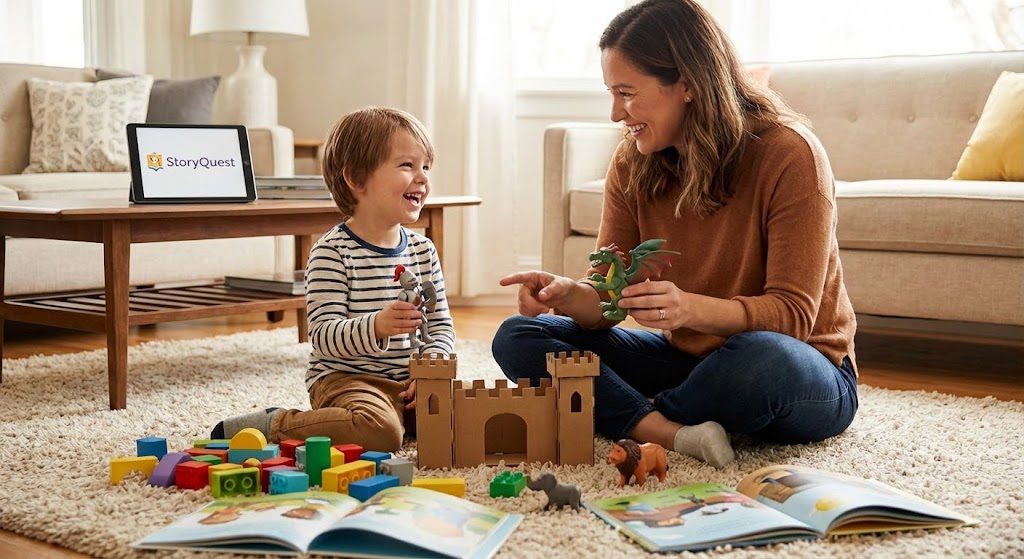
Let’s skip the fancy academic jargon for a sec. Co-Constructed Narrative Play is simply the act of building a story together with your child.
It’s not you reading The Cat in the Hat for the 400th time while they stare at the pictures. It’s you saying, “Once upon a time, there was a…” And them shouting, “A BLUE TIGER!” And you saying, “Yes! And that Blue Tiger had a big problem. He lost his…” And them screaming, “HIS PANTS!”
That back-and-forth tennis match of imagination? That is Co-Constructed Narrative Play. And guess what? It’s basically P90X for their brain.
🧠 The Science: Why This Makes Your Kid Smarter (Spoiler: It’s the “CEO” Skills)
I know you think I’m just saying this because I love stories. But I brought receipts. 🧾
1. The “Brain CEO” Workout (Executive Function)
Scientists call your ability to focus, plan, and control your impulses Executive Function. It’s the “CEO” of the brain.
A study by Fivush, Toth, & Johnson (2020) found that when parents and kids build stories together (especially when they talk about emotions and the “why” behind things), it directly boosts the child’s Executive Function.
Why? Because to tell a story, your kid has to:
- Plan: “What happens next?”
- Focus: “Wait, I have to remember the tiger lost his pants.”
- Control Impulses: They have to wait for you to finish your sentence before dropping a plot twist.
2. The Dual-Language Superpower
If you are raising a bilingual kiddo (show off 😉), listen to this. Research by Kovelman et al. (2008) on the bilingual brain suggests that the mental gymnastics required to manage two languages overlaps heavily with the skills used in storytelling.
When you switch languages or context during a story, you are training their brain to be flexible. It’s like cognitive yoga. Namaste, genius child. 🙏
🚀 How to Do It (Without Losing Your Mind)
“Okay Gerry,” I hear you say, “I’m tired. I’m not JK Rowling. How do I do this?”
Relax. You don’t need a plot outline. You just need 10 Minutes.
The StoryQuest 3-Step Recipe:
- The Hook (You start): “Imagine we are shrinking down to the size of an ant. What do we see first?”
- The Twist (They lead): Whatever they say, you accept it. “A giant Cheerio? Okay! But oh no… the Cheerio is rolling away! How do we stop it?”
- The Resolution (Together): “We used a rubber band to stop it! And then we ate it for dinner. The End.”
Pro Tip: If they get stuck, don’t solve it for them. Ask, “What would a brave ant do?” That question right there? That’s where the brain growth happens.
💡 Key Takeaways for Busy Parents (TL;DR)
- It’s a Partnership: Don’t read at them. Build with them.
- Science Backs It: It boosts Executive Function (Focus) and Language Skills.
- It’s Free: No batteries required. Just imagination.
- It Connects You: In a world of screens, looking into their eyes and laughing about a pant-less tiger is pure magic.
🙋♀️ Frequently Asked Questions (FAQ)
Q: My child is only 3. Can they do this? A: Absolutely! Their stories might make zero sense (“The dog said mooo”), but the act of taking turns is building those neural pathways.
Q: I’m not creative. What if I freeze? A: That’s why we built StoryQuest. We give you the sparks, the prompts, and the ideas so you look like a storytelling wizard without the stress.
Q: Does this help with reading? A: Big time. Understanding story structure (beginning, middle, end) is a huge predictor of literacy success later on.
Ready to Build a Genius Brain?
You’ve got the science. You’ve got the charm. Now go build a story!
And hey, if you need a little help getting started, StoryQuest is your wingman. We’ve got the prompts to turn that 10 minutes of chaos into 10 minutes of magic. ✨
Let’s Get creative! – Enroll for the Beta
(P.S. If your kid invents a story about me, make sure I have great hair in it, okay?)
📚 References
- Fivush, R., Toth, K., & Johnson, A. (2020). Parent-Child Reminiscing and Children’s Executive Function. Link to Study
- Kovelman, I., Baker, S. A., & Petitto, L. A. (2008). The Bilingual and Monolingual Brain. Link to Study
- Weisberg, D. S., Ilgaz, H., & Hirsh-Pasek, K. (2022). Learning in the wild: The importance of free play. Link to Study
🎁 The “I’m Too Tired to Remember Science” Cheat Sheet
Look, I get it. You read this post, you thought, “Wow, Gerry, you are a beacon of wisdom,” and you felt inspired.
But then… 5 minutes from now? Your kid is going to ask for a snack, the dog is going to bark, and all this beautiful neuroscience is going to fall right out of your ear. 👂💨
I got you.
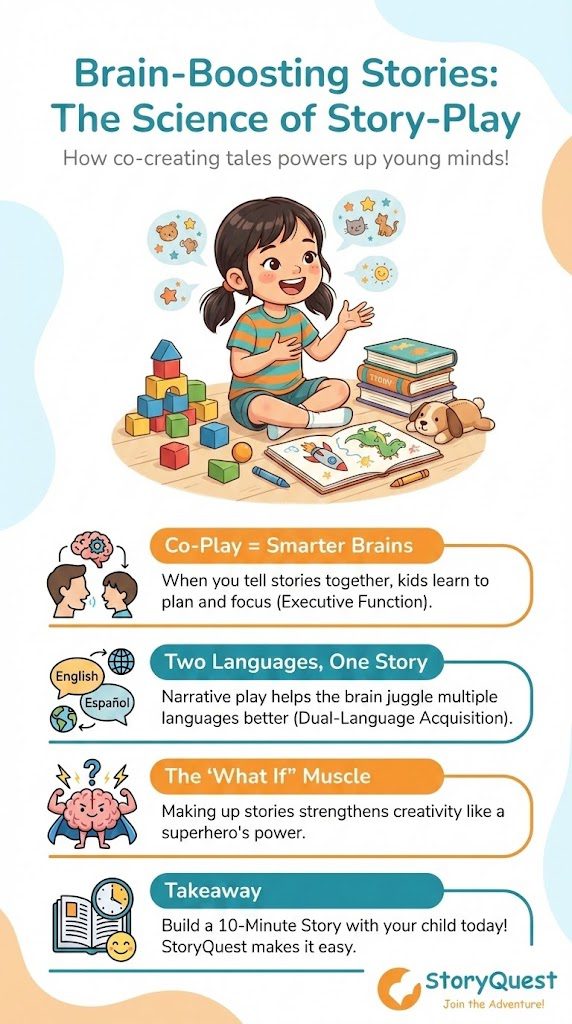
I turned all these big-brain insights into a gorgeous, fridge-worthy Infographic.
It’s got the tips. It’s got the science. It’s got a cute kid on it. Print it out, stick it on the fridge, and let it… gently encourage (guilt-trip) you into doing your 10 minutes of storytelling.
Save it to your phone for later, or print it out and look like the smartest parent at the playground.
📥 Grab the “Brain-Boosting Stories” Cheat Sheet (PDF)
(You’re welcome. I made it pretty just for you.)
Watch also








Leave a comment