
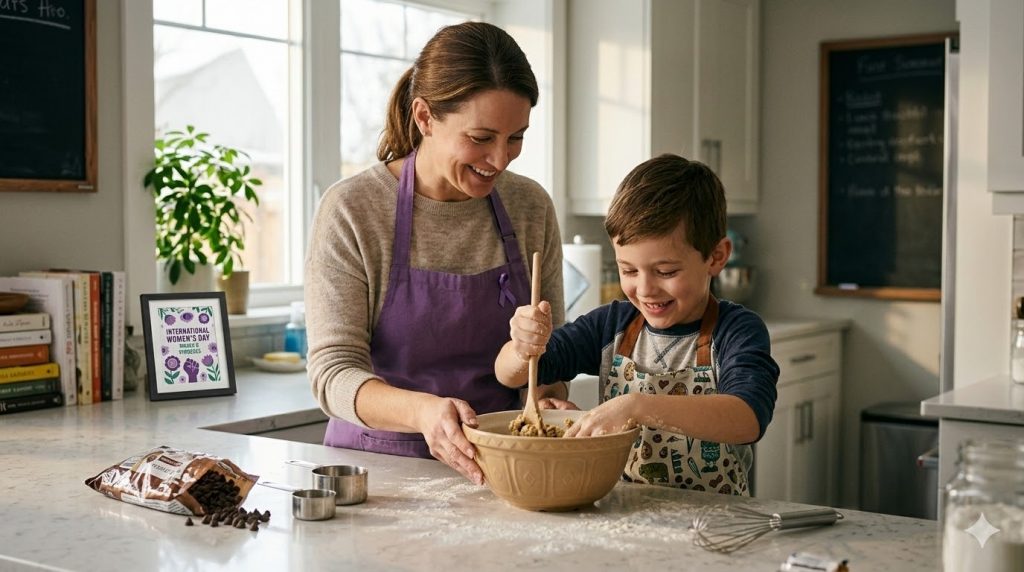
Key Takeaways
- Teaching boys to cook, clean, and care for themselves isn’t “extra.” It’s the bare minimum — and one of the best gifts you’ll ever give a future partner.
- The moment your son tells you “his wife will do that” is a parenting turning point. Handle it right and you’ve just changed someone’s future marriage. Mess it up and… well. You’ve met those guys.
- Women’s Day isn’t just for women. It’s a great annual reminder to check what our kids are actually learning at home — right now, today, in the real world.
“I’ll Have a Wife for That”
Let me paint you a picture.
It’s a regular Tuesday. My son is standing in the middle of the living room. There are crumbs on the floor. I have asked him, nicely, to clean up.
He looks at me. Considers this information. And then — with the confidence of a tiny CEO who has clearly never paid rent — he says:
“I don’t have to clean. I’ll have a wife for that.”
I want you to know that I stood very still for about three full seconds.
Not because I was calm. But because I was deciding between laughing, crying, and immediately listing him for adoption. 😅
What I actually did was take a breath. And then I said, very quietly:
“That’s not your wife’s job. That’s your job. And right now, the job is the whole house. Off you go.”
He cleaned the whole house.
You’re welcome, to every future partner of his out there. Whoever you are, you owe me one. 💅
(PS: If you want to understand WHY kids say things like this — and how to use stories to reshape those ideas before they calcify — this post on drama and roleplay is quietly brilliant.)
Why I’m Actually Teaching Him This
Here’s the thing. I don’t teach my son to cook and bake and clean because I’m trying to raise a domestic goddess in miniature trousers.
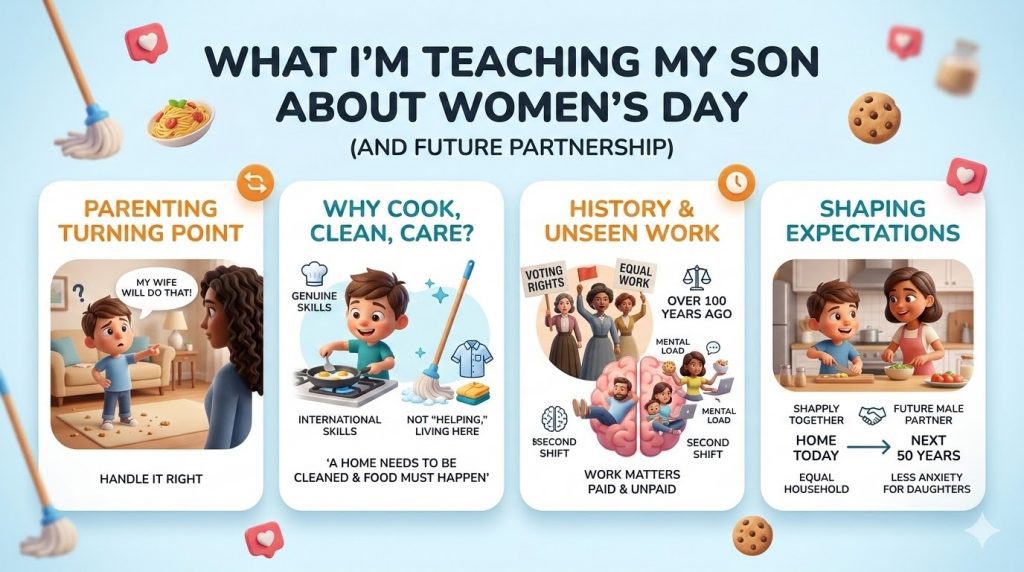
I teach him because one day, he will live in a home. Alone, or with someone. And that home will need to be cleaned. And food will need to happen. And laundry doesn’t fold itself — a fact that apparently surprises grown adults on a daily basis.
We teach kids to read so they can be independent. We teach kids maths so they can handle money. Why would we NOT teach kids to make a proper pasta and run a mop without looking like they’ve never seen one before?
The answer, historically, has been: because we assumed someone else would do it.
That someone else, for centuries, has been a woman.
And on International Women’s Day — on March 8th — I think it’s worth pausing on that for a moment.
What Women’s Day Actually Is (Very Short History, I Promise)
International Women’s Day started over 100 years ago. It grew out of labour movements and women demanding the right to vote, to work, to be treated like full human beings rather than a very capable piece of furniture.
It’s not a day invented by greeting card companies. It’s not a day about flowers (though flowers are always welcome, obviously). It’s a day that says: the work women do — seen and unseen, paid and unpaid — matters. And it has always mattered.
The unseen part is the bit that still trips us up in 2025.
Because here’s what the data shows: even in households where both partners work full-time, women still do significantly more of the cooking, cleaning, childcare, and invisible mental load. This is called the “second shift” — and it’s not a myth, it’s a measurable, well-documented reality that shows up across countries and cultures.
The place where this starts? Childhood.
The kids who grow up watching one parent cook while the other puts their feet up. The boys who are told “that’s not your job.” The girls who are praised for tidying while their brothers are not asked at all.
Your home right now is a classroom. And it’s teaching something, whether you mean it to or not. We wrote about exactly this idea — how the unspoken stories of home shape what kids believe is normal — and it’s worth a read.
The Science Bit (Keep Up, It’s Quick)
Research on gender and household labour consistently shows that children who grow up in households with more equal division of chores grow up with more equal expectations in their own adult homes.
Sons who are taught domestic skills are more likely to share household work in adult relationships. Daughters who grow up in homes where domestic labour is treated as everyone’s responsibility show higher career ambition and less anxiety about “having it all.” Harvard Business Review backs this up — daughters of working mothers who shared the domestic load are more likely to be employed, earn higher wages, and hold supervisory roles.
In other words: what you do at home today is shaping what your kids expect and accept for the next 50 years of their lives.
That’s a lot of pasta to be responsible for. But also — it’s pretty motivating. 🍝
What I’m Teaching My Son This Women’s Day
Here’s the actual list, since we’re being honest:
🍳 To cook. Real food. Not just cereal. He can make scrambled eggs, pasta, and his cookies are genuinely excellent. I’m not even biased. (I’m a little biased.)
🧹 To clean. Including the bits nobody sees. Behind the toilet. Inside the microwave. The crumbs that somehow multiply under the sofa like they’re plotting something.
🛒 To notice when things run out. This one is advanced. We’re still working on it.
💬 To say thank you when someone cooks for him. Because food doesn’t appear from nowhere. Someone thought about it, bought it, made it, and served it. That is a gift. Every single time.
🤝 That a partnership is just that. Two people, sharing a life, sharing the work. Not one person doing everything while the other one “helps.” There is no help. There is just: we both live here.
Try This Today (The Women’s Day Edition)
Tonight, involve your kids — sons especially — in one domestic task. Not as “helping mum.” Just as: this is something that needs doing and you live here too.
Cook together. Clean together. Fold laundry together while you talk about something completely unrelated.
You’re not making a feminist statement. (Well, you are. But you’re also just making dinner.)
Need a way to get even the most resistant kid into the kitchen? The Fire Horse Energy post has a sneaky trick for turning physical tasks into something kids actually WANT to do. Highly recommend. 🐎
And if your son ever tells you he’ll have a wife for that?
You know what to do. 😉
Questions Parents Ask
Q: Isn’t it enough to just model equality at home without making it a lesson? Modelling matters enormously — but kids also need things said out loud. Especially when culture, school, and peer groups are saying something different. Name it. Say it plainly. “In our house, everyone cleans.”
Q: My son resists anything domestic. How do I get him interested? Make it interesting, not mandatory-feeling. Baking is chemistry. Cooking is creativity. Cleaning is… okay, cleaning is just cleaning. But you can turn it into a race. A challenge. “Whoever finishes first picks the movie tonight.” They’ll tidy so fast your head will spin. Also — see The 10-Minute Cheat Code for Your Kid’s Brain for how to make any activity feel like play.
Q: My daughter refuses to do chores but my son does them without complaint. Is that a problem? It’s actually a lovely problem to have! And no — the goal isn’t gendered chore distribution. The goal is everyone contributing. If your daughter needs a different approach to engagement, that’s a parenting challenge, not a feminist failure.
Happy International Women’s Day. To every mum out there doing invisible work today: we see you. And we’re teaching our kids to see you too. 💐








Leave a comment