
7:47 AM
Someone is already awake.
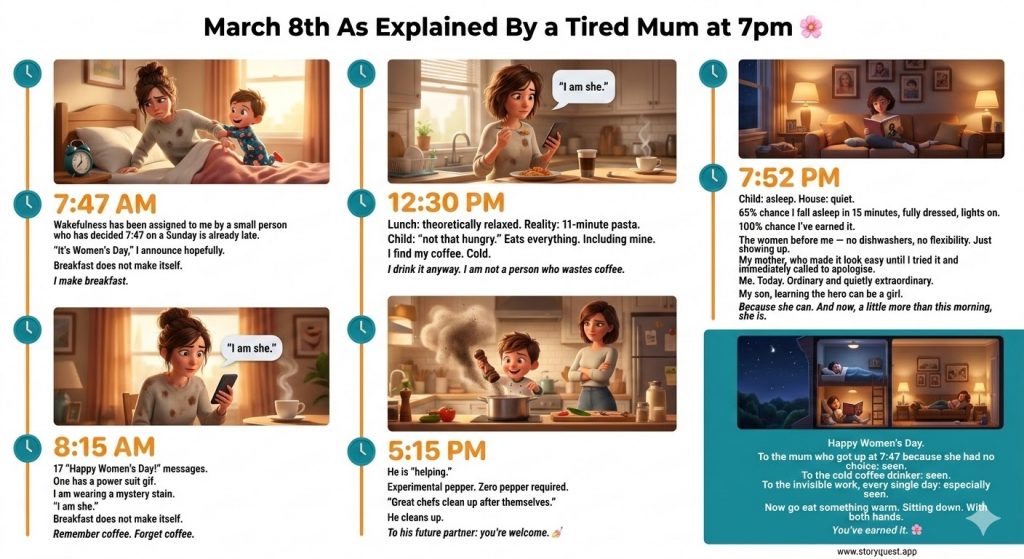
Not me. I have not chosen to be awake. Wakefulness has been assigned to me, by a small person who has apparently decided that 7:47 on a Sunday is, actually, very late in the day and we’ve all been wasting precious time.
“It’s Women’s Day,” I announce to no one in particular, possibly hoping this information will result in breakfast appearing by itself.
It does not.
I make breakfast.
8:15 AM
Coffee is on. This is the high point of the day. Everything from here is managing expectations.
Check phone. Seventeen “Happy Women’s Day!” messages. One has a flower emoji. One has a gif of a woman in a power suit. I am wearing a jumper with a small mystery stain on the sleeve and I haven’t brushed my hair yet but sure, yes, I am she.
Feel briefly celebrated. Put the phone down. Remember the coffee.
Forget the coffee.
9:30 AM
It’s Sunday, which means family time, which means togetherness, which means everyone is in the same house doing different things while I try to make “doing different things” feel like connection.
Someone is watching something on a screen. Someone (me) is doing three loads of laundry that accumulated since Thursday because WHERE DOES IT COME FROM. Someone (also me) is composing a grocery list in my head while nodding along to a detailed explanation of a Minecraft thing I do not understand.
The mental load says: Happy Women’s Day, babe.
(If you want to understand why this “mental load” thing isn’t just a meme but an actual, measurable, well-documented phenomenon — Pew Research has the numbers and they will make you feel extremely vindicated.)
10:45 AM
A well-meaning relative calls to wish me a Happy Women’s Day.
“Are you doing something nice for yourself today?” she asks.
I look at the laundry. I look at the floor. I look at a single sock that is somehow on top of the fridge and I have chosen, at this time, not to investigate further.
“Absolutely,” I say. “It’s been a whole thing.”
12:30 PM
Lunch. On a Sunday this is theoretically a relaxed meal — nice food, maybe some music, everyone sitting down at the same time like a family in an advert.
What actually happens: pasta, made in 11 minutes, served to a child who immediately announces they’re not that hungry and then eats all of it plus tries to eat mine.
I eat standing up because the moment I sat down someone needed something. I do not know what they needed. I no longer remember. It’s been handled.
I find my coffee. It is cold. I drink it anyway because I am not a person who wastes coffee. I am many things, but I am not that.
2:00 PM
We go to the park. This was my idea and I stand by it.
My son runs at full speed toward absolutely nothing in particular, the way children do, like they’re being chased by invisible joy. I walk behind him with my hands in my pockets, breathing actual outdoor air, thinking actual thoughts.
For approximately nine minutes I feel like a full human being with an interior life and opinions about things other than snacks.
Then: “Mum. MUM. I need a snack.”
There it is.
3:45 PM
Post-park slump. Everyone is tired. No one will admit it. There is a full negotiation about whether screens are happening, whether socks are optional indoors (they are not), and whether the small piece of chocolate I said we’d have “later” is now “later” yet.
It is not later yet.
“Later” is a concept I invented to buy myself twelve minutes of peace. It works approximately 40% of the time.
(The other 60% of the time, I recommend The Time-Travel Trick. Genuinely the most useful thing I’ve read about heading off late-afternoon meltdowns before they happen.)
5:15 PM
Cooking dinner. My son is “helping.”
I use that word loosely. He has added an experimental quantity of pepper to something that did not require any pepper at all, and is now explaining to me — with genuine confidence — that he could probably be a chef if he wanted. A great chef. Maybe the best.
“That’s wonderful,” I say. “Great chefs clean up after themselves.”
“But—”
“The whole kitchen.”
He cleans up.
To every future partner of his: you are so welcome. This one’s on me. 💅
(The full origin story of how we got here — including the incident that shall be forever known as The Wife Comment — is in What I’m Teaching My Son About Women’s Day. It’s funnier than it should be and I’m not sorry.)
6:00 PM
Dinner is on the table.
It is not beautiful. It will not be photographed. No one will describe it as “elevated” or “rustic” or anything other than “food, hot, present.”
Everyone eats it. No complaints. This is, by any reasonable measure, a roaring success and I will be accepting my award shortly.
6:45 PM
Bath. Hair washing negotiation. Hair gets washed despite the dramatic implication that something terrible is happening.
Nothing terrible is happening.
(If the post-bath bedtime stretch regularly goes sideways in your house, The Insidious Bedtime Trap is the read that changed our evenings. Actual magic. Slightly suspicious how well it works.)
7:00 PM
The window.
Parents know this window. The golden twenty minutes between the end of bath and the actual surrender to sleep, where your child becomes — inexplicably, briefly — the softest, most delicious version of themselves. Cuddly. Quiet. Smelling of shampoo and something vaguely biscuity.
It’s Sunday, so bedtime is a touch later. I take this as a gift from the universe in partial compensation for everything.
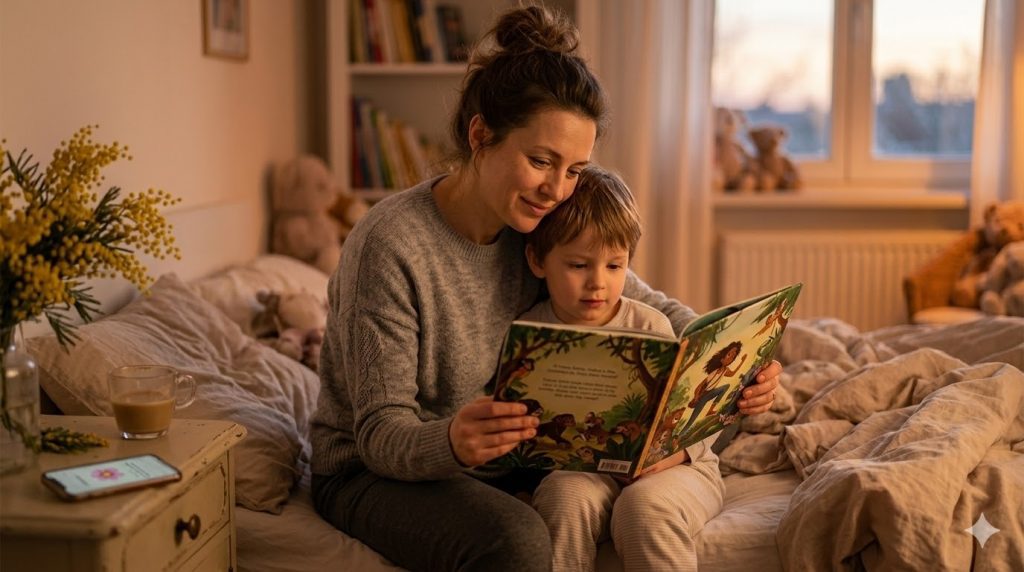
We read a story. Tonight I pick one with a girl who goes on an adventure — brave, funny, makes a few mistakes, fixes them herself. My son listens with complete seriousness and then says, like it is the most obvious thing in the world:
“She’s cool.”
Yes. She is. Good. This is the whole point. We’re doing it.
(Why story choice at bedtime matters more than most of us realise — The Heroines Missing From Your Kid’s Bedtime Stories is the read for after they’re asleep. Spoiler: male characters still outnumber female ones in children’s books, even in 2024. The gap starts at picture book age. Worth knowing.)
7:45 PM
Child: asleep.
House: quiet.
Me: on the sofa, in the specific way you lower yourself onto a sofa when your body is done negotiating with the day.
It’s Sunday evening, which has its own particular feeling — warm but slightly aware that tomorrow is Monday and Monday has opinions. I decide not to think about Monday. Monday can wait.
There is a 65% chance I fall asleep in the next fifteen minutes, fully dressed, with the lights on.
There is a 100% chance I have earned this.
7:52 PM (The Sentimental Bit. Yes, Already.)
I think about what Women’s Day actually means to me.
Not the version with the power suits and the inspiring quotes and the branded campaigns telling me I can have it all (narrator: she cannot, in fact, have it all, nobody can have it all, “it all” is a myth propagated by people who have assistants).
The real version.
It means the women who came before me who did all of this — all of it — without dishwashers, without flexible working, without anyone calling it “invisible labour” or writing think-pieces about the mental load. Who raised children and cooked and cleaned and managed and endured and also somehow, also, ran farms and businesses and quiet revolutions, without anyone throwing them so much as a brunch.
It means my mother. Who worked full time and still made my lunches and still showed up to everything and made it look so easy that I genuinely did not understand what she was doing until I was doing it myself, at which point I immediately called her to apologise.
It means me. Today. This Sunday that was mostly ordinary and also — if you look at it right — completely extraordinary, in all the ways ordinary days secretly are.
It means my son in that kitchen, carefully (mostly) adding the right amount of pepper, cleaning up when asked without too much drama, listening to a story about a girl who saves the day like that is the most normal and obvious thing in the world.
Because it is. It should be. And now, a little more than it was this morning, it is.
The Big Things Live Inside the Small Things
The rights. The representation. The progress that was hard-won and is still fragile in more places than we like to think.
All of that is real and it matters enormously.
And also: it lives in the small things.
The story you choose at bedtime.
The task you hand to your son instead of just doing it yourself because it’s faster.
The way you answer when your daughter asks “can girls do that?”
The way you answer when your son assumes they can’t.
These aren’t grand gestures. They’re Tuesday evenings. Sunday afternoons. Eleven-minute pasta. And they add up. Research on how kids build identity through everyday moments is very clear on this: the small stuff is, actually, the whole thing.
And if you want to understand how the stories you choose are literally shaping your child’s brain — not metaphorically, neurologically — The Power of Storytelling: Supercharge the Brain! is a five-minute read that will change how you look at bedtime forever.
Happy Women’s Day
To the mum who got up at 7:47 because she didn’t have a choice: seen.
To the one who ate cold coffee and called it breakfast: seen.
To the one who spent her Sunday doing laundry and making pasta and negotiating about socks: seen.
To the one doing the invisible work every single day, including the days that are technically days off: especially seen.
And to every parent — whatever you are, whatever your family looks like — quietly raising kids to see women as whole, full, complicated, capable people who are worth writing stories about:
Thank you.
Now go eat something warm. Sitting down. With both hands.
You’ve earned it. 🌸
Try This Tonight
Read a story with a female hero. Ask your kid: “What do you think she was feeling when that happened?”
That’s it. That’s the whole thing.
If you want a ready-made adventure where YOUR child is the hero — whatever their gender, mood, or energy level at 7pm on a Sunday — StoryQuest was built exactly for this moment.
Questions Parents Ask
Q: Is Women’s Day relevant to my young child? Yes, at whatever age-appropriate level works. For a 5-year-old: “Today we celebrate how amazing women are.” For a 10-year-old: real conversation territory. For a teenager: buckle up, they already have opinions and most of them are correct.
Q: Should I explain the political history of Women’s Day to my kids? Always, age-appropriately. The short version: women had to fight for rights that others took for granted. Some are still fighting. That’s a story worth knowing. Here’s a child-friendly overview from UNICEF if you need a starting point.
Q: My child asked why we don’t have a Men’s Day. What do I say? Good news: we do. November 19th. And also — every day that didn’t require a social movement to achieve basic rights was already, historically speaking, a pretty solid day. Say that part gently though. They’re small.
Q: How do I actually start making changes at home — not just reading about it? Start small. One task. One conversation. One story choice. Strengthen Your Bond: Storytelling with Your Child is full of zero-effort, high-impact things you can do starting tonight. No prep required.
From all of us at StoryQuest: Happy International Women’s Day. May your coffee be hot, your Sunday evening be gloriously quiet, and your children’s bookshelves be full of every kind of hero. 🌸






Leave a comment