
Key Takeaways
- The Brain’s Flight Path: Sudden routine changes aren’t just annoying for kids; they feel like a literal glitch in reality, triggering a massive alarm bell in the brain.
- The Science of “Prediction Errors”: When what a child expects doesn’t match what happens, the brain’s threat center (the amygdala) takes over, leading to meltdowns.
- Micro-Flexibility is Your Secret Weapon: You can build your child’s adaptability through low-stakes “Plot Twist” games, turning sudden changes from terrifying to thrilling.
Welcome to Your Sudden Detour
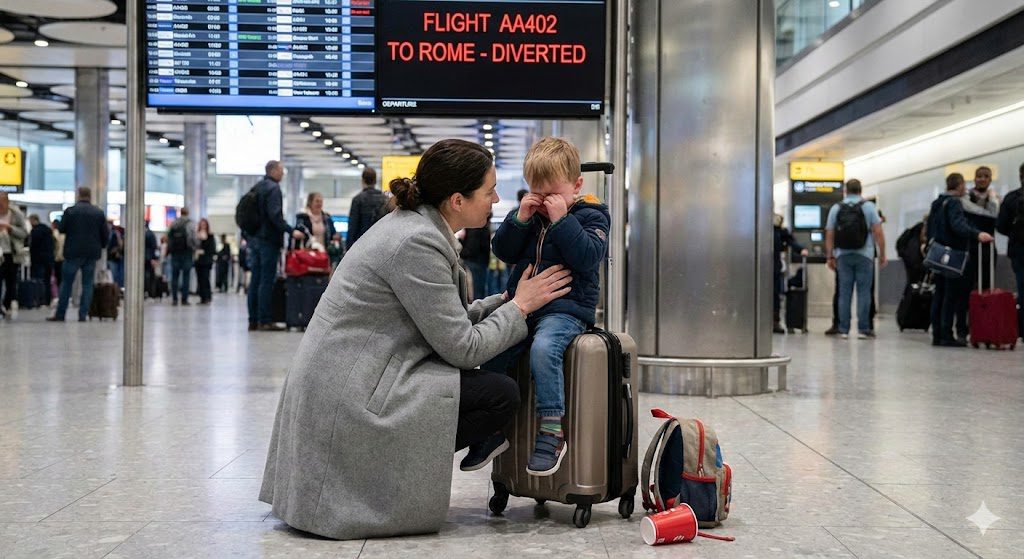
Imagine this for a second. You’ve packed your bags, you’ve boarded the plane, and you’re settling in for your highly anticipated European vacation. You’ve visualized the exact moment you’ll step off the plane, grab a gelato, and stroll past the Colosseum. But halfway across the Atlantic, the pilot’s voice crackles over the intercom with news that sends a ripple of anxiety through the cabin: there’s been an issue, and your American Airlines flight diverted Rome to a completely different, unexpected airport hours away from your destination.
For you, as an adult, this is incredibly frustrating. It’s a logistical nightmare. You have to rebook hotels, figure out train schedules, and manage your profound disappointment. But your fully developed adult brain can handle it. You take a deep breath, open your laptop, and start solving the problem.
Now, imagine that exact same feeling of total, rug-pulled-out-from-under-you disorientation. Except you are four years old. And the “diverted flight” isn’t an international travel crisis—it’s the fact that mom gave you the blue cup instead of the red cup. Or that you had to take a detour on the way to school because of construction. Or that the grocery store stopped stocking your favorite dinosaur-shaped chicken nuggets.
To us, these are tiny bumps in the road. To a child—especially a neurodivergent child or a toddler who relies heavily on predictability to feel safe—a sudden detour feels like a threat to their survival. It is a literal glitch in their reality.
If your child completely loses it when you take a different route home from school, or if an unexpected substitute teacher ruins their entire week, I need you to know two very important things:
- You aren’t alone.
- Your child isn’t just being “stubborn” or “difficult.” They are experiencing a very real, very intense neurological traffic jam.
Let’s dive into exactly why this happens, and more importantly, how you can help them navigate these turbulent skies without crashing.
The Science Corner: Why Plot Twists Hurt
Welcome to the Science Corner! This is where we take the white coats off, grab a cup of coffee, and figure out what is actually happening inside your kiddo’s incredible, growing mind.
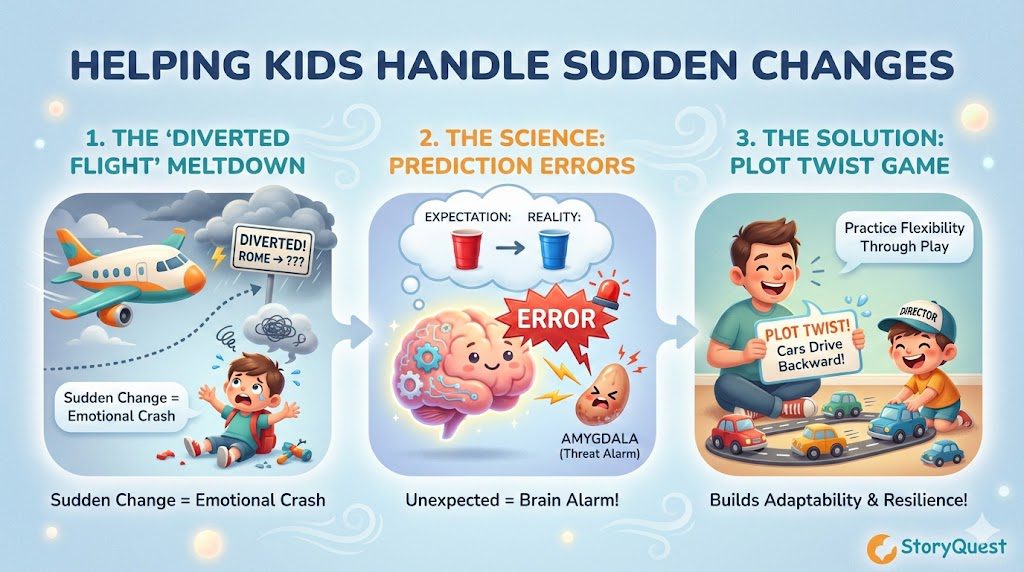
We often talk about kids needing routines. But why do they need them so badly? It all comes down to two fascinating concepts: Cognitive Flexibility and Prediction Errors.
1. The “Prediction Error” Crisis
Human brains are essentially hyper-advanced prediction machines. From the moment we wake up, our brains are subconsciously guessing what will happen next based on past experiences.
- If I push this door, it will open.
- If I sit in my car, it will smell like stale french fries.
- If I ask for juice, it will come in the red cup.
When reality matches our predictions, our brain releases a tiny, happy squirt of dopamine. It feels safe. It feels right. But when reality doesn’t match the script—when the door is locked, when the car smells like smoke, or when the cup is blue—the brain registers a “Prediction Error.”
According to research published in the Journal of Neuroscience, prediction errors in a developing brain don’t just register as “Oh, that’s different.” They register as an anomaly that must be investigated. For children whose executive functioning (the brain’s CEO) is still under construction, a prediction error bypasses logic and goes straight to the amygdala—the brain’s threat-detection center.
Read the science for yourself: Dopamine Reward Prediction-Error Signalling: A Two-Component Response
2. The Struggle with Cognitive Flexibility
Cognitive flexibility is the mental ability to switch gears. It’s the brain’s shock absorbers. It allows us to seamlessly transition from thinking about one concept to another, or to abandon an old plan when a new rule is introduced.
In a classic study on childhood executive function, researchers found that young children are notoriously bad at cognitive flexibility. If you teach a three-year-old to sort cards by color, and then suddenly tell them to sort by shape, they will continue sorting by color, even if they repeat the new rule out loud! Their brains get “stuck” in the original groove.
Read the science for yourself: The Development of Executive Function in Early Childhood
When plans change suddenly, you are asking your child’s brain to slam on the brakes, erase the map they spent all morning drawing, and instantly draw a new one. For a brain that is still building its shock absorbers, that sudden stop causes a massive, fiery emotional pile-up.
Why This Helps All Kids (The Universal Superpower)
One of the coolest things about understanding brain science is realizing that the exact same tools work for vastly different kids. We call this “Universal Design.” When you build a ramp into a building, it helps the person in a wheelchair, but it also helps the parent pushing a stroller and the delivery driver pushing a cart.
Building cognitive flexibility is the mental equivalent of that ramp.
For the highly energetic, chatty, “standard” kiddo: Life is going to throw them curveballs. Sports games will be rained out. Best friends will move away. The career they want might change. By teaching them how to handle a diverted route to the grocery store today, you are laying the foundational wiring for resilience when they face real disappointments as teenagers. You are giving them the gift of grit! (Speaking of grit, if you want a fantastic story to teach resilience, check out our post on Why the “Great Race” is the Ultimate Lesson in Grit).
For the kiddo who needs extra support (like those with ASD or ADHD): Children who process the world differently often cling to routines as a lifeline in a chaotic, overwhelming world. A rigid routine is their shield against sensory and social overload. When that shield is moved, the anxiety is devastating. Practicing micro-flexibility in safe, controlled, and loving ways gently expands their comfort zone without throwing them into the deep end. It transforms them from feeling like victims of a chaotic world to capable navigators of it.
If you want more strategies on managing these intense transitions before they explode, you absolutely need to read our guide on The “Time-Travel” Trick: How to Stop Devastating Tantrums Before They Happen.
Try This Today: “The Plot Twist Game”
Alright, enough theory. How do we actually fix this? How do we take a child who screams when their toast is cut in triangles instead of squares and turn them into an adaptable, resilient superstar?
You do it through play. Children don’t learn through lectures; they learn through games. We are going to intentionally introduce “micro-changes” in a totally safe environment so their brain can practice hitting a bump in the road and surviving.
Welcome to The Plot Twist Game.
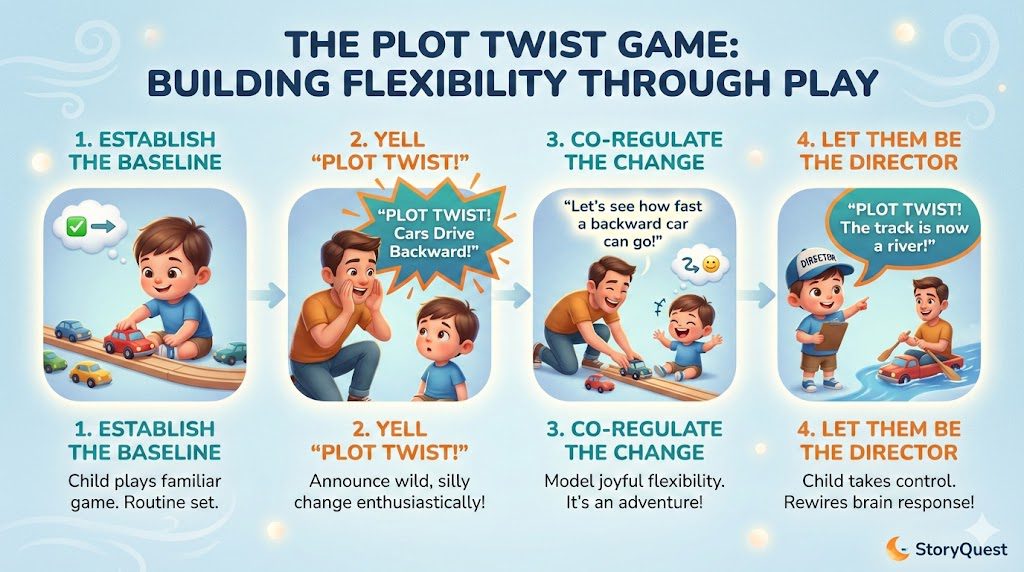
Step 1: Establish the Baseline
Pick an activity your child loves and knows well. It could be playing with toy cars on a track, building a Lego tower, or drawing a picture of a house. Let them get into the groove of the expected routine.
Step 2: Yell “PLOT TWIST!”
Right in the middle of the game, enthusiastically announce a wild, silly change.
- “PLOT TWIST! The cars are out of gas and now they have to drive backward!”
- “PLOT TWIST! A giant purple dragon just sat on our Lego tower and we have to build it upside down!”
- “PLOT TWIST! It’s raining green jellybeans on our drawing, we need to draw an umbrella fast!”
Step 3: Co-Regulate the Change
At first, your child might resist. They might say, “No! Cars go forward!” That is their rigidity talking.
Your job is to model joyful flexibility. Laugh. Be silly. Show them that a change in the plan isn’t a threat; it’s an opportunity for a new adventure. Say, “I know, it’s so weird! Let’s see how fast a backward car can go!”
Step 4: Let Them Be the Director
Once they get the hang of it, give them the power to yell “Plot Twist” and change the rules on you. When they are in control of the unexpected change, the amygdala stays completely calm. They are learning that unpredictability can be fun.
By doing this daily in low-stakes environments, you are literally rewiring their brain’s response to prediction errors. The next time the American Airlines flight diverted Rome equivalent happens in their daily life (like a rained-out park trip), their brain will have a filed-away memory that says: Wait, unexpected changes aren’t always bad. Sometimes they are Plot Twists.
How StoryQuest Helps: Your Co-Pilot in Flexibility
Let’s be honest—as parents, we are exhausted. We don’t always have the mental energy to invent elaborate Plot Twists after a long day of work. You just want a fun activity that naturally builds these social and cognitive superpowers without feeling like “therapy work.”
That is exactly why we built StoryQuest.
StoryQuest isn’t just an app; it’s a dynamic, voice-driven storytelling adventure that makes your child the hero. And guess what? We baked the “Plot Twist” mechanism right into the code!
When your child is navigating a magical forest using their voice, the AI Storyteller will intentionally introduce safe, low-stakes changes.
- “You approach the bridge, but oh no! The troll says it’s closed for repairs! What should we do next to cross the river?”
It forces the child to pause, abandon their original expectation (crossing the bridge), and flex their creative problem-solving muscles to come up with a new plan. It gamifies cognitive flexibility. They think they are just playing an epic game; you know they are building the exact mental shock absorbers they need for real life.
Questions Parents Ask
Q: Why does my child only melt down over changes at home, but their teacher says they are perfectly flexible at school? A: This is so incredibly common! We call it the “Safety Restraint.” At school, your child is using every ounce of their executive function to hold it together, follow the rules, and mask their anxiety. By the time they get home to their safe space (you!), their battery is at 0%. Home is where they let their guard down, meaning you get the raw, unfiltered reaction to any changes. It’s actually a sign that they feel completely secure with you!
Q: Should I warn my child about every single change ahead of time? A: Yes and no. For massive transitions (a new school, a doctor’s appointment), definitely prepare them with visual schedules and ample warnings. But if you protect them from every tiny daily change, you accidentally steal their opportunity to practice resilience. Use the Plot Twist Game to build their tolerance for the little surprises, so you don’t have to walk on eggshells for the rest of your life.
Q: How long does it take for cognitive flexibility to improve? A: Brain wiring takes time. You are planting seeds, not building a microwave dinner. Consistency is key. If you practice silly, low-stakes Plot Twists a few times a week, you will likely start seeing a shift in how they handle real-world disappointments within a few months. Remember, progress isn’t a straight line; it’s a messy, beautiful, upward spiral!
Remember, parenting is an adventure with plenty of detours. You’re doing a great job navigating the turbulence. 💛







Leave a comment