
Key Takeaways
- In the 1960s, nearly 75% of children’s books featured male protagonists. In 2020? Male characters are still overrepresented — even in books for the youngest readers.
- When kids mostly see boys as the hero, they quietly learn who stories are “for” — and it shapes what they believe is possible for them.
- The good news: you don’t need to throw out your bookshelf. You just need to make one small change tonight.
A Tiny Experiment You Can Do Right Now
Go look at your child’s bookshelf.
Count the heroes. The main characters. The ones who go on the quest, solve the problem, save the day.
Now count how many of them are girls.
I’ll wait. ☕
…
Yeah. If your shelf looks like most shelves, the boys are winning by quite a lot.
And before anyone says “well, that’s just how stories go” — that’s exactly the problem. Because that’s just how stories go is something kids learn before they can read. And it stays with them a very long time.
The Numbers (Because Facts Are Fun at Parties)
Researchers at Princeton and Emory Universities did something brilliant and slightly exhausting: they analysed 3,280 children’s books published between 1960 and 2020. That is a LOT of books. Someone deserves a very large coffee.
Here’s what they found:
In the 1960s, nearly three quarters of children’s books had a male main character.
Sixty years later — after decades of progress, Hermione Granger, Moana, and an entire feminist movement — male protagonists are still overrepresented in children’s literature.
In the most recent decade, for every female protagonist, there are still 1.2 male protagonists overall. Sounds almost fine, until you zoom in: for books aimed at the youngest children — babies, toddlers, the kids whose brains are doing the most building — the gap is bigger. Books for infants feature male protagonists twice as often as female ones.
And when the characters aren’t human? When it’s a bear, a truck, a rabbit, a monster? Male authors are three times more likely to make those characters male.
Even a fictional truck, apparently, defaults to “he.”
(Don’t get me started on the truck. 🚛)
Why This Actually Matters (The “Ohhh, THAT’s Why” Moment)
“Okay,” you’re thinking. “So there are more boy characters. Does that really affect anything?”
Yes. And here’s how.
Children’s brains are meaning-making machines. They take in information and build patterns from it. Patterns like:
- Who goes on adventures?
- Who solves the problems?
- Who is brave, clever, funny, the one everyone is following?
- Who waits at home?
- Who is the helper?
- Who is the prize?
When those patterns are repeated — in book after book, story after story — they start to feel like the natural order of things. Not a choice. Just… how it is.
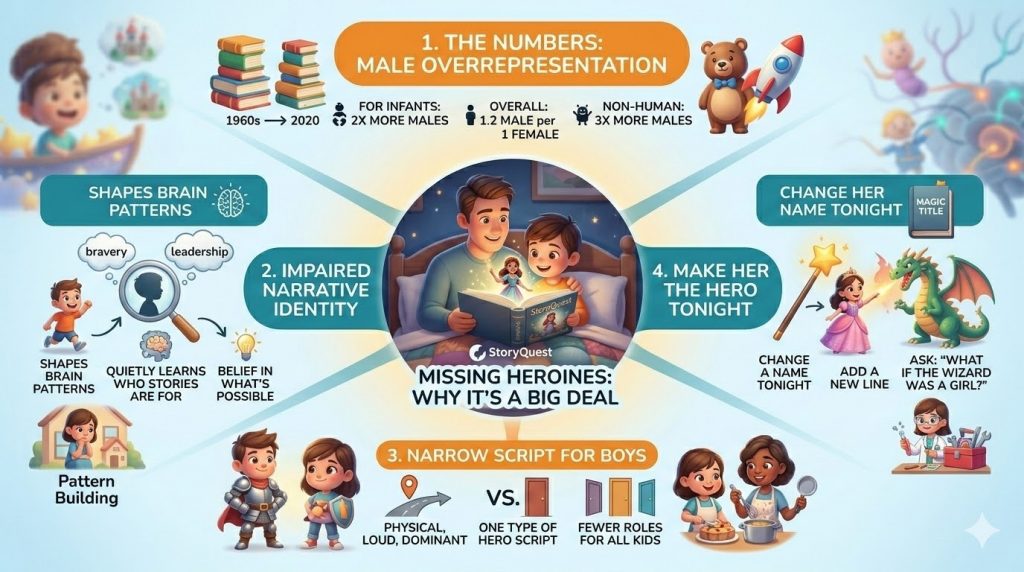
Research on narrative identity shows that children who regularly see characters like them as heroes develop stronger self-confidence, higher ambition, and a broader sense of what’s possible for their own lives. We explored this in depth in Is Your Child’s Imagination Atrophying? — the stories kids absorb shape the stories they tell about themselves.
Flip that around, and you get: children who almost never see themselves as the hero start to quietly assume they probably aren’t one.
This is not dramatic. This is just how brains work.
It’s Not Just About Girls
Here’s the bit that surprises people.
The missing heroines problem doesn’t only affect girls.
When boys grow up consuming mostly stories with male heroes, they get a very narrow picture of what a hero looks like. Heroes look like them. Heroes are brave in the specific way boys are “supposed” to be brave — physical, loud, dominant. Heroes don’t ask for help. Heroes don’t cry. Heroes don’t bake cookies.
(See Post 1. Baking cookies is heroic. I will die on this hill. 🍪)
Boys who are only ever handed one type of story grow up with one type of script. And when life doesn’t match that script — when they feel scared, or lost, or need someone to help them — they don’t have a narrative for that.
This connects directly to something we explored in The “Safe Danger” Paradox: kids need stories about ALL kinds of bravery — not just the loud, obvious kind — to develop a full emotional toolkit.
Diverse stories about diverse heroes aren’t a gift just to girls. They are a gift to every child who has ever needed to see a different way of being brave.
The Science Corner 🔬
The research on this is genuinely fascinating.
Studies on “non-stereotypical protagonists” show that when children read about characters who break gender expectations — a girl who’s an engineer, a boy who’s a nurturer — they are more likely to accept those behaviours as normal and possible in real life. Research from Princeton and Emory Universities confirms: the stories actually shift what kids believe about themselves and others.
This connects directly to what we know about Theory of Mind — the brain’s ability to understand that other people have different experiences. We broke down exactly how this works in And the SAG Award Goes To… Your Toddler? — the more diverse the characters a child encounters in stories, the more flexible and empathetic their social brain becomes.
Stories are not neutral. They are teaching something, always.
The question is just: what?
The Good News (There Is Always Good News Here)
You do not need to:
- Throw out your existing books
- Feel guilty about what’s already on the shelf
- Only buy books with female protagonists from now on
You just need to do one simple thing.
Make her the hero tonight.
Whatever story you’re reading — whatever your child is watching, listening to, playing — you can add a line. You can change a name. You can ask: “What if the wizard was a girl? What would she be called?”
StoryQuest was built on exactly this principle. In every adventure, your child IS the hero. Whatever your child’s name, gender, personality, energy level at 8pm. The story wraps around them. The narrative says: you are the one we’ve been waiting for.
That is not a small thing. And if you want the science behind why that sense of narrative agency matters so much for child development, The “Choose Your Own Adventure” Brain has you covered.
Five Heroines Worth Adding to Your Shelf Tonight
If you DO want to rebalance that bookshelf a little — no pressure — here are five with brilliant female leads that kids of all ages actually love:
- Pippi Longstocking — Astrid Lindgren. A girl who lives alone, lifts horses, and takes no instructions from anyone. Goals.
- Matilda — Roald Dahl. Proof that reading is a superpower and adults are sometimes idiots.
- The Paper Bag Princess — Robert Munsch. She saves the prince. He’s rude about her outfit. She leaves. (Correct ending.)
- Moana — yes, the film, but also the picture books. Navigates by stars. Saves her people. Wears no glass slipper.
- Ada Twist, Scientist — Andrea Beaty. A girl who asks WHY about everything. Extremely relatable for parents of certain children.
Try This Tonight
At bedtime, before you start the story, ask your child:
“What if the hero of tonight’s story was a girl? What would she be called?”
That’s it. Let them answer. Let the story go where it goes.
You just changed something. It was small. But it wasn’t nothing.
And if you want more ways to turn bedtime into a genuine brain-building moment, Strengthen Your Bond: Storytelling with Your Child is full of ideas that take about five minutes and cost exactly nothing.
Questions Parents Ask
Q: My daughter only wants to read princess stories. Is that a problem? Not at all. Loving princess stories is not anti-feminist — it’s being five. The question is whether princess is the only story she has access to. Mix it in with other kinds of heroines. The more types of “possible” she sees, the better.
Q: My son refuses to read books with girl main characters. How do I handle that? Gently persist. Research shows boys who grow up reading female protagonists develop higher empathy. Also: Matilda is a masterpiece and no child should miss it on principle.
Q: Does this really start at picture book age? Yes. Research shows that books for infants and toddlers have the biggest gender gap. The youngest brains are getting the most skewed stories. This is exactly the age where exposure to diverse characters matters most — and where the stories we share shape identity most powerfully.
The stories we give our children are the first mirror they look into to see who they might become. Let’s make sure there’s more than one reflection.








Leave a comment