

Key Takeaways
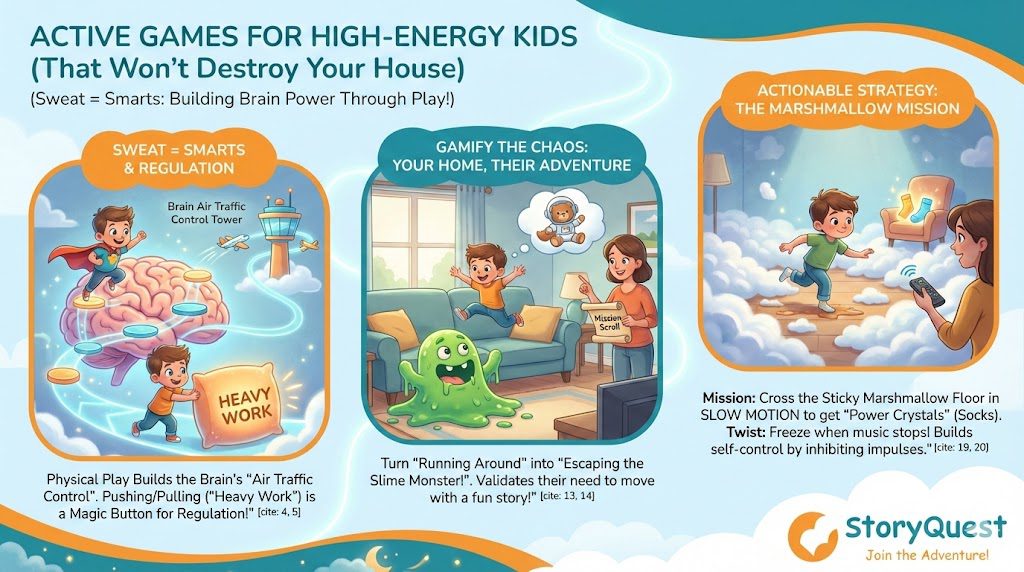
- Sweat = Smarts: Physical play builds the brain’s “Air Traffic Control” system.
- Heavy Work: Pushing, pulling, and crawling are magic buttons for regulation.
- Gamify the Chaos: Turn aimless running into a mission to save the universe.
The Indoor Olympics
If you’ve ever watched your child try to scale a bookshelf like it’s Mt. Everest or turn a laundry basket into a bobsled, you know the struggle. You aren’t raising a child; you’re raising a stunt double. The standard advice is “calm down,” but trying to cap that energy is like trying to hold a beach ball underwater. Eventually, it’s going to pop up and smack you in the face.
Instead of fighting the hurricane, let’s give it a path.
The Science (Simplified): Why They Need to Move
This isn’t just about burning calories. According to the Harvard Center on the Developing Child, active play is crucial for building Executive Function—the mental skills that help us focus, plan, and multitask.
Think of it as the brain’s air traffic control tower. When your kid navigates an obstacle course, they aren’t just moving; they are training their brain to switch gears and solve problems. This is often called Proprioceptive Input (or “heavy work”), which Edutopia notes is essential for emotional regulation.
If you’re noticing this energy spike right before bed, check out our guide on Bedtime Routine Hacks.
Wondering how this movement connects to speech? We break it down in Movement and Language Development.
The Benefit
- For the “Tornado” (High-Energy): It gives their energy a job. Running isn’t “running”; it’s “escaping the slime monster.” It validates their need to move.
- For the “Observer” (Quiet): It builds confidence. They might not want to dance in front of people, but they will want to “sneak past the sleeping dragon” because the story gives them a shield.
5 Active Games to Channel the Chaos
Here are five “missions” that turn destruction into development. These are designed to target specific sensory needs—from heavy lifting to precision focus.
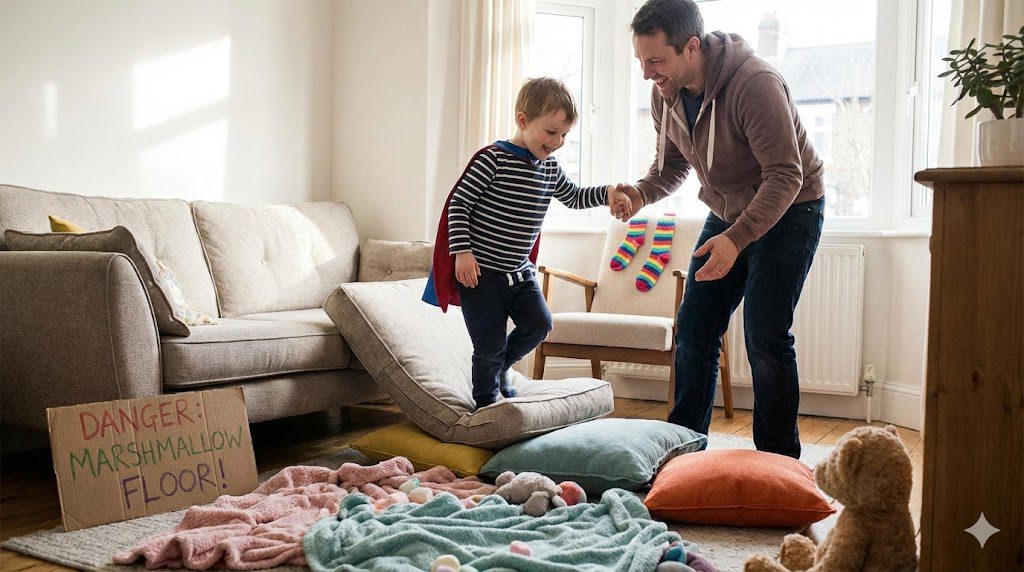
1. The Floor is Marshmallows (Regulation)
Upgrade the classic “Floor is Lava.” In this version, speed is the enemy.
- The Mission: The floor is made of sticky, gooey marshmallows. You must cross the room to retrieve the “Power Crystals” (socks), but you have to move in slow motion.
- The Twist: Every time you clap your hands, the marshmallows freeze, and they have to stop mid-step.
- Why it Works: Slow, controlled movement requires massive core strength and forces the brain to inhibit impulses (stopping when they want to go).
2. The Heavy Turtle Transport (Calming “Heavy Work”)
This is perfect for when they are bouncing off the walls and need to be grounded.
- The Mission: Your child is a “Space Turtle” carrying vital supplies to the colony.
- The Setup: Fill a backpack with something heavy but soft (books, bags of rice, water bottles). Have them wear it while crawling on hands and knees across a “rocky” terrain (pillows).
- Why it Works: Heavy resistance on the joints (proprioception) releases calming chemicals in the brain. It’s like a weighted blanket, but active.
3. The Laser Grid (Focus & Precision)
Ideal for the “sneaky” energy that usually results in climbing furniture.
- The Mission: You are a spy breaking into the vault.
- The Setup: Tape yarn or streamers across a hallway at different angles and heights to create a “laser web.”
- The Goal: They must navigate through the web without touching the “lasers.” If they touch one, the alarm sounds (you make a beeping noise), and they have to start over.
- Why it Works: This builds spatial awareness and forces them to plan their body movements carefully.
4. Balloon Asteroids (Coordination)
For when they need to burn energy but you need to stay on the couch.
- The Mission: The floor is deep space. The balloon is an asteroid. It cannot touch the ground.
- The Twist: Call out body parts they must use to keep it afloat. “Elbows only!” “Nose only!” “Knees!”
- Why it Works: Tracking a moving object builds visual-motor integration (hand-eye coordination), which is actually a precursor to reading skills.
5. Animal Statues (Impulse Control)
A high-energy version of “Red Light, Green Light.”
Why it Works: The rapid switch from “Go” (dancing) to “Stop” (freezing) exercises the brain’s “brakes.” It’s pure executive function training disguised as a dance party.
The Mission: Play high-energy music. When the music stops, you shout an animal. They must freeze immediately in that pose.
The Examples:
Tiger: Claws out, silent roar face.
Flamingo: One leg up, balance.
Sloth: Hanging or lying flat.
The StoryQuest Solution
If you’re too exhausted to invent a Marshmallow World, let us do it. StoryQuest takes your child’s energy level and spins a tale around it. We turn “running around the living room” into “training for the Space Olympics,” giving you a break while they save the galaxy.
FAQ (People Also Ask)
- Q: What are the best indoor games for high-energy kids?
- A: Focus on “heavy work” games like obstacle courses, wheelbarrow races, or “animal walks” (bear crawl, crab walk) which burn energy and calm the nervous system.
- Q: How much physical activity does a child need daily?
- A: The CDC recommends at least 60 minutes of moderate-to-vigorous physical activity daily for children ages 6-17.
- Q: Can active play help with ADHD?
- A: Yes. Structured active play increases dopamine and norepinephrine levels, which can help improve focus and attention span.




Leave a comment