


Key Takeaways
- The Kinetic Engine: High-energy kids aren’t “naughty”; they are just waiting for a script to match their speed.
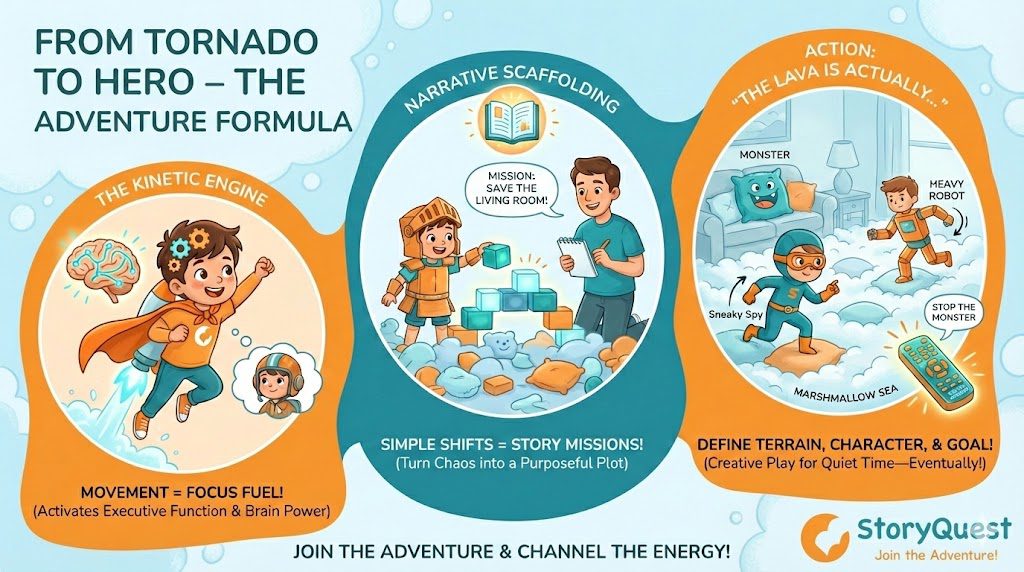
- The “Air Traffic Control” Brain: Movement activates the vestibular system, which Harvard’s Center on the Developing Child identifies as essential for building executive function and focus.
- Narrative Scaffolding: Simple game-mechanic shifts turn physical chaos into a story-driven mission.
From Living Room Demolition to Directorial Debut
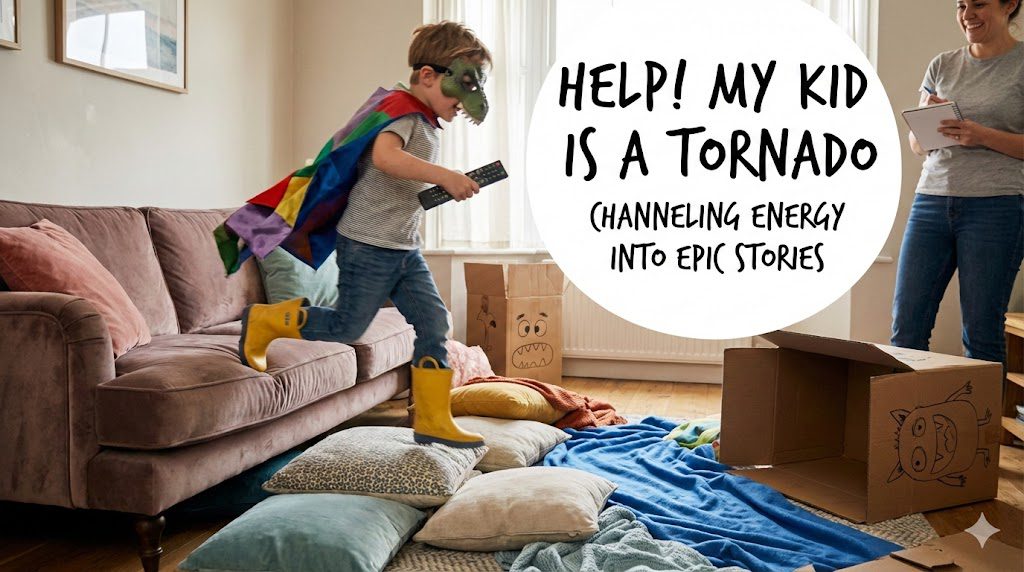
I recently watched my six-year-old attempt to “parkour” off a velvet sofa while wearing a dinosaur mask and a single rain boot. My first instinct? To check my homeowner’s insurance. My second? To realize that this whirling dervish of chaos wasn’t trying to destroy the house—they were just a protagonist without a script.
If your kid has more juice than a lithium-ion battery and the attention span of a caffeinated squirrel, you aren’t failing. You’re just living with a high-octane hurricane. Most parenting advice tells you to “calm them down.” I say: let’s lean into the gale-force winds and turn that kinetic energy into a plot point.
The Science: Why Movement Makes the Brain Pop
Making your kid sit still to “focus” is like trying to charge a phone with a potato. For high-energy kids, movement is the fuel for cognition. Research shows that active play is a primary driver for developing executive function—the brain’s “air traffic control” system.
When children engage in “heavy work” (jumping, crawling, or pushing), they stimulate the vestibular system. Edutopia notes that this system is linked to better spatial awareness and emotional regulation. By turning a jump across the rug into a “leap over a chocolate swamp,” you’re engaging the prefrontal cortex and the imagination simultaneously.
Dealing with a “Late Talker” tornado? Read about movement and language development.
Need more high-speed ideas? Check out our guide on active games for high-energy kids.
Need a break? Here is our take on quiet-time stories that actually work.
For more high-speed ideas, check out our guide on Active games for high-energy kids.
Need a break? Here is our take on Quiet-time stories that actually work.
If you’re dealing with a “Late Talker” tornado, read about Movement and Language Development.
Actionable Strategy: “The Lava is Actually…”
Forget the standard “Floor is Lava.” We’re upgrading to a narrative mission that uses common household items to ground the imagination.
1. Map the Terrain (The Setup)
Grab 3-5 pillows, a few towels, or even sheets of scrap paper.
- The Marshmallows: Scatter the pillows/towels across the floor. These are your “Safety Clouds.”
- The Sea: The carpet/hardwood is now the Sea of Sticky Marshmallows. If you touch it, you get “stuck” (you have to wiggle your way out for 5 seconds).
2. Choose the “Movement Mask” (The Constraint)
The secret to burning energy isn’t just speed; it’s control. Tell them they must cross the sea, but they can only move like:
- The Heavy Robot: Stiff limbs, 90-degree turns, making “bloop-bleep” noises. (Builds proprioception).
- The Sneaky Spy: Slow-motion, exaggerated tip-toes. (Builds balance and inhibitory control).
3. The High-Stakes Goal (The Story)
They aren’t just reaching the couch. They are The Intergalactic Delivery Team.
- The Asset: Give them a “Top Secret Package” (a rolled-up sock or a plastic cup).
- The Mission: “Deliver the Golden Battery to the Moon Base (the sofa) before the Space-Dragon wakes up!”
Why This Works for Every Kid
- For the Hurricane: This channels their need for speed into a structured narrative. They aren’t just running; they are “delivering a secret message to the Moon Queen before the timer hits zero.” If you need more ways to burn that fuel, see our post on physical play for wild imaginations.
- For the Quiet Observer: Physical storytelling gives them a safe “mask” to wear. It’s easier to be bold when you’re pretending your legs are made of heavy robot springs.
The StoryQuest Solution
Don’t have the mental bandwidth to invent a “Space-Dragon” plot on the fly? Our app handles the “Narrative Scaffolding” for you, turning your living room chaos into a scripted adventure with one tap.
FAQ (People Also Ask)
Q: How do I stop my high-energy child from getting overstimulated during play? A: Use “Heavy Work” constraints. Tasks like “crawling like a turtle” or “pushing a laundry basket” provide sensory input that helps ground them while they play.
Q: Can active storytelling help with bedtime? Yes! By “burning off” the physical energy through a structured story in the afternoon, you reduce the “second wind” that often hits right at 8:00 PM. Check our Bedtime Routine Hacks for more.
Q: My kid just wants to wrestle; how do I turn that into a story? A: Assign roles! They aren’t just wrestling; they are “Training the Dragon.” Add a goal and a set of “fair play” rules that exist within the story world.



Leave a comment