
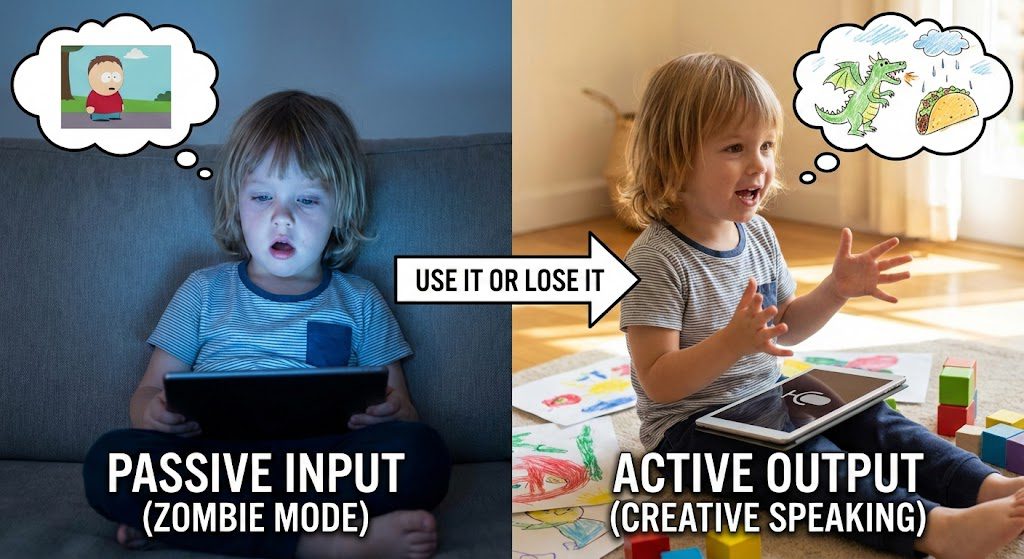
Key Takeaways:
- The “Zombie” Effect: Passive screen time provides “ready-made” images, causing your child’s imagination muscles to atrophy.
- The 49% Risk: Research shows that for every 30 minutes of passive handheld screen time, the risk of expressive speech delay nearly doubles.
- The Solution: Shifting from “Input” (watching) to “Output” (creating) bridges the gap between knowing words and actually using them.
The Silence of the “Zombie Mode”
You know the look. The glazed eyes. The open mouth. The eerie silence that falls over the living room the moment the iPad turns on.
As parents, we often crave this silence. It’s a moment of peace. But have you ever wondered what is happening inside your child’s brain during that quiet time?
The answer is… not enough.
Neuroscience tells us that the brain follows a strict “Use It or Lose It” rule. And when our kids are stuck in “Passive Consumption” mode, they aren’t just resting—they are missing out on the critical reps they need to build confidence, creativity, and communication skills.
The Science: Why “Input” Isn’t Enough
We often assume that because our kids are watching educational videos, they are learning. If they watch a video about dinosaurs, they know what a T-Rex is, right?
Yes, but there is a massive difference between Input (Receptive Language) and Output (Expressive Language).
- Receptive Language: Understanding what is said (The “Input”).
- Expressive Language: Being able to retrieve those words and use them to communicate (The “Output”).
A pivotal study presented at the Pediatric Academic Societies Meeting found that for every 30-minute increase in daily handheld screen time, there was a 49% increased risk of expressive speech delay.
Why? Because passive screens do all the heavy lifting. They provide the images. They provide the words. They provide the plot. Your child’s brain is just a passenger.
“When a child watches a show, they are given ‘ready-made’ mental images. This reduces the need for them to generate their own, effectively putting their imagination on pause.” — Frontiers in Psychology, Active vs. Passive Screen Time Study
The Dual-Benefit: Why “Output” Matters for Every Child
Whether you have a “chatterbox” who loves to perform or a “quiet observer” who needs extra support, the move to Active Screen Time is a game-changer.
1. For the Creative Kid (The “Vitamin”)
The Danger: “Mental Atrophy.” If your child loves Lego, they are building. If they love drawing, they are creating. But if they are just watching other people play Roblox on YouTube, their creative muscles are withering. The Unlock: Active storytelling forces them to be the Director, not the audience. It pushes them to use “Divergent Thinking”—the ability to come up with multiple unique solutions to a single problem.
2. For the Child Who Needs Support (The “Painkiller”)
The Danger: “The Receptive-Expressive Gap.” Many neurodiverse kids (including those with ASD or speech delays) have high receptive language—they understand everything! But they struggle to get the words out. The Unlock: Passive screens widen this gap. Active tools (like voice-controlled games) act as a bridge. They provide a safe, low-pressure environment to practice retrieval—finding the word “Dragon,” saying it aloud, and seeing a result.
Actionable Strategy: Play “The Cliffhanger Game” Tonight
You don’t need an app to start building these muscles. Try this simple dinner game to switch your family from “Input” to “Output.”
- The Setup: One person starts a story with a single sentence.
- You: “Once upon a time, a giant taco fell from the sky…”
- The Cliffhanger: You point to your child. They must add one sentence to move the story forward.
- Child: “…and it landed on the Principal’s car!”
- The Twist: They point to the next person.
Why it works: It forces “Active Listening” (they have to hear you to build on it) and “Rapid Retrieval” (they have to speak to keep the fun going).
Need more screen-free ideas? Check out our guide on Screen-Free Saturdays: Fun and Engaging Alternatives.
The StoryQuest Solution: Turning “Screen Time” into “Speak Time”
We built StoryQuest to solve the “Zombie” problem. We didn’t want to take the device away (let’s be real, we all need a break). We wanted to change how it’s used.
In StoryQuest, the story literally stops until your child speaks.
- The hero is stuck? Your child has to tell them which way to go.
- The dragon is sad? Your child has to ask it why.
It’s the perfect blend of digital fun and developmental “vegetables”—gamifying the “Output” your child needs to thrive.
Stop Watching. Start Speaking. [Create Your First Story Free]
People Also Ask (FAQ)
1. Is all screen time bad for speech development? No! Research differentiates between “Passive” (watching TV/YouTube) and “Active” (interactive video calls, educational games). Active screen time, where a child engages and responds, can actually support vocabulary growth.
2. How much screen time is too much for a 5-year-old? The AAP suggests limiting high-quality screen time to 1 hour per day for children aged 2-5. However, the quality of that time (Active vs. Passive) is just as important as the quantity.
3. My child only repeats lines from TV (Scripting). Is that bad? Not necessarily. Many Gestalt Language Processors use “scripts” to communicate. The goal is to help them move from repeating whole scripts to mixing and matching words (mitigation). Active storytelling tools can help bridge this gap.








Leave a comment