
Key Takeaways
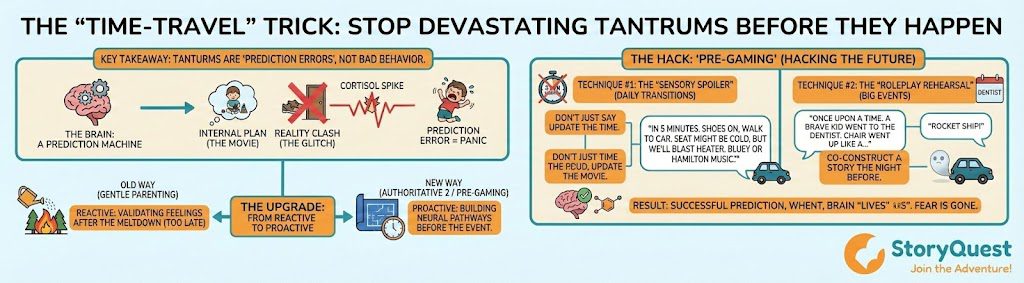
- The Glitch: Most tantrums aren’t “bad behavior” — they are Prediction Errors. The brain panics when reality doesn’t match the internal plan.
- The Upgrade: Moving from “Gentle Parenting” (reacting to feelings) to “Authoritative 2.0” (proactively building neural pathways).
- The Hack: “Pre-Gaming” allows you to write the code for your child’s brain before the stressful event happens, eliminating the cortisol spike.
The “Doorway of Doom”
It’s 8:00 AM. You need to leave for the dentist. You told your child five minutes ago. You told them two minutes ago.
But when you say, “Okay, shoes on!”—it happens.
The arch in the back. The scream that shatters windows. The absolute, boneless refusal to move.
If you’ve been following the “Gentle Parenting” trend, you might kneel down, take a deep breath, and say: “I see you’re frustrated. You really wanted to keep playing Legos.”
And that’s great. Validation is important.
But it’s also too late.
The meltdown has already hijacked their amygdala. You are doing damage control, not prevention. You are trying to put out a forest fire with a watering can.
Welcome to Authoritative 2.0. This isn’t about being stricter. It’s about being smarter. It’s about using a neuroscience concept called Predictive Processing to stop the explosion before the fuse is even lit.
The Science: Your Child’s Brain is a “Prediction Machine”
We used to think the brain was like a camera, passively recording what it sees.
Wrong.
Neuroscientists now know the brain is actually a Prediction Machine. It is constantly projecting a “movie” of the future onto the present. It creates a mental model of what should happen next to save energy.
- The Safety Loop: If reality matches the movie in their head, the brain stays calm.
- The Prediction Error: If reality clashes with the movie (e.g., “I thought I was playing Legos all day” vs. “Mom says get in the car”), the brain triggers a massive spike in neural activity.
This spike is called a Prediction Error. To a child (especially one with ADHD or Autism), this doesn’t feel like a change of plans. It feels like a glitch in reality.
According to research in Nature Reviews Neuroscience, the brain treats these prediction errors as threats, releasing cortisol immediately Source: The Predictive Brain, Clark, 2013.
Furthermore, studies show that anxiety in children is often just a persistent inability to predict the immediate future accurately Source: National Institutes of Health.
The takeaway? Your kid isn’t being “defiant.” Their brain is alerting them that the future is broken.
The Strategy: Hacking the Future with “Pre-Gaming”
If the problem is a bad prediction, the solution is to give them a better script.
This is called Pre-Gaming (or Narrative Rehearsal).
Instead of waiting for the transition to happen, you “time-travel” with your child to the future event using a story. You aren’t just telling them what to do; you are building the neural pathway for the event before they physically experience it.
This is the bridge between “Gentle Parenting” (empathy) and “Authoritative Structure” (boundaries). You are setting the boundary in advance, when their brain is calm enough to process it.
Technique #1: The “Sensory Spoiler” (For Daily Transitions)
Don’t just give a “5-minute warning” (time is abstract). Give a Sensory Spoiler.
- The Old Way: “We are leaving in 5 minutes.” (Easy to ignore).
- The Pre-Game Way: “In 5 minutes, we are going to put on our shoes. Then we will walk to the car. The car seat might feel cold, but we will blast the heater. Will we listen to the ‘Bluey’ soundtrack or ‘Hamilton’?”
Why it works: You just updated their internal movie. When the car seat is cold, their brain says, “Aha! I predicted this!” Dopamine is released instead of cortisol because the prediction was successful.
Technique #2: The “Roleplay Rehearsal” (For Big Events)
Got a doctor’s appointment? A first day of school?
Turn it into a Co-Constructed Story the night before. This utilizes the concept of Affect Labeling, which studies confirm diminishes the response of the amygdala Source: UCLA Psychology.
- You: “Once upon a time, a brave kid went to the dentist. The chair went up and down like a…”
- Child: “Rocket ship!”
- You: “Yes! And then the dentist used a little mirror. It tickled a bit. What did the brave kid do?”
- Child: “Opened his mouth like a lion!”
By the time you get to the actual dentist, their brain has already “lived” the event safely. The fear is gone because the uncertainty is gone.
(This focuses the brain, similar to the mechanism we discuss in The Bottleneck Effect — reducing cognitive load so the brain can function.)
The Dual-Benefit (Why This Works for Every Brain)
- For the “Vitamin” Market (The Spirited Kid): It teaches Mental Flexibility. You are training them to visualize future scenarios and adapt—a key leadership skill for the future workplace.
- For the “Painkiller” Market (ADHD/Autism): Children with neurodivergence often struggle with Executive Function. Pre-gaming acts as an “external hard drive,” holding the plan so their working memory doesn’t have to. It turns “demand avoidance” into “shared prediction.”
How StoryQuest Automates Pre-Gaming
We know you can’t always come up with a magical story when you’re rushing to get out the door.
That’s why StoryQuest isn’t just for bedtime. It’s a Transition Tool.
- Scenario: Nervous about the first day of school?
- The Fix: Create a StoryQuest adventure about a “Space Captain’s First Day at Academy.”
- The Result: The app guides your child through the emotions of a new beginning—meeting new friends, missing home, and finding courage.
They practice the feeling of bravery in the story, so they can use it in real life. This is the ultimate version of Serve and Return — using dialogue to build emotional resilience.
People Also Ask (FAQ)
1. Isn’t explaining everything just coddling them? No. “Coddling” is removing the challenge. “Pre-gaming” is preparing them for the challenge. You are still going to the doctor (the boundary), but you are giving them the map (the support). It creates “secure attachment,” which research shows leads to higher independence later.
2. What if they still cry? That’s okay! Pre-gaming reduces the panic, not necessarily the dislike. They might still be annoyed they have to leave the park, but they won’t go into “fight or flight” meltdown mode.
3. Does this work for teenagers? Surprisingly, yes. Teen anxiety is often rooted in poor predictive processing about social situations. Casually “gaming out” a scary conversation (“If he says X, what would you say?”) calms the teen brain just as effectively as a toddler’s.
Ready to Hack the Tantrum? Next time you see a storm brewing, don’t wait for the rain. Time-travel. Build the story. Predict the feelings. And watch the meltdown melt away.
[Start Pre-Gaming with StoryQuest Today]








Leave a comment