
(And Why Protecting Them is Backfiring)
KEY TAKEAWAYS
- The Trap: “Parental Accommodation” (saving your child from fear) actually rewires their brain to be more anxious.
- The Fix: Bravery is not the absence of fear; it is the practice of acting through it.
- The Simulator: Storytelling provides a “Safe Danger” environment where kids can practice facing threats without real-world consequences.
The “Be Careful” Instinct
We have all done it.
You are at the playground. Your child approaches the “big kid” slide. They hesitate. They look at you with wide, uncertain eyes.
And your brain screams: PROTECT.
You shout, “Be careful! That’s too high!” or “Come down, sweetie, let’s do the baby slide.”
You grab them. You hold them. You feel their heart rate go down, and you feel a rush of relief. I saved them.
But here is the uncomfortable truth: You didn’t save them. You just fed the Anxiety Monster.
By removing the scary thing, you accidentally taught their brain a dangerous lesson: “You were right to be scared. You can’t handle this. The world is too dangerous for you.”
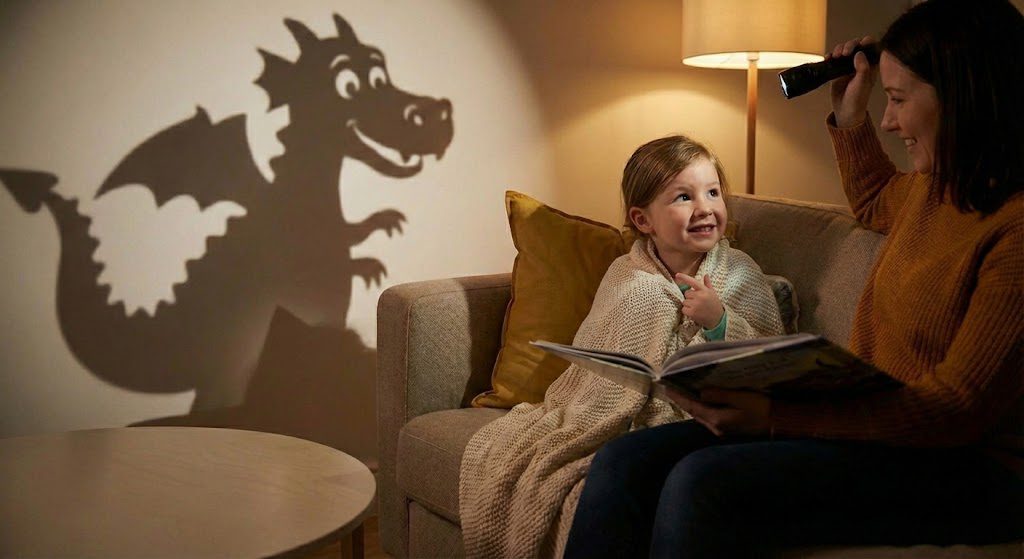
This is the Safe Danger Paradox. To raise a brave child, you have to stop making them feel safe all the time. You have to let them fight the dragon.
The Science: Why “Saving” Them Makes It Worse
(Put on your lab coat, we’re going to Yale).
Dr. Eli Lebowitz at the Yale Child Study Center has revolutionized how we treat childhood anxiety with a program called SPACE (Supportive Parenting for Anxious Childhood Emotions).
His research uncovered a phenomenon called Parental Accommodation.
- What it is: Changing your behavior to prevent your child from feeling distress (e.g., ordering for them at a restaurant because they are shy, or checking under the bed 10 times).
- The Result: Studies show that higher levels of accommodation are linked to more severe anxiety symptoms over time.
- Source: Family Accommodation of Child and Adolescent Anxiety (NIH)
Why? Because of Neural Plasticity.
As Dr. Norman Doidge famously said, “Neurons that fire together, wire together.”
- If your child feels fear → and you remove the fear → their brain wires Avoidance.
- If your child feels fear → faces it → and survives → their brain wires Resilience.
You cannot talk a child out of anxiety. You have to wire them out of it.
Source: Exposure Therapy Triggers Lasting Reorganization of Neural Fear (PMC)
The Solution: “Safe Danger” Simulation
Okay, so you can’t just throw your anxious 5-year-old into a pit of snakes and shout, “Build resilience!” (Please don’t do that).
You need a middle ground. You need a Simulator.
This is where Storytelling becomes a clinical tool.
When a child listens to a scary story—a dragon attacking a village, a dark forest, a lost puppy—their brain releases a cocktail of neurochemicals:
- Cortisol: (Stress) “Oh no! The dragon is coming!”
- Oxytocin: (Safety) “But I am sitting on Mom’s lap.”
This unique mix creates a state of Safe Danger.
It allows the child to “rehearse” bravery. They get to feel the physical sensation of fear (racing heart, tight chest) while simultaneously knowing they are safe. It is Graded Exposure Therapy disguised as a bedtime story.
The Dual-Benefit: Why “Safe Danger” Works for Every Kid
Whether you have a “Vitamin” kid (you want them to have grit) or a “Painkiller” kid (you are managing GAD), this works.
1. For the Shy/Anxious Kid (The Painkiller)
- The Goal: Fear Extinction.
- The Win: When the character in the story faces the monster and wins, your child’s brain mirrors that victory. They experience a “vicarious win.” Over time, this desensitizes the amygdala, making the real world feel less threatening.
- Related: If the anxiety triggers a meltdown, use our 90-Second Calm-Down Method.
2. For the Confident Kid (The Vitamin)
- The Goal: Divergent Thinking.
- The Win: “Safe Danger” stories force kids to problem-solve under pressure. “The bridge is breaking! What do we do?” This builds Executive Function—the ability to stay cool when things go wrong.
- Source: Enhancing Fear Extinction via Graded Exposure (eLife)
Actionable Strategy: The “What If” Monster Game
You can start Graded Exposure tonight with a simple game.
The Rules:
- Create a Monster: Ask your child to describe a scary thing (A Shadow Blob? A Lava Spider?).
- The Threat: Imagine the monster is blocking the fridge. “Oh no! We can’t get the juice!”
- The Pause: This is crucial. Do not solve it for them. Ask: “What should we do?”
- The Action: Whatever they say (Magic wand? Laser eyes? Offering the spider a cookie?), accept it.
Why this works: You are forcing them to look the “threat” in the eye and generate a solution. You are moving them from Passive Victim to Active Hero.
(This utilizes the same mechanism as the Serve and Return technique—building brain architecture through dialogue).
How StoryQuest Automates Bravery
We know it’s hard to come up with the “perfectly scary but not too scary” story on the fly.
We built StoryQuest to be your co-pilot in bravery training.
- Controlled Intensity: Our stories introduce “Safe Danger” (a lost key, a mysterious noise), but the AI waits for your child to speak.
- Agency: The story cannot be fixed until your child uses their voice to command the hero.
- The Result: They aren’t just listening to a hero; they become the hero.
So tonight, don’t promise them that the world is safe. Promise them that they are brave enough to handle the dragons.
Start Your First Adventure (It’s Free)

People Also Ask (FAQ)
Q: Will scary stories give my child nightmares? A: Generally, no—if the child has control. “Passive” fear (watching a scary movie they can’t stop) causes nightmares. “Active” fear (where they help the hero win) resolves the tension before sleep, often leading to a sense of empowerment.
Q: How do I know if a story is “too” scary? A: Watch their body language. Leaning in = Good Stress (Eustress). Covering ears/crying = Distress. If they hit distress, simply ask, “What silly thing should happen to the monster now?” Humor breaks the fear loop immediately.
Q: My child refuses to participate in scary stories. What do I do? A: Start with “Low Stakes” danger. Instead of a dragon, maybe a squirrel lost its acorn. Build the “problem-solving” muscle on small things before tackling big fears. This is the essence of Graded Exposure.






Leave a comment