
The Insidious Bedtime Trap: How This Secret ‘Hero Hack’ Destroys Sleep Resistance Forever
Key Takeaways
- The Identity Shift: Moving from a “Passive Listener” to the “Main Character” satisfies a child’s need for autonomy, reducing bedtime resistance.
- Narrative Transportation: Deep immersion in a story reduces cortisol (the stress hormone) and triggers physical relaxation.
- The Dopamine Reset: Ending the day with a “win” in a story provides a safe, low-stimulation reward that stabilizes the brain for sleep.
The “One More Thing” Hostage Situation
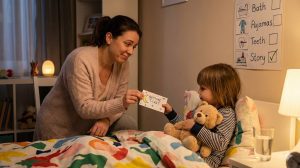
It’s 8:30 PM. You’ve done the bath, the pajamas, and the “final” glass of water. You’re dreaming of the couch and that half-finished Netflix episode. But then, the lower lip quivers. “Just one more story? I’m not tired! I want to stay up!”
Bedtime feels like a catastrophic hostage negotiation because, to your child, sleep is a devastating ending to the “show” of their life. They aren’t being defiant; they’re experiencing a digital-age hangover. If your child has been stuck in the Dopamine Trap of passive screen time all day, their brain is literally screaming for one more “hit” of engagement before the lights go out.
So, here is the secret: Stop trying to turn the show off. Just change the script. Instead of reading at them, put them in the story. When they become the Hero, they aren’t “going to bed”—they are embarking on a boundless mission to the Land of Nod.
The Science Quadrant (The Nerdy-but-Cool Part) 🤓
We’re keeping it light, but this strategy is backed by electric brain science:
- Narrative Transportation: When we get “lost” in a story, we enter a state called Narrative Transportation. Research published in PNAS shows that storytelling—specifically oral narratives—increases oxytocin (the “cuddle” hormone) and significantly decreases cortisol (the stress hormone) in hospitalized children.
- Cortisol vs. Melatonin: A child fighting sleep is often in a “fight or flight” state. By shifting the focus to a story where they are the hero, you move them from the Amygdala (fear/resistance) to the Prefrontal Cortex (imagination).
- The “Pragmatic” Bridge: For parents of neurodiverse kids, this isn’t just a hack; it’s therapy. If you’re dealing with The 20-Minute Monologue, putting them in a structured Hero’s Journey forces natural turn-taking and social reciprocity.
The Actionable Game: The “Sleepy Quest”
Tonight, don’t pick up a book. Dim the lights and start the Sleepy Quest.
- The Inciting Incident: “Captain [Child’s Name], the Kingdom of Dreams has lost its Golden Pillow! Without it, no one can dream of chocolate clouds. Will you help us find it?”
- The Sensory Obstacle: “We have to cross the Marshmallow Mountains (the duvet). Oh no! The wind is blowing! We have to take three ‘Sleepy Bear Breaths’ to calm the storm”.
- The Hero’s Choice: “We found the cave! But there are two doors. One is made of moonbeams, and one is made of silver starlight. Which one should we open?”.
- The Resolution: The hero finds the Golden Pillow (their actual pillow) and must rest their head on it to “activate” the magic.
Why Every Kid Wins
- This builds Creative Grit. You are strengthening your bond by showing them that their voice has power.
- For kids with ASD or speech delays, this is a miracle bridge for Joint Attention. They aren’t staring at a “solo silo” screen; they are looking at you, the Co-Pilot, to finish the mission.
The StoryQuest Solution: Your Bedtime Wingman
Let’s be real: sometimes you are too exhausted to invent a “Moonbeam Door.” That’s why we built StoryQuest.
Our AI-powered adventures turn your child into the star without you having to write a script. The app handles the narrative structure, provides the sensory details, and — most importantly — it waits for your child to speak their choices. It’s the ultimate “cheat code” for a calm, imaginative, and screen-free transition to sleep.
[Start your Hero’s Journey tonight — Create a story for free!]
People Also Ask (FAQ)
Q: Won’t making them the star make them too excited to sleep? A: Actually, no. Studies on imaginative play suggest that structured role-play helps children regulate emotions. When a child has agency, their “prediction error” drops, which lowers the heart rate.
Q: My child has ADHD and can’t focus on a long story. What do I do? A: Use the “3-Second Rule.” Give them a choice, then wait. Their brains often just need a moment to “buffer” before they can output a creative thought.
Q: Is this better than watching a movie before bed? A: 100%. Fast-paced cartoons create “Popcorn Brain,” where the brain expects a dopamine hit every 4 seconds. Audio storytelling forces the brain to build its own visual images, which is much more relaxing and helps build the Default Mode Network.