
Key Takeaways
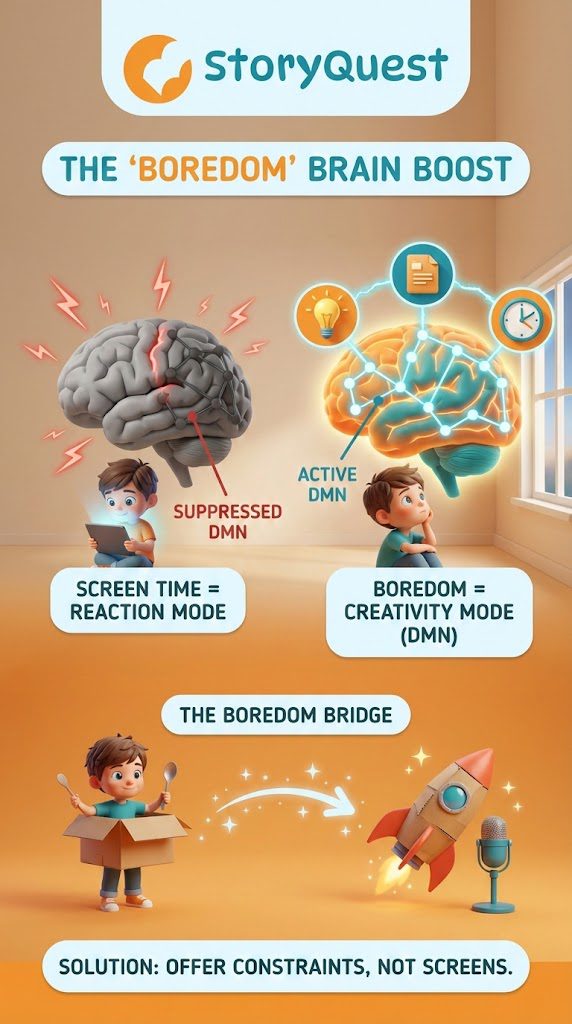
- The “Idle” Myth: We treat boredom like a problem to be solved, but neuroscience defines it as a vital brain state called the Default Mode Network (DMN).
- The Creativity Switch: The DMN is the only time your child’s brain connects disparate ideas, plans for the future, and solidifies their sense of self.
- The Screen Killer: Constant high-dopamine input (tablets, TV) suppresses the DMN, effectively preventing the brain from “filing” its memories and emotions.
The “I’m Bored” Emergency Siren
It happens at 10:00 AM on a rainy Saturday. Or 20 minutes into a car ride.
“Mooooooom. I’m borrrrred.”
For modern parents, this phrase triggers a visceral panic response. We feel like we are failing. We feel like the cruise directors of the Titanic, frantically shuffling deck chairs to keep the passengers entertained.
So, what do we do? We hand over the iPad. We turn on the TV. We offer a dopamine lollipop to silence the whining.
But here is the uncomfortable truth: By killing their boredom, we might be killing their creativity.
We are raising a generation with a “Default Mode” Deficit. We have removed the empty space from their lives, and their brains are paying the price.
The Science: Meet the “Default Mode Network”
For years, scientists thought that when you stopped focusing on a task (like doing math or reading), your brain went to sleep.
They were wrong.
In 2001, neuroscientists discovered that when the brain is “at rest”—daydreaming, staring out the window, or being “bored”—a massive neural network lights up like a Christmas tree. They called it the Default Mode Network (DMN).
Think of the DMN as your child’s internal CEO. When the “workers” (focus/attention) take a break, the CEO steps in to:
- Consolidate Memories: “What happened today and where do I file it?”
- Envision the Future: “What happens if I try this tomorrow?”
- Process Social Emotions: “Why was Tommy mean to me?”
According to research published in Frontiers in Psychology, the DMN is crucial for divergent thinking—the ability to come up with original ideas.
The Problem: High-stimulation screens (YouTube, fast-paced games) forcefully suppress the DMN. They keep the brain in “Reaction Mode” (Task Positive Network). If a child is constantly entertained, the CEO never gets to come into the office. The files never get sorted. The self-identity never gets built.
(This constant toggling between screens and real life can also lead to fragmented attention. Read more about The “Popcorn Brain” Epidemic.)
The Dual-Benefit: Why “Boredom” Wins
Boredom isn’t just “not having fun.” It is a physiological state of seeking stimulation. How your child solves that problem matters.
1. For the “Vitamin” Parent (The Creative Kid) You want a child who builds forts, writes songs, and invents games. That only happens in the DMN. When you refuse to solve their boredom, you force their brain to generate its own dopamine. This is the birth of innovation. As Dr. Sandi Mann notes in her research, boredom is the “incubator of creativity.”
2. For the “Painkiller” Parent (The ADHD/Neurodiverse Kid) For kids with ADHD, the brain is starved for dopamine. The instinct is to give them a screen (cheap, fast dopamine). But this creates a tolerance loop. Allowing them to be bored—even if it’s painful for 10 minutes—helps reset their dopamine baseline. It teaches the brain that it can survive without constant external input. It creates “Psychological Calluses” that make them more resilient.
(Struggling to get them off the device without a meltdown? Check out our guide on Screen-Free Saturdays for transition tips.)
Actionable Strategy: The “Boredom Bridge”
You can’t just rip the iPad away and say, “Go stare at a wall.” That’s a recipe for a riot. You need a bridge.
The Strategy: “Constructive Boredom”
Next time they say “I’m bored,” do not offer a solution. Instead, offer a Constraint.
- The Setup: “I know you’re bored. That’s actually great! It means your brain is about to have a good idea.”
- The Constraint: “You can do anything you want, but it has to use these three things.”
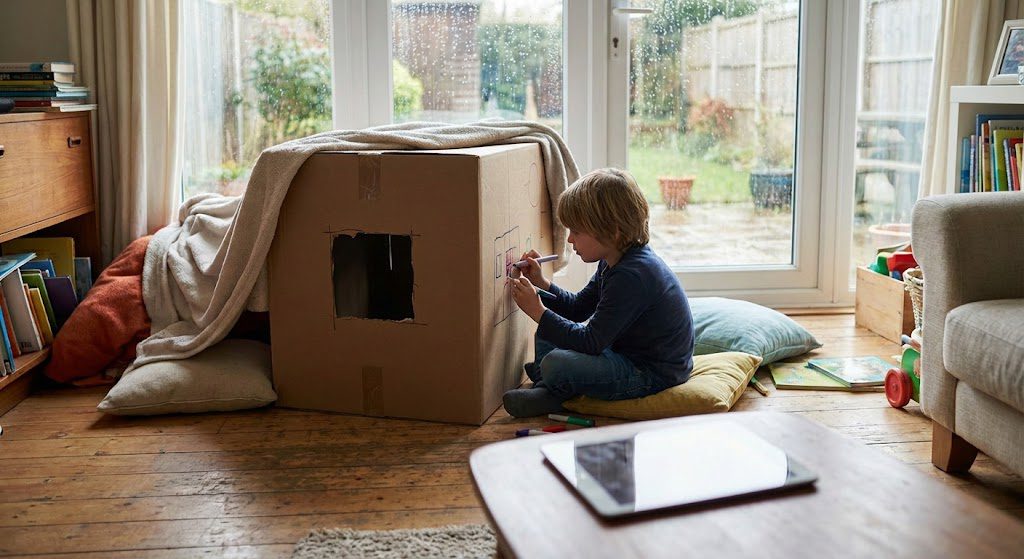
- Example: A cardboard box, a marker, and a spoon.
- Example: The couch cushions and a flashlight.
- The Walk-Away: This is the hardest part. Leave the room.
Why? Because if you stay, you become the entertainment. By leaving, you force the DMN to kick in. They might whine for 5 minutes. But at minute 6, the spoon becomes a microphone, the box becomes a stage, and the “Boredom Beast” is tamed.
(This aligns with the “Use It or Lose It” Rule — we are forcing the brain to output, not just input.)
The StoryQuest Solution
StoryQuest sits perfectly on the “Boredom Bridge.”
Unlike a movie that feeds the brain every visual detail, StoryQuest is Audio-First. We give the prompt (“You are walking into a dark cave…”), but your child’s brain has to do the work.
They have to:
- Visualize the cave (DMN activation).
- Decide what happens next (Executive Function).
- Speak the answer (Language Skills).
It solves the “I’m bored” complaint by providing a spark, but it keeps the DMN active by demanding their imagination do the heavy lifting.
People Also Ask (FAQ)
1. Is boredom good for kids with ADHD? Yes, but in moderation. ADHD brains struggle to regulate attention. “Unstructured” boredom can sometimes lead to destructive behavior. It is better to provide “Scaffolded Boredom”—a low-dopamine environment with open-ended toys (Legos, art supplies) rather than a completely empty room.
2. How long should I let them whine before I step in? The “agitation phase” of boredom usually lasts 15-20 minutes. This is the withdrawal from high stimulation. If you can hold the line past 20 minutes, you will often see them slip into deep play.
3. Does listening to audiobooks count as boredom? Not exactly, but it is “active rest.” Unlike video, which suppresses the DMN, listening allows the mind to wander and visualize. It is a healthy middle ground between high-stimulation screens and total silence.








Leave a comment