
(A Light, Playful, Storytelling Guide for Parents & Curious Adults)
Introduction
If you’ve ever read a bedtime story and thought,
“Wow… why does this one feel like magic, while others feel like soggy cereal?”
— you’re in the right place.
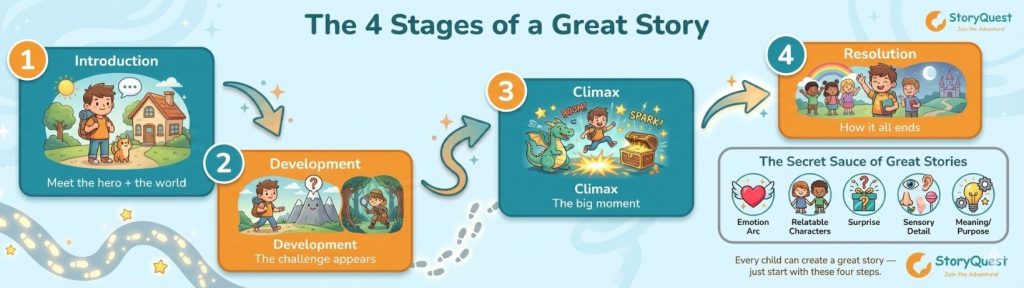
Yes, every story has its classic 4-part skeleton:
Introduction → Development → Climax → Resolution.
But here’s a little secret between us (wink):
The structure is only the beginning.
The magic comes from what you sprinkle inside that structure.
Today we’re diving into both:
✔ the timeless 4 stages
✔ the “secret sauce” the best authors and storytellers use
✔ how parents can bring this into everyday story time
And don’t worry — you don’t need a writing degree, a magic wand, or unlimited patience.
Just a tiny spark of curiosity. 🔥✨
⭐ What Are the 4 Stages of a Great Story?
Let’s start with the essentials. Think of these as the “road map”:
1. Introduction — Meet the Hero & Their World

This is where the story opens its door and says:
“Come on in, let me show you around.”
Kids instantly latch onto stories when they know:
- Who the hero is
- Where they are
- What feels familiar or exciting
The introduction sets the vibe.
Is it cozy? Mysterious? Funny? A little chaotic? (We love chaotic.)
2. Development — The Challenge Appears
This is where things get juicy.
The hero wants something…
But something is also in the way.
It doesn’t have to be a dragon.
It can be:
- a lost hat
- a missing cookie
- a grumpy cloud
- a friend who needs help
Development is the heart of the journey — the place where kids lean in and go:
“Okayyy… and then what happened?!”
3. Climax — The Big Moment
This is the drumroll section.
Think:
Boom! Ta-da! Aaaaaaand… there it is.
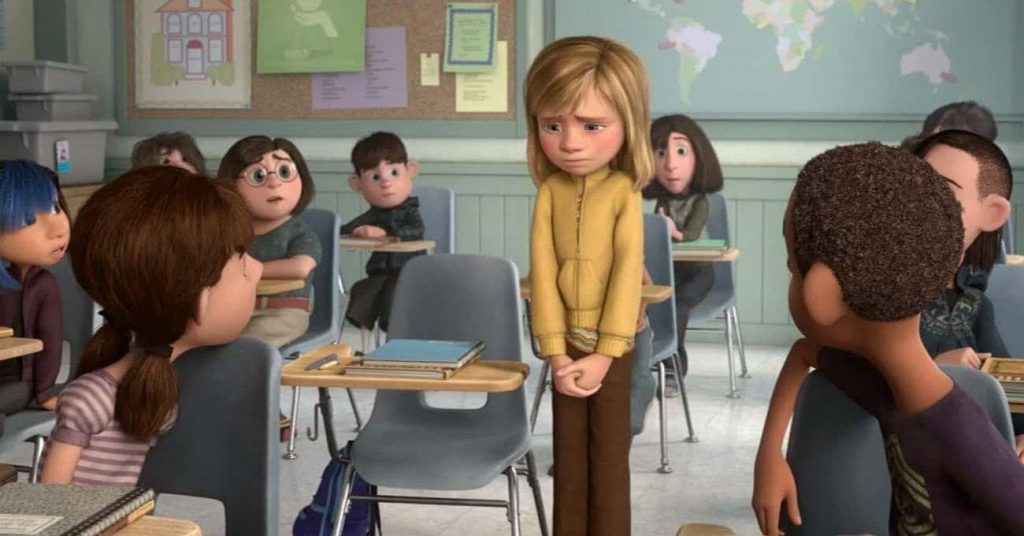
The climax is the turning point — the moment when the hero faces the problem head-on.
It’s exciting, emotional, sometimes dramatic, sometimes silly, always memorable.
Kids feel the thrill.
Parents get goosebumps.
The story hits its high note.
4. Resolution — How It All Ends
Ah, the satisfying exhale.
The place where everything settles.
Where the hero learns, grows, changes, or simply gets their cookie back.
This is also where the message lands — without preaching, without forcing.
Just a gentle wrap-up that makes the heart feel warm.
⭐ But Wait… Structure Alone Isn’t Enough.
(Here comes the fun part.)
If structure is the skeleton, the secret sauce is the personality — the flavor, the sparkle, the “tell me another one!” energy.
Most great authors use one (or several) of these magic ingredients:
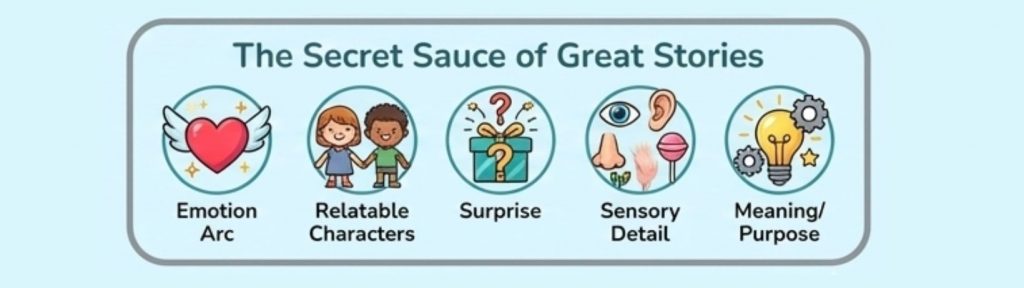
⭐ The Secret Sauce Behind Every Great Story
✨ 1. Emotional Arc
Kids don’t just listen to stories — they feel them.
Fear → curiosity → surprise → joy → relief
This emotional rollercoaster cements the story into their memory.
We explore this brain-boosting magic even further in our article on how storytelling supercharges cognitive growth.
✨ 2. Relatable Characters
The hero doesn’t need to be perfect.
In fact… please don’t make them perfect.
Kids connect deeply with characters who:
- Make mistakes
- Try again
- Are silly, curious, brave, shy, or a mix
Imperfection is irresistible.
✨ 3. Surprise (The “Oooh!” Factor)
A tiny twist makes kids’ brains light up like fireworks.
A frog who sings jazz?
A rock that tells jokes?
Yes, please.
✨ 4. Sensory Detail
The more senses you activate, the more vivid the world becomes:
- How did the forest smell?
- What sound did the dragon make?
- How cold was the magic river? Even simple stories feel cinematic when they engage the senses.
✨ 5. Meaning (The Gentle Takeaway)
Every story whispers something.
It doesn’t lecture — it nudges.
A tiny message makes the story grow roots in a child’s mind.
⭐ Why This Matters for Kids
Storytelling isn’t “just fun.” It is one of the most powerful learning tools children have.
- Boosts language skills
- Strengthens memory
- Builds emotional intelligence
- Teaches problem-solving
- Ignites creativity
- Improves focus
- Grows confidence
Stories shape how kids see the world — and themselves.
Not bad for a 5-minute bedtime ritual, right? 😉
Why Kids Learn Best Through Stories
⭐ How Parents Can Use This (Even If You Don’t Feel Like a “Storyteller”)
Good news:
Kids don’t want professional storytelling.
They want you — your voice, your imagination, your silliness.
Here’s how to apply the secret sauce in real life:
- Add a funny twist
- Give the hero a tiny flaw
- Describe one sensory detail
- Ask your child what happens next
- Let the story wander a bit
Your story doesn’t need to be perfect.
It only needs to be yours.
👉 If you’d like inspiration for weaving storytelling into your daily connection routine, here’s a simple guide on using stories to strengthen your parent–child bond.
⭐ Final Thoughts — Every Child Can Be a Storyteller
Structure makes stories understandable.
The secret sauce makes them unforgettable.
And when kids learn both?
They become confident, expressive, imaginative humans who love creating.
So tonight — try a tiny 4-step story.
Sprinkle a little magic.
Add one drop of chaos. (Optional but recommended.)
And watch the spark happen. ✨








Leave a comment