

Key Takeaways:
- The Pattern: Bright children often struggle to switch from “sharing facts” to “sharing a conversation.”
- The Audience: This is common in neurodiverse kids (ADHD, Level 1 Autism) who have high vocabularies but struggle with social cues.
- The “Why”: “Info-dumping” is a way of sharing joy, not just data.
- The Fix: Gamified practice can teach the “pause” button without shame.
It starts with a simple question: “How was your day?”
Twenty minutes later, you have heard a complete history of the Titanic, a detailed timeline of the Star Wars galaxy, or a breakdown of every train schedule. But the moment you try to interject, share a thought of your own, or change the subject, the connection breaks.
If this dynamic feels familiar, you aren’t alone.
Who is this post for? This guide is written specifically for parents of neurodiverse children — often those with ADHD or Level 1 Autism (formerly Asperger’s). These children are often incredibly bright and possess advanced vocabularies, yet they struggle with the “Tennis Match” of conversation.
They can serve the ball with incredible power, but they haven’t yet learned the science of Serve and Return.
What is “Pragmatic Language”? (The Hidden Social Skill)
In the speech and therapy world, the gap between knowing words and using them socially is known as a Pragmatic Language Deficit.
While structural language is about grammar and definitions (which your child likely excels at), pragmatic language is the social use of those words. To have a functional conversation, a child needs to master three hidden skills:
- Turn-Taking: Knowing that conversation requires a pause to let the other person speak.
- Topic Maintenance: Staying on the same subject as the partner, rather than pivoting immediately back to their own special interest.
- Reciprocity: Understanding that a conversation is a shared exchange of energy, not a solo performance.
Traditional social skills groups often try to teach this with worksheets or “fake” role-playing. But for many bright, neurodiverse kids, that just feels like more schoolwork.
The “Monologue Trap”: Why Info-Dumping Happens
It is easy to get frustrated when you feel talked at, but it is vital to understand the intent behind the behavior.
“Info-dumping” is often a love language for neurodiverse kids.
Sharing facts is how they share joy! It is their specific way of saying, “I love this thing, and I feel safe with you, so I want you to have all this data.” Sometimes, their brains are overflowing with so much information that they experience a Bottleneck Effect, where they feel they must get it all out at once.
The challenge is: How do we honor their passion while teaching them to pause?
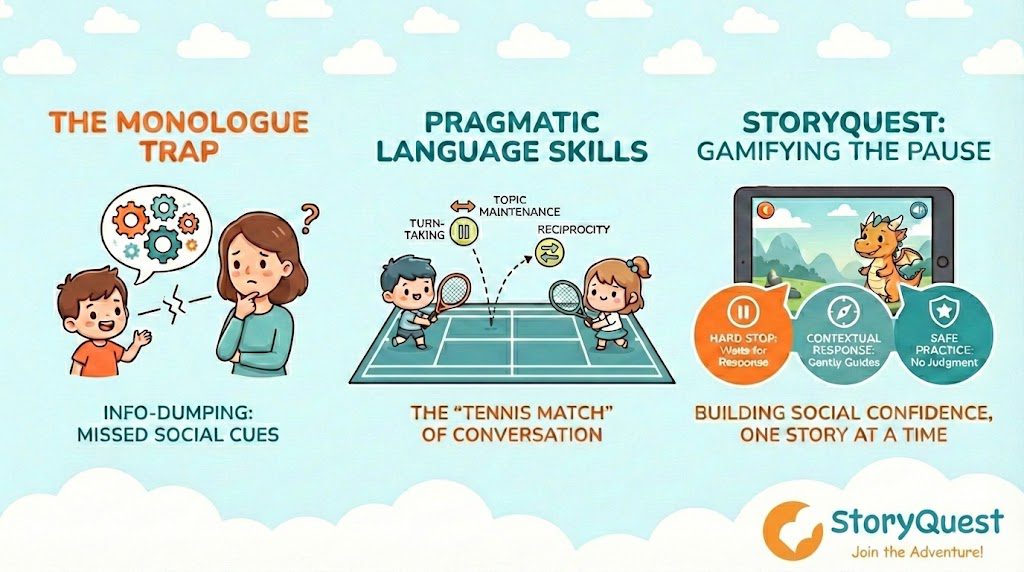
How StoryQuest Gamifies the “Pause”
We built StoryQuest to be the ultimate Conversation Simulator. Unlike a standard video game or YouTube video that keeps playing no matter what the child does, our AI Storyteller is designed to stop, listen, and wait.
Here is how StoryQuest acts as a gentle “Turn-Taking Coach”:
1. The Hard Stop
The AI narrates an exciting scene and then asks a specific question (e.g., “The dragon is waiting. What should we say to him?”). The story literally cannot proceed until your child answers. This forces a natural pause and requires input to move forward.
2. Contextual Response
If your child goes off-topic, the AI gently brings them back (“That sounds cool, but the Alien Captain is asking for coordinates!”). This models staying on topic without the shame that can sometimes lead to emotional meltdowns.
3. Safe Social Practice
Practicing conversation with a human is high-pressure because there is facial, tone, and body language to decode. Practicing with a character is safe. There is no eye contact required, no fear of judgment, and no “wrong” answers — just practice.
3 “Turn-Taking” Games to Play at Dinner Tonight
You can practice reciprocity without screens, too. If you want to help your child build these muscles at home, try these three simple prompts:
The “Talking Stick” Rule
Use a physical object (like a salt shaker). Only the person holding it can speak. Pass it back and forth rapidly to build the physical rhythm of exchange. This makes the abstract concept of “taking turns” concrete and visible.
The “2-Question” Challenge
Tell your child they can tell you one cool fact about their favorite topic, but then they must ask you two questions about your day. This turns interest in others into a game they can win.
The “Cliffhanger” Story
Start a story with one sentence (“Once there was a cat who loved pizza…”). Point to your child. They must add only one sentence. Then they must point back to you. This builds the habit of listening intently to build on what was just said, rather than waiting for a turn to monologue.
Build Social Confidence, One Story at a Time
Conversation is the bridge to friendship. By turning “social skills practice” into an epic adventure, we help children build that bridge—without them even realizing they are learning.
Ready to practice conversation the fun way? [Join the StoryQuest Beta Waitlist] – The story stops until you speak.








Leave a comment