
Key Takeaways
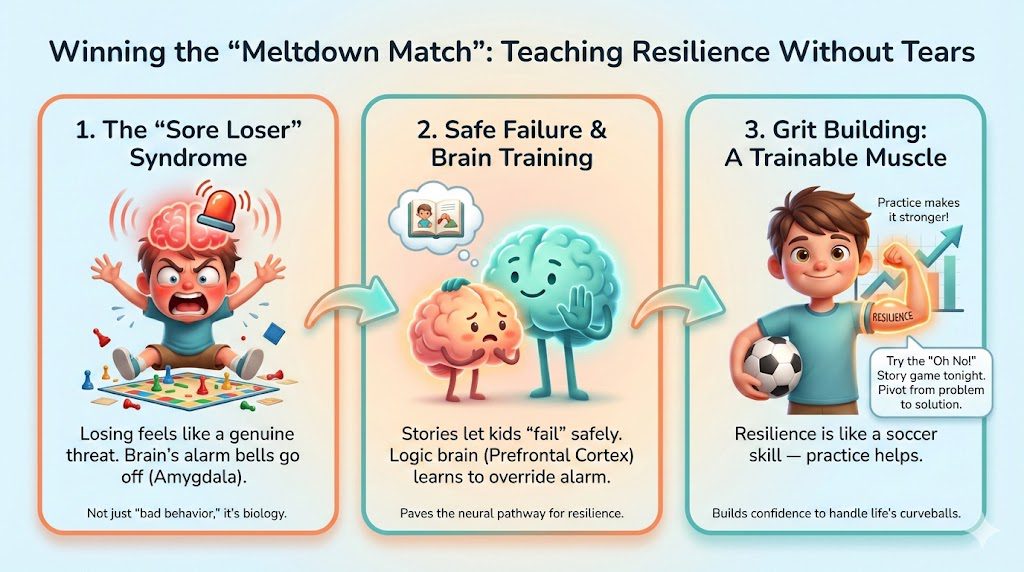
- The “Sore Loser” Syndrome: Losing triggers a genuine threat response in the brain—it’s not just “bad behavior.”
- Safe Failure: Stories allow kids to “fail” and recover without real-world stakes.
- Grit Building: Resilience is a muscle you can train, just like soccer skills.
The Big Game Blowout
Whether you’re watching Man City vs Liverpool or the latest Real Madrid match, sports fans know the feeling well: High stakes. Big emotions. Crushing defeats. You see grown men crying in the stands or shouting at the TV.
Now, imagine feeling that level of intensity… over a game of Candy Land. 🍬😭
We’ve all seen the board game flip. The “I’m not playing anymore!” scream. The tears because you “stole” their property in Monopoly.
In professional sports, we call it passion. In parenting, we call it a nightmare.
But here is the truth: teaching your child to lose (and win) gracefully is one of the hardest—and most important—skills they’ll ever learn. It’s not just about being polite; it’s about wiring their brain to handle life’s inevitable curveballs.
The Science Corner (Nerdy but Cool) 🤓
It’s all about Cortisol Regulation and the Amygdala.
When a child loses a game, their brain’s “threat detection center” (the Amygdala) lights up. To them, losing isn’t just a game result; it feels like a genuine loss of status or safety. Their body floods with cortisol (stress hormone).
Resilience isn’t about not feeling sad. It is the ability of the Prefrontal Cortex (the logic brain) to step in, override the alarm bells, and say, “It’s okay. We are safe. We can try again.”
- The Study: Research shows that “scaffolded exposure” to failure—failing in small, safe ways—helps build this neural pathway. If they never lose, that pathway never gets paved.
- The Link: Resilience in Children: Developmental Perspectives
Why This Helps Every Kid
Resilience looks different for every personality type. Here is how storytelling helps build it:
For the “Competitive Beast” 🦁
This is the kid who flips the board. They have a high drive but low frustration tolerance. They need to learn that losing isn’t the end of the story—it’s just a plot twist.
- The Fix: They need stories where the hero fails first, then learns a lesson, and then succeeds. It re-frames failure as a necessary step to victory.
- 👉 Read more: How to Calm a Child During a Meltdown in 90 Seconds (Research-Backed)
For the “Give-Up” Kid 🐢
This is the kid who quits the moment things get hard. “I can’t do it! It’s too hard!” If they sense a challenge, they shut down. They need “scaffolded challenges” to prove to themselves that they can overcome obstacles.
- The Fix: Instead of a blank page (which is scary), they need a guide.
- 👉 Read more: The Bottleneck Effect: Why Your ADHD Child Has Big Ideas but a Blank Page
Try This Today: The “Oh No!” Story 😱
You can train this resilience muscle at the dinner table tonight.
The Game: Start a simple story where everything goes wrong. The Rule: Every time you say “Oh no!”, your child has to fix the problem.
- You: “Once there was a soccer player who ran onto the field and… tripped on his shoelaces in front of everyone!”
- Child: “Oh no!”
- You: “But then… he laughed and tied them into a super-cool double knot. What happened next?”
Why it works: You are teaching them to pivot from Embarrassment (The Problem) to Problem Solving (The Solution) in a safe, funny environment.
How StoryQuest Helps
Our stories aren’t always easy! We don’t just hand the victory to the child.
Sometimes the hero gets stuck. Sometimes the bridge breaks. Sometimes the dragon wakes up. Your child has to pause, think, and help the hero figure it out. It’s “Grit Training” disguised as a fun adventure.
By the time they face a real-world setback—like a difficult math test or a lost soccer match—they’ve already practiced overcoming “disaster” a hundred times in the story world.
Questions Parents Ask (FAQ)
Q: Should I let my kid win board games? A: Sometimes (for confidence), but not always. The rule of thumb is the “1-in-3 Rule.” Let them win enough to feel capable, but let them lose enough to build immunity to the disappointment.
Q: How do I handle the crying when they lose? A: Validate, don’t fix. Don’t say, “It’s just a game, stop crying.” Instead say, “It feels really frustrating to lose. I get that. I hate losing too.” Once they feel heard, the tears usually stop faster.
Q: Can stories really teach sportsmanship? A: Yes! Kids mimic what they see (and hear). If the hero in their story shakes hands with the Goblin after the race, your kid is much more likely to shake hands after their game, too.








Leave a comment