


Key Takeaways
- The Zodiac Myth: The story of the “Great Race” isn’t just a fairy tale; it’s a masterclass in problem-solving and personality types.
- The Horse’s Lesson: Why getting “spooked” and falling behind (but finishing anyway) is the ultimate sign of resilience.
- Try This: A “Living Room River” game to teach your child that it’s okay to be scared, as long as you keep moving.
A Race, A River, and a Sneaky Snake 🐍🐎
Happy Year of the Horse! (Mǎ nián kuài lè! 马年快乐!)
We all know the basics: There are 12 animals in the Chinese Zodiac. But do you know why?
The legend of the Great Race isn’t just a bedtime story; it’s actually one of the best tools you can use to teach your child about Grit (Jiān yì 坚毅).
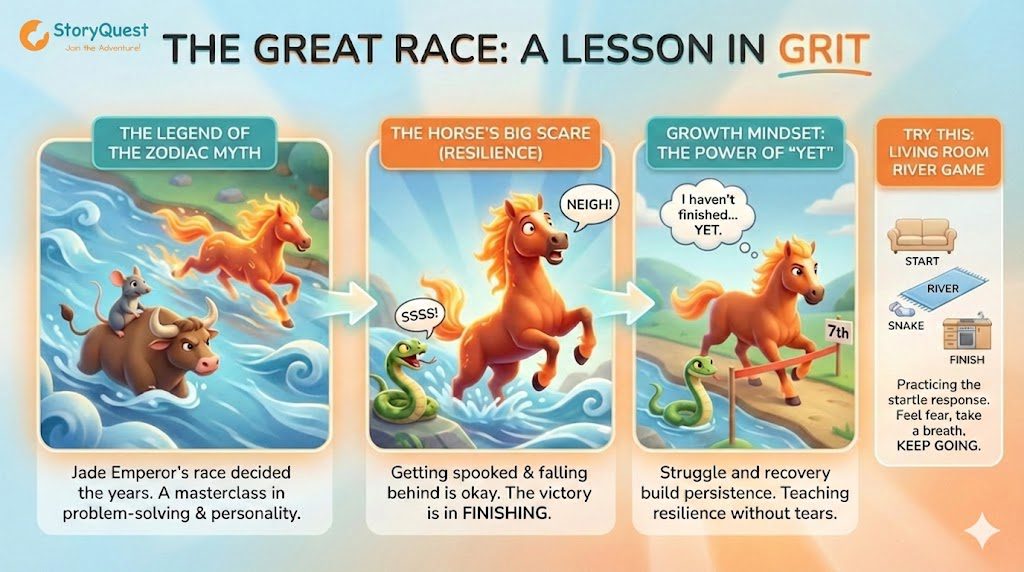
In the story, the Jade Emperor invited all the animals to race across a wild, rushing river. The order they arrived would decide the order of the calendar years.
- The Rat was smart (he rode on the Ox).
- The Ox was hardworking (he just kept swimming).
- But the Horse? The Horse teaches us the most important lesson of all.
The Storytelling Angle: The Horse’s Big Scare 😱
When you tell this story to your kids tonight, don’t just list the animals. Focus on the drama of the Horse.
Here is the script: “The Horse was swimming so fast! He was strong and brave. He was about to finish the race! But suddenly—SSSS!—a Snake popped out from behind his hoof!”
“The Horse was so scared he reared back and neighed! He lost his place. The Snake slithered ahead.”
The Teaching Moment: Most kids think if they get scared or make a mistake, they have “failed.” But the Horse didn’t quit. He took a deep breath, got back in the water, and finished the race (coming in 7th).
This is a perfect metaphor for Resilience (Rèn xìng 韧性). It’s okay to get spooked. It’s okay to fall back. The victory isn’t in coming first; it’s in finishing the swim.
👉 Read more: The “Fire Horse” Energy: Channeling Your Child’s Wild Side into Creativity
The Science Corner (Nerdy but Cool) 🤓
This connects to Growth Mindset.
When children hear stories about characters who struggle and recover (rather than characters who are just “perfectly fast”), they are more likely to persist in their own challenges.
- The Concept: It’s called “The Power of Yet.” The Horse didn’t say, “I can’t win.” He said, “I haven’t finished… yet.”
- The Link: Winning the “Meltdown Match”: Teaching Resilience Without the Tears
Try This Today: The “Living Room River” 🌊
Turn your floor into the Jade Emperor’s river.
The Setup:
- The River: The rug is the rushing water.
- The Banks: The sofa is the starting line; the kitchen is the finish line.
- The Snake: Put a pair of rolled-up socks (the “Snake”) hidden somewhere on the path.
The Mission: Tell your child: “You are the Fire Horse! You have to cross the river. But watch out for snakes! If you see one, you have to jump back, take a deep breath, and KEEP GOING.”
Why it works: You are practicing the Startle Response. You are training their body to feel fear (“Ah! A snake!”) and then immediately switch back to action (“I can keep going”).
How StoryQuest Helps
In StoryQuest, we love myths and legends because they are ancient codes for human behavior.
Our stories often feature heroes who get scared. We don’t edit out the fear. We ask the child: “Oh no! The hero is trembling! What should they say to make themselves brave?”
By practicing bravery in a story, they are rehearsing it for real life.
👉 Read more: And the SAG Award Goes To… Your Toddler? (Why Drama is Good for the Brain)
Questions Parents Ask (FAQ)
Q: My child gets upset if they don’t win the race. What do I do? A: Remind them of the Zodiac! “The Dragon could fly, but he stopped to make rain for the people, so he came in 5th. Being kind is better than being first.”
Q: How do I say “Year of the Horse” in Mandarin? A: It’s Mǎ nián (马年). Mǎ means Horse, and Nián means Year.
Q: Is the snake the “bad guy”? A: No! In Chinese culture, the Snake (Shé 蛇) is wise and clever. He just used a different strategy. This teaches kids that people solve problems in different ways.








Leave a comment