


By The StoryQuest Team | Reading Time: 4 Minutes
KEY TAKEAWAYS
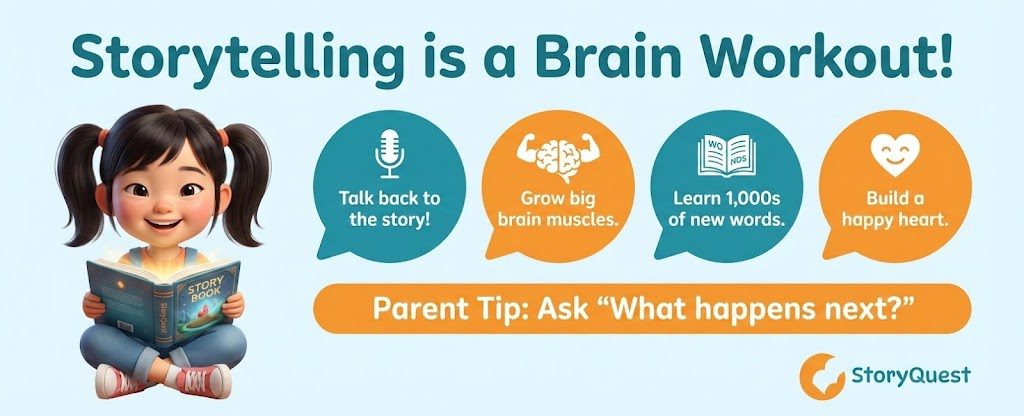
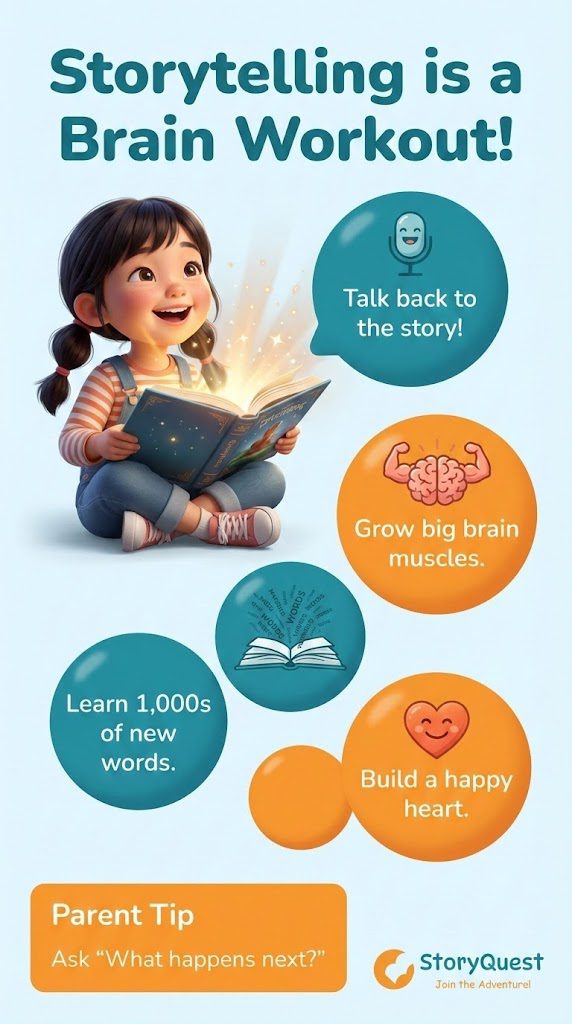
- It’s not rude, it’s research: When kids interrupt a story to talk, their brains are building massive connections.
- The Tennis Match: Science calls this “Serve and Return,” and it’s the #1 workout for a developing mind.
- Passive is Passé: Listening quietly is okay, but interacting is where the magic happens.
- Try This: Turn your next bedtime story into a “chat-time” story.
Hey there, Super Parent (and you too, Teacher Tina)! 👋
We know the feeling. You’ve had a long day. You just want to finish the bedtime book, turn off the lights, and maybe—just maybe—eat a cookie in peace. 🍪
But then, it happens.
You’re reading, “The dragon flew over the castle…” And your little one shouts, “BUT WHY IS THE DRAGON GREEN? DOES HE EAT BROCCOLI?!”
It’s tempting to say, “Shhh, let me finish the page.”
But what if we told you that interruption is actually pure gold? 🏆
Science has a fancy name for it: Serve and Return. And it turns out, it’s the secret sauce to building a smarter, happier, and more creative brain.
What is “Serve and Return”? (Think Tennis! 🎾)
Imagine a game of tennis.
- The Serve: Your child does something (babbles, points at a picture, asks a question).
- The Return: You notice it and reply back (nod, smile, answer the question).
That back-and-forth volley? That is how brain architecture is built. Literally.
According to the brilliant folks at the Harvard Center on the Developing Child, these interactions are like the bricks and mortar of a healthy brain. When a child “serves” a question and you “return” with interest, neural connections fire up like fireworks. 🎆
If you ignore the serve? The ball drops. The connection creates a “dead end.”
The Science: Why “Chatting” Beats “Listening”
We often think a “good” child sits still and listens. But research shows that a noisy storytime is often a better one.
1. It Builds “Brain Wiring”
When you pause the story to talk about that broccoli-eating dragon, you aren’t just wasting time. You are building executive function (the brain’s air traffic control tower).
The Science: Check out this foundational research from Harvard explaining how Serve and Return interactions shape brain circuitry.
2. It Supercharges Vocabulary
Passive listening is like watching a cooking show. Active storytelling (Serve and Return) is like actually cooking the meal. Children learn words faster when they have to use them to explain their ideas.
The Science: Research published in Psychological Science shows that “Dialogic Reading” (talking about the book) significantly boosts language skills compared to just reading the text.
Read the abstract here.
3. It Wakes Up the Brain
Recent studies using brain scans show that there is a “Goldilocks” zone for stories. Audio alone is hard to visualize. Video alone is too passive (the brain goes into zombie mode). But interactive storytelling? That’s just right. It lights up the parts of the brain responsible for visual imagery and understanding.
The Science: A study in PLOS ONE highlights how different storytelling formats impact brain connectivity. See the study here.
How to Master the “Serve and Return” (Without Going Crazy)
Okay, so you’re ready to try it. Does this mean bedtime takes 3 hours? No! (We promise).
Here is how you can use StoryQuest techniques at home tonight:
1. The “Pause and Point”
Don’t rush to turn the page. Pause. Point at a character. You: “Look at that face. How do you think she is feeling?” Child: “She looks grumpy!” You: “Totally grumpy. Maybe she needs a nap?” (Boom! You just did a Serve and Return.)
2. The “What If” Remix
This is our favorite at StoryQuest. Change the story! You: “The book says the pig built a house of straw. What would YOU build a house out of?” Child: “Marshmallows!” You: “Marshmallows? That would be sticky! Who would try to eat it?”
3. Let Them Be the Boss
If your child interrupts, roll with it. Child: “I see a bug!” You: “Oh wow, a bug! Is it a friendly bug or a spy bug?”
The StoryQuest Difference 🚀
We know parents are busy. Sometimes you don’t have the energy to come up with all these cool questions.
That’s why we built StoryQuest.
We don’t just “tell” stories. We create Serve and Return adventures. Our stories pause, ask your child questions, and let them decide what happens next. We turn screen time into active brain time.
So, next time your little one interrupts you to ask about the dragon’s diet? Give yourself a high five. 👋 You aren’t being interrupted. You’re building a genius.
Ready to play?
Start your StoryQuest adventure today!
FAQ: Quick Answers for Curious Parents
Q: Does this work for toddlers? A: Yes! Even before they can talk, “Serve and Return” works with pointing, cooing, and facial expressions.
Q: Is it okay to just read the book normally sometimes? A: Absolutely. Sometimes we just want to cuddle and listen. Balance is key!
Q: How does this help with school? A: “Serve and Return” builds Executive Function (focus, working memory), which are the exact skills needed to succeed in a classroom.
Tags: #ChildDevelopment #ServeAndReturn #StoryQuest #ParentingHacks #EarlyLiteracy #BrainScience #InteractiveStorytellin








Leave a comment