



Key Takeaways
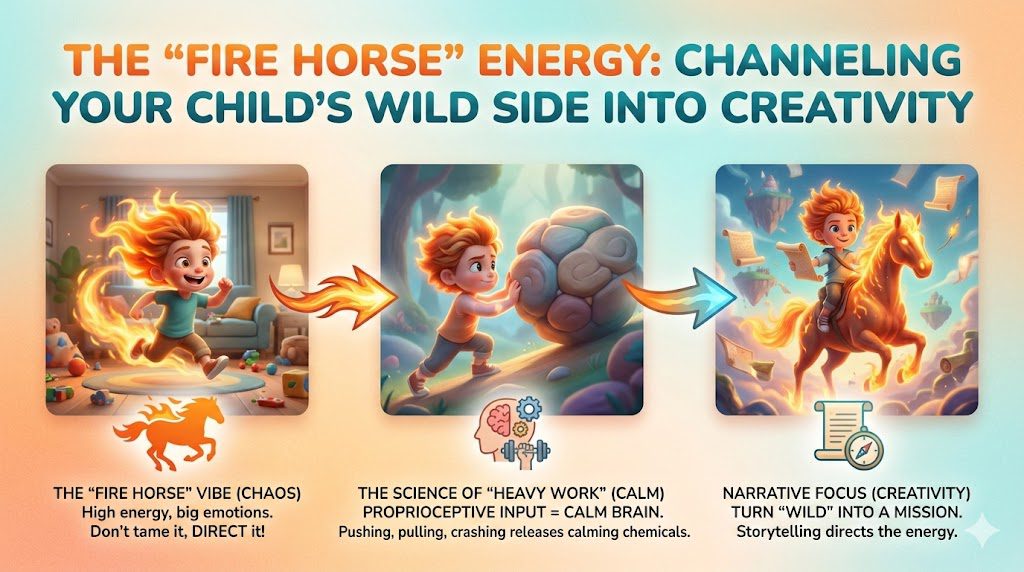
- The “Fire Horse” Vibe: 2026 is a year of high energy and big emotions. Instead of fighting it, use it!
- Heavy Work = Calm Brain: Why “galloping” and “crashing” actually helps kids settle down (Science Alert!).
- Narrative Focus: How to turn “wild behavior” into a focused mission using storytelling.
Is Your Child Galloping? (It’s Not Just Sugar!) 🐎🔥
Happy Lunar New Year! 🧧 Today (Feb 17, 2026) marks the start of the Year of the Fire Horse.
If you aren’t up on your zodiac lore, let me fill you in: The Fire Horse is the most energetic, rebellious, and free-spirited sign of them all. It represents action, adventure, and—let’s be honest—a little bit of chaos.
Does your child feel like a galloping pony lately? Are they bouncing off the walls, making loud noises, and refusing to sit still?
Take a deep breath. It’s not just the sugar from the Valentine’s candy. It’s the vibe of the year! But here is the secret: You don’t need to “tame” this energy. You just need to give it a direction to run.
👉 Read more: Why the “Great Race” is the Ultimate Lesson in Grit (and How to Tell It)
The Science Corner (Nerdy but Cool) 🤓
You might be tempted to say, “Sit still!” But for a high-energy child, sitting still is physically painful. What they actually need is Proprioceptive Input (often called “Heavy Work”).
- The Science: Proprioception is the body’s ability to know where it is in space. High-energy kids often crave resistance—pushing, pulling, jumping, and crashing. This sensory input releases calming chemicals (serotonin/dopamine) in the brain.
- The Reality: When they are “wild,” their body is actually screaming, “I need to feel my muscles working so I can calm down!”
- The Link: Sensory Processing and the Brain: A Guide for Parents
So, instead of a “Time Out” (sitting), try a “Time In” (moving with purpose).
Why This Helps Every Kid
For the “Wild Child”: They aren’t being “naughty”; they are under-stimulated. Channeling that physical energy into a story gives their brain the dopamine hit it craves, but in a controlled way.
For the “Daydreamer”: Even quiet kids have “Fire Horse” moments! Connecting movement to imagination helps them “wake up” their body and focus better on tasks later. 👉 Read more: The Backyard Safari: Transforming a Boring Walk into an Epic Quest
Try This Today: The “Galloping Story” 🐎
Don’t fight the gallop. Use it.
The Setup: Tell your child, “You are a Fire Horse. You have a secret message for the Dragon King. But the path is tricky!”
The Game:
- “Open Field!” -> They must gallop as fast as they can (burns energy).
- “Muddy Swamp!” -> They must stomp heavily in slow motion (heavy work/calming).
- “Sleeping Giant!” -> They must tiptoe silently (emotional regulation/control).
Why it works: You are alternating between High Arousal (galloping) and Inhibition (tiptoeing). This is the gold standard for teaching self-regulation.
How StoryQuest Helps
StoryQuest isn’t just about sitting and listening. We have an entire genre of Adventure Stories designed to get kids moving.
In our stories, the narrator might say: “Quick! The bridge is collapsing! Run to the other side of the room!” or “Push the heavy rock out of the way!” (Have them push against a wall).
We use the story to provide the “Heavy Work” their body needs, so by the time the story ends, their body is regulated, and they are ready to relax.
👉 Read more: Winning the “Meltdown Match”: Teaching Resilience Without the Tears
Questions Parents Ask (FAQ)
Q: My child gets TOO wild when we play rough. How do I stop it? A: Use a “Stop Signal.” In the story, make it part of the game. “When the wizard freezes time, you must freeze!” Practice freezing before they get too dysregulated.
Q: Is “Heavy Work” good before bed? A: Yes! Paradoxically, pushing/pulling (like a pillow fight where they are squished under pillows) is very grounding and can help them sleep better than just watching TV.
Q: What if they don’t want to be a horse? A: Be a Rocket Ship. Be a Cheetah. Be a runaway Train. The “skin” of the story doesn’t matter; the movement does.




Leave a comment