



Key Takeaways
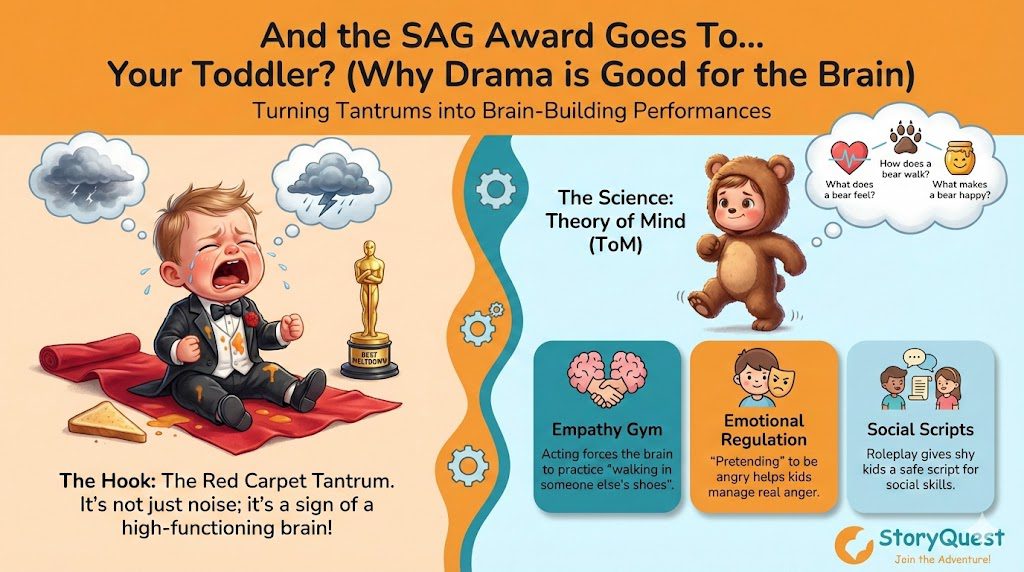
- Empathy Gym: Acting out a character forces the brain to practice “walking in someone else’s shoes.”
- Emotional Regulation: “Pretending” to be angry helps kids learn how to manage real anger.
- Social Scripts: Roleplay gives shy kids a safe script to practice social skills.
The Red Carpet Tantrum
Everyone is buzzing about the SAG Awards 2026 and the new show Suits LA. The outfits! The drama! The speeches! It’s all very exciting.
But let’s be honest — the most dramatic performance you’ve seen this week wasn’t on TV. It was your 4-year-old realizing you cut their toast into triangles instead of squares. 🍞🎭
If there was an award for “Best Meltdown in a Grocery Aisle,” we’d all be winners. But here’s the twist: That drama? It’s actually a sign of a high-functioning brain.
We often think of “drama” as a bad thing (especially when it’s happening at 7 AM on a Tuesday), but dramatic play is actually one of the most sophisticated things a human brain can do.
The Science Corner (Nerdy but Cool) 🤓
It’s called Theory of Mind (ToM).
This is the ability to attribute mental states — beliefs, intents, desires, emotions—to oneself and to others. It’s the realization that your thoughts are different from my thoughts.
- The Study: Research from the Journal of Experimental Child Psychology shows that children who engage in active role-play develop ToM (the ability to understand others’ thoughts) faster than those who don’t.
- The Link: The relations between role play and children’s theory of mind
When a child pretends to be a grumpy bear, they aren’t just making noise. They are running a complex simulation: “What does a bear feel? How does a bear walk? What would make a bear happy?” This is the gym where empathy is built.
Why This Helps Every Kid
Roleplay isn’t just for the theater kids. It’s a crucial developmental tool for every personality type.
For the “Drama Queen/King”: If you have a child with BIG feelings, roleplay is their release valve. Channel that energy! Acting out stories gives them a stage for their emotions so they don’t have to explode at the dinner table. It turns “acting out” (bad) into “acting” (good). 👉 Read more: How to Calm a Child During a Meltdown in 90 Seconds (Research-Backed)
For the “Wallflower”: For the shy child, roleplay is what psychologists call a “Safe Danger.” They might be terrified to speak up in class, but they can roar like a lion in a game. It allows them to practice being brave, loud, and assertive in a world where the consequences aren’t real. 👉 Read more: The “Safe Danger” Paradox: Why Your Shy Kid Needs to Fight a Dragon Tonight
Try This Today: The “Emotion Charades”
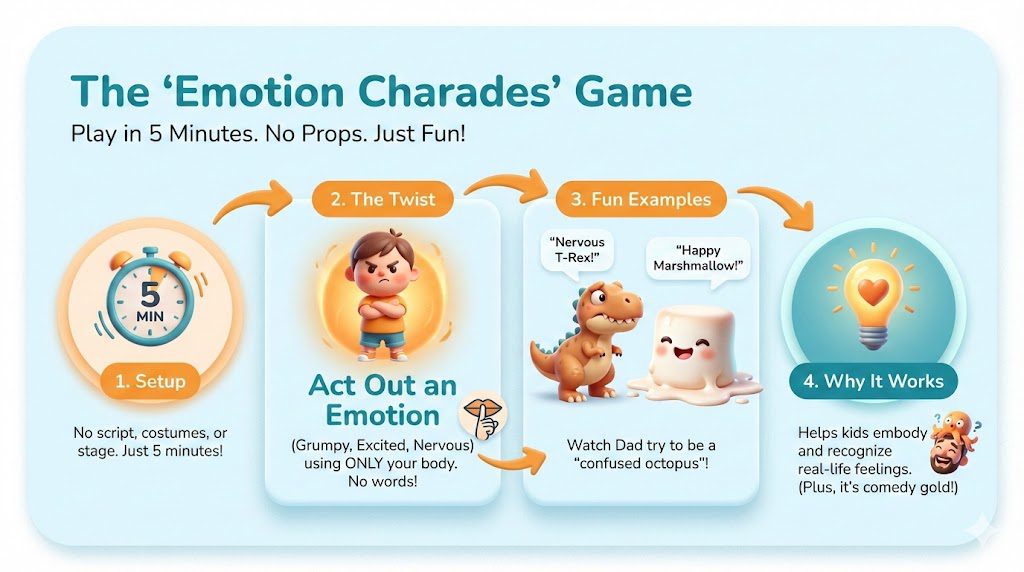
You don’t need a script, costumes, or a stage. You just need 5 minutes.
The Game: Pick an emotion (Grumpy, Excited, Nervous, Confused). The Twist: You have to act it out using ONLY your body — no words!
- “Show me a nervous T-Rex!” (Watch them hunch their shoulders and look around)
- “Show me a happy marshmallow!” (Watch them melt and smile)
Why it works: It forces the child to physically embody an emotion, which helps them recognize that feeling when it happens in real life. Plus, watching Dad try to be a “confused octopus” is comedy gold.
How StoryQuest Helps
StoryQuest isn’t just a passive story—it’s an interactive roleplay engine.
In our stories, we ask kids to become the character. The narrator might say: “Captain, use your brave voice to scare the goblin!” or “The fairy is sad. What should we say to cheer her up?”
It’s acting class, therapy, and a bedtime story all rolled into one. We give them the script, so they can practice the skills.
Questions Parents Ask (FAQ)
Q: My kid lies sometimes. Is that just ‘storytelling’? A: Up to a certain age (usually around 6 or 7), yes! It’s them testing the boundaries of reality. They aren’t trying to deceive you; they are trying to see if their words can change the world. Guide it (“That sounds like a fun story!”), don’t punish it.
Q: Is roleplay good for kids with Autism? A: Absolutely. It helps practice social scripts in a predictable, low-stakes environment. Many children with ASD struggle with the unpredictability of real conversations. Roleplay gives them a “rehearsal” where they can learn the rules of social interaction safely.
Q: How do I join in if I’m not an actor? A: Just be silly. Kids love it when parents look ridiculous. It gives them permission to play. You don’t need to be Meryl Streep; you just need to be present.






Leave a comment