



Key Takeaways
- The AI Shift: Tech giants are building the hardware, but humans need to build the ideas.
- Soft Skills > Hard Code: Creativity is the one skill AI can’t replicate (yet).
- The “Human” Edge: Storytelling builds the empathy and communication skills future CEOs need.
The Hook: The Tech Panic
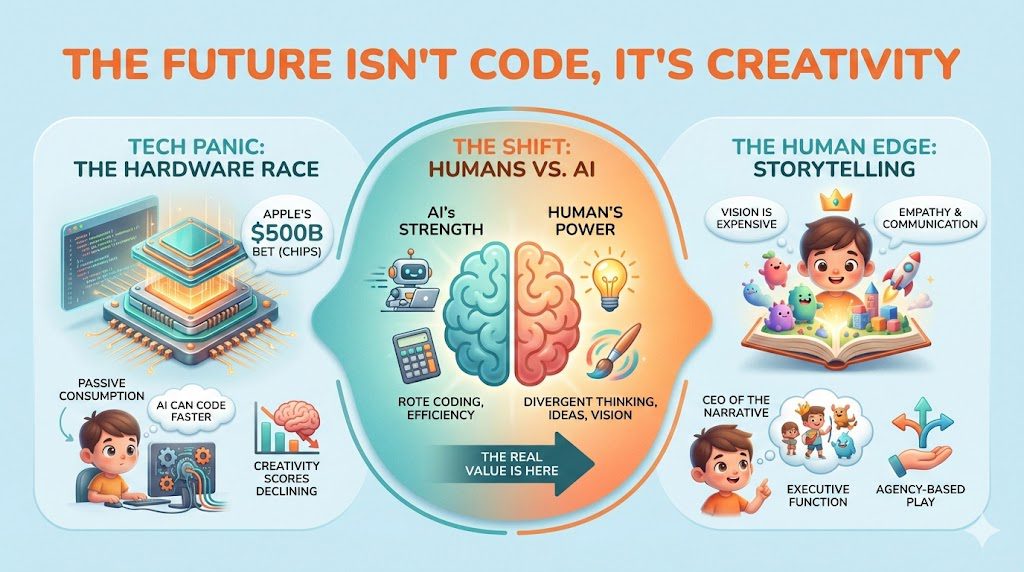
Did you see the news? Apple just announced a massive $500 billion investment strategy, and NVDA (Nvidia) is basically powering the entire planet right now. It feels like if our kids aren’t learning to code in Python by age 4, they’re going to be left behind, right?
Take a deep breath. 😮💨
It is easy to panic when we see these numbers. We feel this pressure to turn our toddlers into mini-engineers. But while the world rushes to build faster chips, the smartest experts are actually saying the opposite.
In a world where AI can write code in seconds, the most valuable employees won’t be the ones who can type syntax — it’ll be the ones who can dream up the story.
The future isn’t just about building the technology; it’s about directing it. And that requires a specific type of brain power that schools often forget to teach.
The Science Corner (Nerdy but Cool) 🤓
It’s called Divergent Thinking.
This is the ability to generate multiple unique solutions to a single problem. It’s not “What is 2+2?” (Convergent Thinking). It’s “How many ways can you use a brick?”
- The Bad News: Research shows that while IQ scores have risen over the decades, creativity scores (measured by the Torrance Tests) have actually been dropping since the 90s. We are raising efficient processors, not creative dreamers.
- The Study: A landmark analysis of 300,000 scores showed a significant decline in creative thinking, specifically in “elaboration” and “originality.”
- The Link: The Creativity Crisis: The Decrease in Creative Thinking Scores
If we focus only on “hard skills” (like rote coding or memorization), we risk raising kids who can follow instructions perfectly… for a machine that can already follow them faster.
Why This Helps Every Kid
This isn’t just about future jobs; it’s about how your child’s brain is wiring right now.
For the “Tech Whiz”: If your kid loves screens, that’s great! But we need to be careful. There is a huge difference between creating a game and consuming a video about a game. If they spend hours passively watching, they might be falling into a common trap where their brain expects constant entertainment without effort. 👉 Read more: The Dopamine Trap: How “Educational” YouTube is Stealthily Short-Circuiting Your Kid’s Grit
For the “Dreamer” (or the Distracted): Does your child have a million ideas but struggles to finish one? That’s actually a sign of high creative potential! The challenge isn’t that they aren’t smart; it’s that their brain is flooding with so many possibilities that they get stuck. 👉 Read more: The Bottleneck Effect: Why Your ADHD Child Has Big Ideas but a Blank Page
The “Human” Edge: Storytelling as Leadership
Here is the secret that Apple executives know: Code is cheap. Vision is expensive.
The ability to tell a story — to explain why something matters, to build a world, to empathize with a character — is the foundation of leadership.
When a child engages in Agency-Based Play (where they make choices in a story), they are practicing Executive Function. They are learning to be the “CEO” of their own narrative. This is the exact skill set that separates the people who program the AI from the people who manage the AI. 👉 Read more: The “Choose Your Own Adventure” Brain: Why Giving Your Kid the Remote Control Builds CEOs
Try This Today: The “Invention Game”
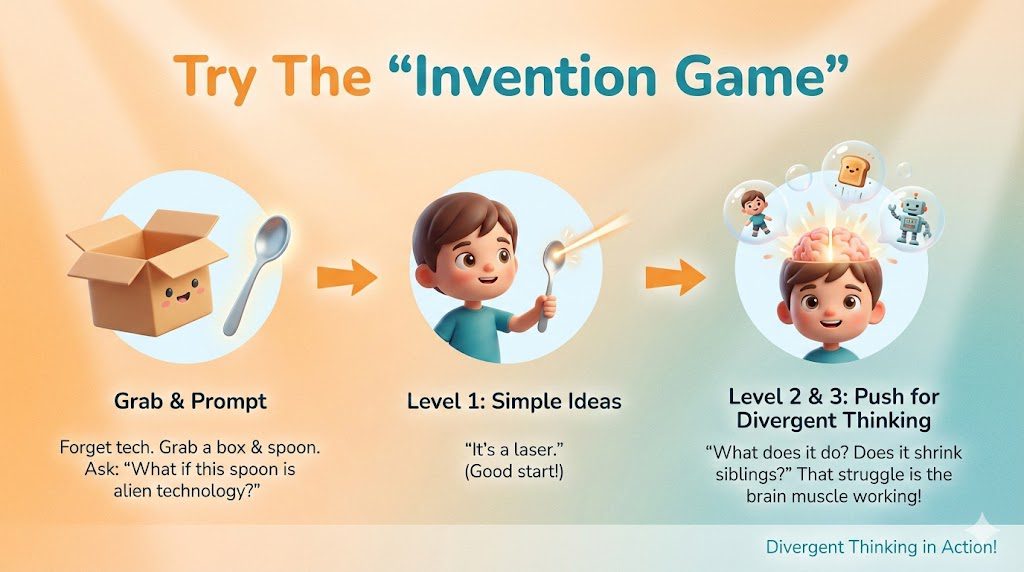
Forget the iPad for 10 minutes. Grab a cardboard box and a kitchen spoon.
The Prompt: “This isn’t a spoon. It’s a piece of alien technology that Apple hasn’t invented yet. What does it do?”
- Level 1: They might say “It’s a laser.” (Good!)
- Level 2: Push them. “What does the laser do? Does it toast bread instantly? Does it shrink your little brother?”
- Level 3: Watch their brain struggle, then EXPLODE with ideas. That struggle? That is the money muscle working. That is Divergent Thinking in action.
How StoryQuest Helps
StoryQuest isn’t just an app; it’s a Creativity Gym.
Our AI narrator doesn’t just tell stories; it stops and asks your child to solve problems. “The bridge is broken! The goblin is angry! How do we cross?”
We don’t give them the answer. We force them to generate the solution. We build the creative confidence that future tech leaders need, all while they think they’re just playing a game about dragons.
Questions Parents Ask (FAQ)
Q: Should I stop teaching my kid coding? A: No! Coding is a great language to learn, just like Spanish or Music. But balance it. Coding is the vocabulary; creativity is the essay. You need both to be successful.
Q: My kid just wants to watch YouTube. How do I switch them? A: Start small. Use the “1-to-1 Rule.” For every hour of watching, they need 15 minutes of creating. You can use audio stories to bridge the gap because it forces them to visualize the world rather than just staring at it.
Q: Is storytelling really a “job skill”? A: Ask any CEO. The ability to sell a vision, communicate a complex idea simply, and understand human emotion is the #1 trait of leadership. Apple didn’t succeed just because they had good code; they succeeded because they told a better story.






Leave a comment