


Key Takeaways
- The Safe Sandbox: AI characters act as “Safe Avatars,” allowing children to practice social interactions without the devastating fear of judgment or rejection.
- Neural Rehearsal: “Social Rehearsal” helps kids build the scripts they need for real-life conversations, bridging the gap between The “20-Minute Monologue” and true connection.
- The Empathy Engine: Engaging with fictional characters develops “Theory of Mind”—the ability to understand that other people have different feelings and perspectives.
The Playground “Ghost”
We’ve all been there. You’re at the park, and there’s a group of kids playing a high-octane game of tag. Your little one stands three feet away, clutching their sleeve, looking like they want to join in but have absolutely no idea how to “download” the rules of the group. It feels catastrophic to watch them hover on the edge of the fun, a silent observer in a world of loud laughter.
Or maybe your child is the “Social Steamroller”—the one who jumps in, starts a monologue, and wonders why the other kids slowly drift away. Whether they are too quiet or too intense, the result is the same: a silent trap of social isolation. You want to help, but you can’t exactly “play social director” without making it weird.
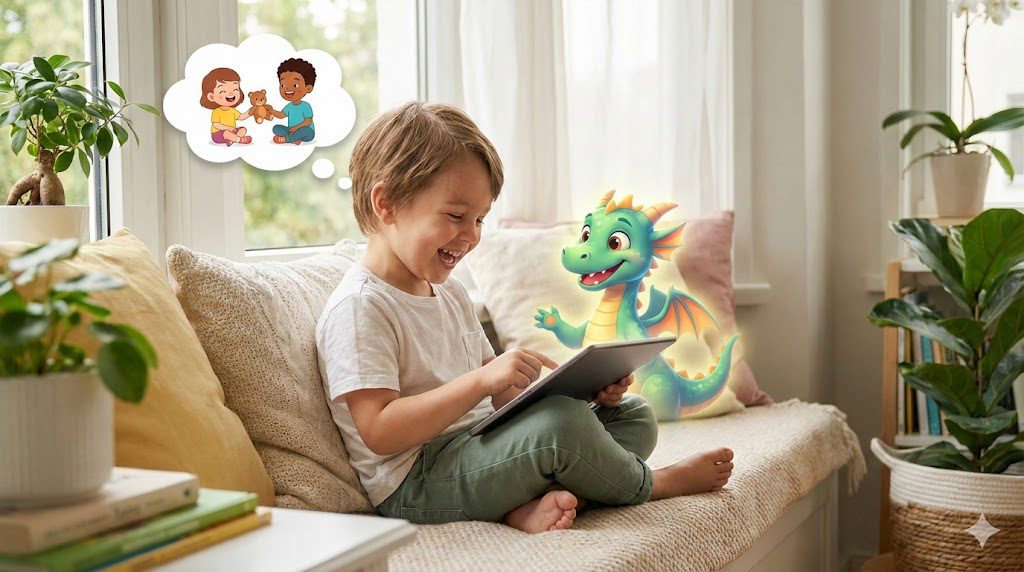
This is where the Invisible Playdate comes in. It’s the secret training ground where your kid can practice being a social rockstar—with a dragon instead of a judgmental third-grader.
The “Safe Avatar” Secret
Think of an AI character as a “Social Flight Simulator.” When a child interacts with a character in a story, they are engaging in Social Rehearsal.
In the real world, social stakes are high. If you say the wrong thing to a peer, they might laugh or walk away. But if you say the wrong thing to a digital pirate? The story just waits. There is no shame, only practice. By using these “Safe Avatars,” we help children move out of The Dopamine Trap of passive watching and into active social participation. They learn how to serve and return a conversation in a low-pressure environment where the “Return” is always gentle.
Actionable Strategy: The “Empathy Interview”
You don’t need a playground to skyrocket your child’s social confidence. You can do it at the dinner table tonight with this simple game.
The Game: Find a “Grumpy” character in any story (or make one up).
- The Setup: “Oh no, the Space Dragon looks super grumpy today. He’s blocking the entrance to the moon base.”
- The Mission: Tell your child: “We can’t just blast him. We have to do an Empathy Interview to find out why he’s upset.”
- The Prompts: Ask your child:
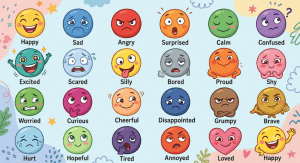
- “What does his face look like? (Is he sad-grumpy or mad-grumpy?)”
- “What is one question we can ask to see how he feels?”
- “If he’s hungry, what’s his favorite snack?”
This forces your child to step out of their own head and into the mind of another. It turns a “social obstacle” into a creative puzzle they can solve.
The StoryQuest Solution
We built StoryQuest to be the ultimate “Invisible Playdate.” Our AI narrators don’t just tell a story; they ask for input and model the 3-Second Rule of patience. Whether your child is building the courage to use their voice or learning to listen, StoryQuest provides the “Safe Danger” they need to grow. We turn the screen from a “Solo Silo” into a collaborative adventure where social skills are the “superpowers” that win the day.
The Science Corner ☕
So, why does talking to a pretend dragon actually work? It’s all about Theory of Mind (ToM). This is the brain’s ability to realize that other people have different thoughts than I do. It’s a miracle of human development, but it takes practice!
The Evidence:
- ToM and Narrative: Research shows that engaging in narrative storytelling is a primary way children develop ToM (see APA on Developmental Psychology).
- Social Rehearsal: Clinical studies suggest that “socially anxious” children benefit from behavioral rehearsal in low-stress environments (NCBI/PubMed Study on Social Anxiety).
People Also Ask (FAQ)
- Q: Can a screen really teach my child social skills?
- A: If it’s passive (YouTube), no. If it’s active (StoryQuest), yes! It requires your child to respond, take turns, and consider the feelings of characters.
- Q: My child has ASD; is this “Safe Avatar” play helpful?
- A: Absolutely. It reduces the “social demand” and allows them to focus on the mechanics of conversation without the anxiety of a real peer interaction.
- Q: How do I know if they are learning empathy?
- A: Listen for when they start describing why a character is doing something (“He’s scared because it’s dark”). That’s the “Aha!” moment!






Leave a comment