


Key Takeaways
- The “Creativity Crisis”: Scores on creative thinking tests have dropped by 30% in 20 years.
- Your Brain on Screens: Passive watching is linked to “Cortical Thinning” (a fancy word for less brainpower).
- The Fix is “Mental Imagery”: Audio storytelling forces the brain to build the world itself, acting as a “gym” for the visual cortex.
The Hook: The “iPad Panic” Test
Let’s play a dangerous game. It’s called the “iPad Panic” Test.
Picture this: It’s Tuesday. You are exhausted. Your child is deep in the trance of a YouTube algorithm hole (we’ve all been there, no judgment). You walk over and—gently—take the device away.
What happens next?
Scenario A: They shrug, grab a stick, and pretend it’s a laser sword. Scenario B: Complete. Nuclear. Meltdown. Followed by the terrified question: “But what do I DO now?”
If the answer is B, your child isn’t just bored. Their imagination muscle might be atrophying.
I know, “atrophying” is a scary word. It sounds medical. But here is the thing: Imagination isn’t just a cute trait for artists. It’s a neurological muscle. And right now, we are letting Netflix do all the lifting.
The Science: Why “Passive” is the Enemy (Not Screens)
Okay, grab your coffee. We’re going to get a little nerdy—but in a fun, “I’m the smartest person at brunch” kind of way.
Not all screen time is created equal. The American Academy of Pediatrics (AAP) distinguishes between Active and Passive media.
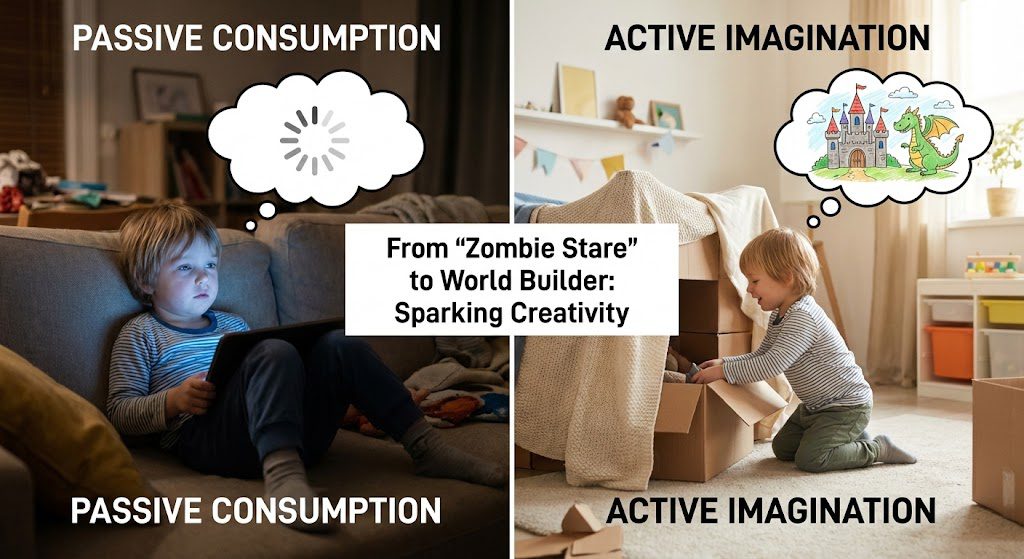
Passive Media (YouTube, TV) provides everything: the sound, the dialogue, and crucially, the visuals. The brain is in “receiving mode.” It’s lounging on a cognitive sofa. Active Play (Building, Storytelling) forces the brain into “generating mode.”
Here is the scary part: A study in JAMA Pediatrics found that higher screen use in young children was associated with lower microstructural integrity of brain white matter tracts. Essentially, the “cables” in the brain that support language and literacy were less developed [1].
Even worse? We are in a “Creativity Crisis.” Scores on the Torrance Tests of Creative Thinking (the gold standard for measuring creativity) have significantly decreased since the 1990s [2].
Why? Because when a screen shows you exactly what the dragon looks like, your Visual Cortex doesn’t have to work. It gets lazy. It’s like taking an Uber to the gym and wondering why you aren’t getting fit.
The Dual-Benefit: From Consumer to Creator
We need to flip the script. We need to turn our kids from “Content Consumers” into “World Builders.” Here is why that matters for your specific kid.
1. For the “Vitamin” Parent (The Future Leader)
You want your child to be the CEO, the inventor, the artist.
- The Win: Leaders are people who can visualize a future that doesn’t exist yet. By removing the screen and using audio/storytelling, you force their brain to practice Mental Imagery. This is the cognitive protein shake for innovation.
- Need ideas? Check out: Screen-Free Saturdays: Fun and Engaging Alternatives
2. For the “Painkiller” Parent (Speech Delay & Neurodiversity)
If your child has a speech delay or ADHD, passive screens are a trap.
- The Win: When a child watches a cartoon, the image is supplied. They don’t need language to understand it. But when they listen to a story, they have to “retrieve” the image in their mind.
- The Bridge: This bridges the gap between Receptive Language (understanding) and Expressive Language (speaking). They have to create the dragon in their head, which primes them to describe it.
- Struggling with focus? Read this: The Bottleneck Effect: Why Your ADHD Child Has Big Ideas but a Blank Page
Actionable Strategy: The “Visual Gap” Game
You don’t need to throw out the TV (I mean, let’s be reasonable, we need showers). You just need to create a Visual Gap.
The Strategy:
- The Cliffhanger: Read a book or listen to an audio story (no pictures!).
- The Pause: Stop right at the cool part. “The monster stepped out of the cave…”
- The Challenge: Ask, “Wait, don’t tell me… what does he look like? Does he have slimy skin or furry skin? Is he pink or neon green?”
- The Verification: If they struggle, give them options (scaffolding). “I think he has three eyes. What do you think?”
You are manually hot-wiring their Visual Cortex. You are forcing them to paint the picture.
The StoryQuest Solution: We Make the Movie in Their Head
We designed StoryQuest to be the antidote to the “Zombie Stare.”
We provide the Audio and the Adventure, but we deliberately leave out the Video.
- The Mechanic: Our AI narrator describes the world, but your child has to fill in the details. “We found a magic sword! But it looks weird… what is the handle made of?”
- The Result: Your child screams, “It’s made of marshmallows!”
- The Science: That moment? That’s Neuroplasticity [3]. That is their brain firing up new connections to visualize a marshmallow sword. They aren’t watching the fun; they are generating the fun.
It’s about 300% more engaging than a cartoon, and 0% as guilt-inducing.
- Deep dive: Why Kids Learn Best Through Stories
People Also Ask (FAQ)
Q: Is all screen time bad for creativity? A: No! “Co-viewing” (watching together) or “Creative Apps” (drawing, coding) are great. The enemy is passive consumption—the “Digital Pacifier” mode where the eyes glaze over. Research shows active engagement preserves cognitive function [4].
Q: My child has a speech delay. Should I cut screens entirely? A: Consult your SLP, but generally, reducing passive screen time correlates with better language outcomes. A 2023 study showed that higher screen time at age 1 was associated with developmental delays in communication at age 2 [5]. Audio storytelling is often a great middle ground—it builds vocabulary without the visual overstimulation.
Q: How long does it take to “detox” their imagination? A: Honestly? About 3 days of boredom. The first day is hell (sorry!). The second is whining. The third day? You’ll walk in and find them building a fortress out of sofa cushions. The brain wants to play; we just have to unclog it.
References (The Science Stuff)
- Hutton JS, et al. (2020). Associations Between Screen-Based Media Use and Brain White Matter Integrity in Preschool-Aged Children. JAMA Pediatrics. Link to Study
- Kim, K. H. (2011). The Creativity Crisis: The Decrease in Creative Thinking Scores on the Torrance Tests of Creative Thinking. Creativity Research Journal. Link to Study
- Draganski, B., et al. (2004). Neuroplasticity: Changes in grey matter induced by training. Nature. Link to Study
- American Academy of Pediatrics (2016). Media and Young Minds. Pediatrics. Link to Guidelines
- Takahashi, I., et al. (2023). Screen Time at Age 1 Year and Communication and Problem-Solving Developmental Delay at 2 and 4 Years. JAMA Pediatrics. Link to Study








Leave a comment