



Key Takeaways
- It’s Not Defiance, It’s Lag: Children’s brains process auditory signals 2–3x slower than adults.
- The “Traffic Jam”: Repeating a command before they process the first one crashes their cognitive browser.
- The Fix: The “3-Second Rule” mimics how AI teaches patience, transforming a chaotic morning into a calm one.
The Hook: The “Broken Record” Syndrome
Do you feel like a broken record?
You say, “Please put on your shoes.” Nothing. You say it louder: “Shoes. Now.” They look at the wall. You feel the heat rising in your chest. You think, Why are they so defiant? Why don’t they respect me?
But here is the insidious truth: They aren’t ignoring you. They are buffering.
If you are a “Vitamin” parent, this is annoying. If you are a “Painkiller” parent (ADHD/ASD), this is a daily battleground. But the culprit isn’t attitude. It’s biology.
The Science: The “Gap Effect” & The Cognitive Traffic Jam
Let’s get nerdy for a second (but keep it fun).
In neuroscience, there is a concept called Auditory Processing Latency. Think of your adult brain like a 5G Fiber Optic connection. You hear a request and process it in milliseconds.
Your child’s brain? It’s still on Dial-Up.
Research shows that young children (and especially neurodiverse children) can take 3 to 7 seconds to process an auditory instruction.
The “Traffic Jam” Scenario:
- You say: “Put on your shoes.” (File 1 starts downloading in their brain).
- 2 Seconds later, you say: “Did you hear me? Shoes!”
- CRASH. The second command interrupts the download of the first command.
By rushing them, we inadvertently create a Cognitive Traffic Jam. We overload their working memory until their brain freezes (zoning out) or explodes (meltdown).
The Dual-Benefit: Why Slowing Down Speeds Things Up
We need to reframe “waiting” not as a passive act, but as an active strategy.
1. For the “Vitamin” Parent (The Leadership Goal)
You want a child who is thoughtful, not just obedient.
- The Win: When you pause, you teach them that their response matters. You are modeling Executive Function. You are building a leader who thinks before they speak, rather than a follower who just reacts to noise.
- Read more: Why Your Kid Interrupting You is Actually Genius
2. For the “Painkiller” Parent (The Regulation Goal)
For kids with ADHD, ASD, or Sensory Processing Disorder, the “Gap Effect” is massive.
- The Win: Rushing a neurodiverse brain triggers the Amygdala (fight or flight). By waiting, you bypass the anxiety response. You give them the grace to process the request without the shame of “being too slow.”
- Study Source: Executive Functions (Annual Review of Psychology)
Actionable Strategy: The “3-Second Rule”
Here is the micro-habit that will save your sanity tomorrow morning. It’s called Wait Time, popularized by researcher Mary Budd Rowe.
The Strategy:
- Give the instruction once. (“Please put on your coat.”)
- STOP.
- Count to 3 (slowly) in your head. One Mississippi… Two Mississippi… Three Mississippi…
- Only then, if they haven’t moved, do you make eye contact and repeat.
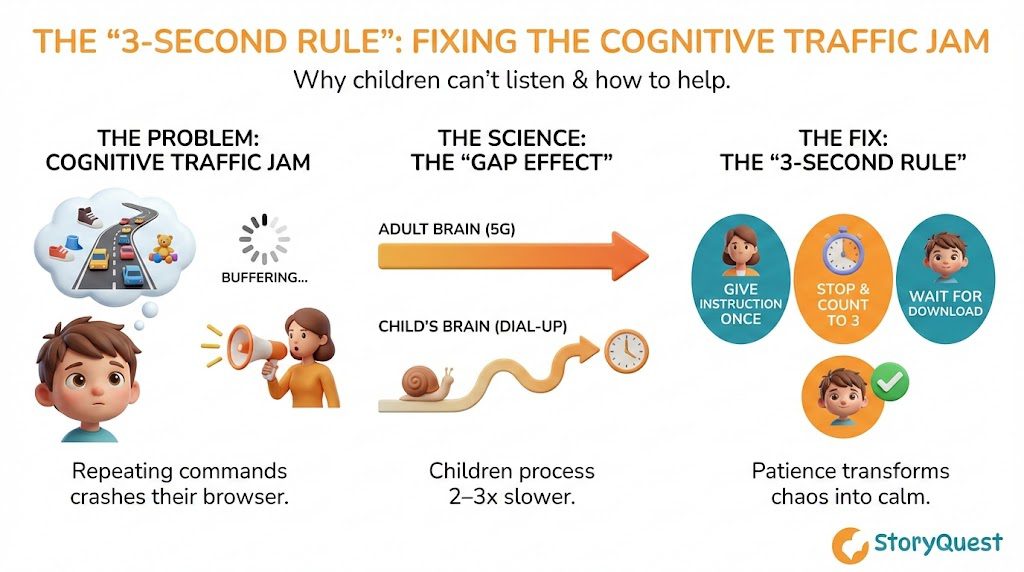
Why it works: Usually, around “Two Mississippi,” you will see their wheels turn and their body move. You gave the file time to download.
- Need another brain hack? The 10-Minute “Cheat Code” for Your Kid’s Brain
The StoryQuest Solution: The Infinite Pause Button
We built StoryQuest on the principle of Radical Patience.
In the real world, people get impatient. Teachers rush. Parents (understandably) snap. But our AI Narrator? It has infinite patience.
- The Mechanic: When the story asks, “Which path should we take?”, the app simply… waits. The music loops gently. There is no buzzer. No “Hurry up!”
- The Result: The child learns that they control the pace. This lowers cortisol (stress) and raises dopamine (reward) when they finally formulate their answer. It trains the brain that it is safe to take time to think.
People Also Ask (FAQ)
Q: Is my child ignoring me or do they have a hearing problem? A: Always rule out medical issues first! But if their hearing is fine, it is likely Auditory Processing Disorder (APD) or just normal developmental latency. If they can hear a candy wrapper open three rooms away but “can’t hear” you ask for chores, it’s processing/attention, not ears.
Q: Won’t waiting make them think I’m weak? A: No. Silence is power. Confident leaders are comfortable with silence. Nervous leaders fill the air with noise. Waiting shows you are in control and expect an answer, peacefully.
Q: How does this help with tantrums? A: Many tantrums are just “cognitive overload.” The brain crashes because too much input is coming in. By using the 3-Second Rule, you reduce the input, which often prevents the crash before it starts.
References:
- Rowe, M. B. (1986). Wait Time: Slowing Down May Be A Way of Speeding Up! Journal of Teacher Education.
- Diamond, A. (2013). Executive Functions. Annual Review of Psychology.
Check also:
The “Safe Danger” Paradox: Why Your Shy Kid Needs to Fight a Dragon (Tonight)
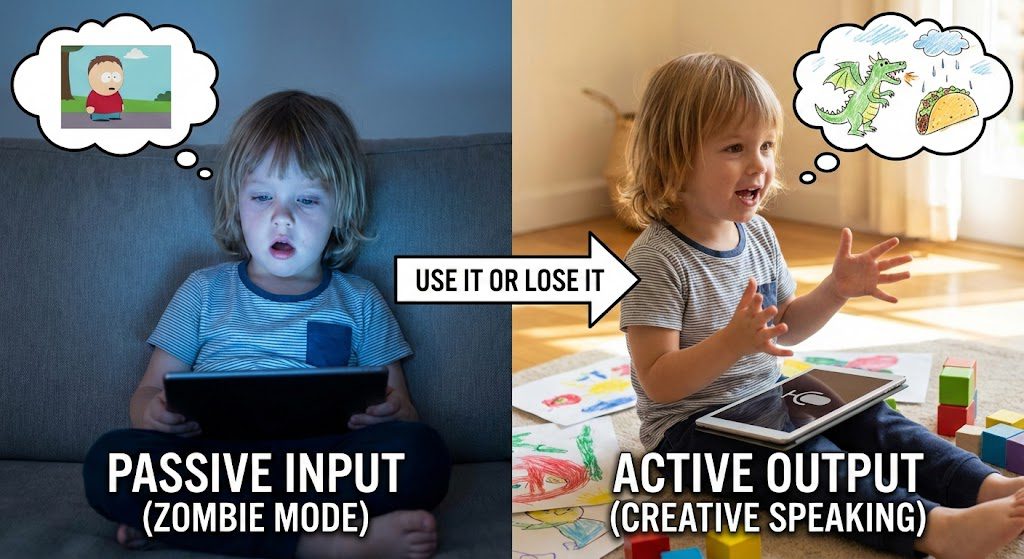
The “Use It or Lose It” Rule: Why Your Child’s Brain Needs to Output, Not Just Input









Leave a comment