


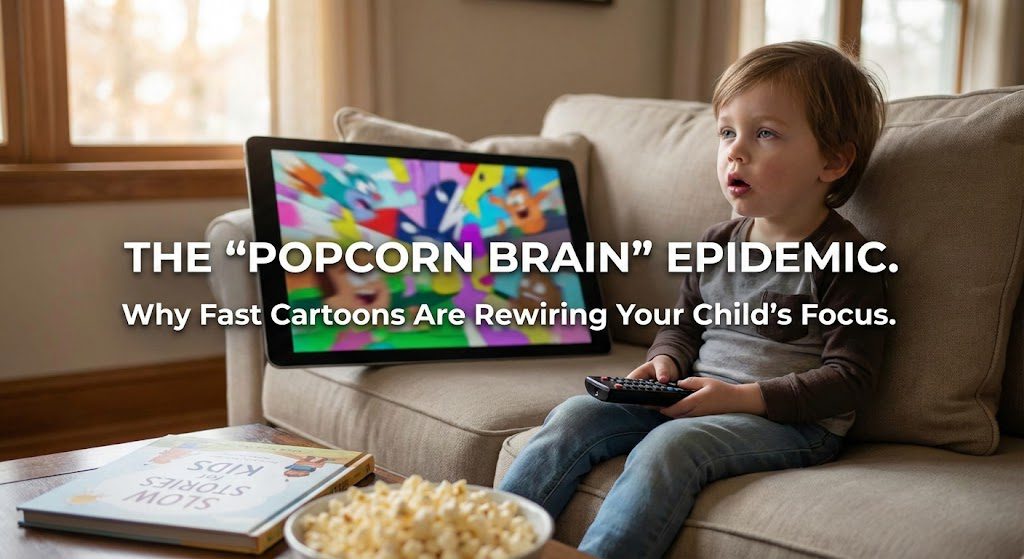
(And How to Fix It)
Key Takeaways
- The Glitch: Fast-paced media (editing cuts every 4 seconds) trains the brain to expect constant dopamine hits, leading to “Popcorn Brain.”
- The Science: Studies show that just 9 minutes of high-speed cartoons can immediately degrade a child’s executive function and focus.
- The Fix: You don’t need to ban screens—you need to slow them down. “Pacing” is the secret variable no one talks about.
The Hook: The Zombie Stare
You know the scene. You walk into the living room, and your child is… gone.
Their body is there, but their eyes are glazed over. Their mouth is slightly open. They are watching a show where the camera cuts, zooms, spins, and explodes every three seconds.
You say their name. Nothing. You wave your hand. Nothing. You turn the TV off. Absolute. Catastrophic. Meltdown.
It’s not just you, and your child isn’t “addicted” in the way you might think. They are suffering from a very modern neurological phenomenon that researchers at the University of Washington have coined Popcorn Brain.
And the scary part? It’s not about how much they watch. It’s about how fast they watch.
The Science (Simplified): Why the Brain Pops
Let’s get nerdy for a second (but, like, cool nerdy).
Your child’s brain is designed to process the world at a natural pace—the speed of a conversation, a walk in the park, or a story being told. But modern “fast-paced” media—think YouTube Shorts or certain high-octane cartoons—moves faster than reality.
The “9-Minute” Study: A famous study published in the journal Pediatrics took 4-year-olds and split them into groups. One group watched a fast-paced cartoon (scenes changing every 11 seconds). The other watched a slow-paced educational show.
The Result: After just 9 minutes, the kids who watched the fast cartoon showed significantly worse Executive Function. They struggled to solve problems, control their impulses, and delay gratification. (Source: The Immediate Impact of Different Types of Television on Young Children’s Executive Function, Lillard & Peterson)
The “Popcorn” Effect: When the screen offers a dopamine hit every 4 seconds (a “pop”), the brain gets used to that rhythm. When the TV turns off and real life (which is slow and boring) starts, the brain goes into withdrawal. It feels under-stimulated, leading to irritability, lack of focus, and the inability to sit still.
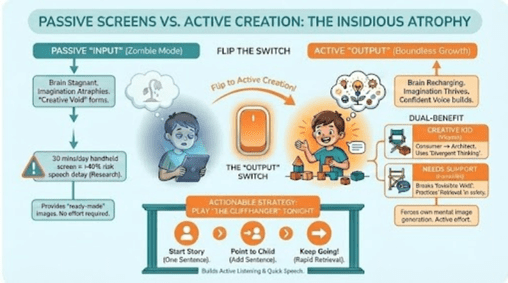
Science Note: This is related to the Use It or Lose It Rule. If the brain only receives fast input and never practices slow output, the “patience muscles” atrophy.
The Dual-Benefit: Why This Matters for Every Child
Whether you have a “Vitamin” kid (you want them to be a genius) or a “Painkiller” kid (you just want the screaming to stop), fixing Popcorn Brain is the answer.
- For the “Loud” Kid (ADHD/High Energy): Fast media is like throwing gasoline on a fire. It over-revs their engine. By slowing down their media diet, you aren’t just “reducing screen time”; you are physically lowering their cortisol and adrenaline levels. This means fewer meltdowns at dinner.
- For the “Quiet” Kid (Daydreamer/Focus Struggles): If your child struggles to finish a sentence or a puzzle, Popcorn Brain might be the culprit. Their brain is scanning for the next “cut” that never comes. Slowing down helps them re-learn how to stay with one thought for longer than 10 seconds.
Actionable Strategy: The “Slo-Mo” Media Detox
You don’t have to throw the iPad in the ocean (tempting, I know). You just need to change the Pace.
Try the “1-to-1” Rule for 3 Days:
- Audit the Speed: Watch 60 seconds of what they are watching. Count the cuts. If the scene changes more than 10 times in a minute? Ban it. It’s too fast.
- The Swap: Replace high-speed shows with “Real Time” content.
- Bad: Cartoons with constant explosions/zooms.
- Good: Nature documentaries, Mr. Rogers-style pacing, or educational apps vetted by the AAP.
- The Bridge: If they freak out (and they might), use audio stories as the bridge. Audio has zero cuts. It forces the brain to visualize the action, which naturally slows down their heart rate.
Pro Tip: If you need help finding alternatives, check out our guide on Screen-Free Saturdays for low-dopamine activities that actually feel fun.
The StoryQuest Solution
We built StoryQuest specifically to be the Anti-Popcorn.
Our stories don’t flash or scream. They wait.
When your child plays a StoryQuest adventure, the story stops and waits for them to speak. This forces their brain to switch from “Passive Zombie” (Receiving) to “Active Hero” (Thinking).
- No fast cuts.
- No over-stimulation.
- Just focus.
It’s like a neurological reset button that tricks them into practicing attention span… while they think they’re just fighting a dragon.
Want to see the difference? Try The 10-Minute “Cheat Code” with them tonight.
People Also Ask (FAQ)
1. Is “Popcorn Brain” a real medical diagnosis? No, “Popcorn Brain” is a term coined by researchers (like Dr. David Levy at the University of Washington) to describe a psychological phenomenon where the brain becomes accustomed to the constant stimulation of multitasking and fast digital media.
2. How long does it take to “fix” a child’s attention span? The brain is plastic! You can see changes in behavior (less irritability, better sleep) within 3–7 days of reducing fast-paced media. However, building long-term executive function is a marathon, not a sprint.
3. Are all cartoons bad for focus? Not at all. The content matters less than the pacing. Shows with long scenes, realistic dialogue, and fewer “camera cuts” (like Bluey or Daniel Tiger) are much easier on a developing brain than high-speed, chaotic animations.
Watch also:








Leave a comment