



It’s a scene every parent of a child with ADHD knows too well.
Your child is bursting with excitement, telling you an elaborate story about space pirates or a magical forest. Their imagination is electric. But the moment you ask them to “write that down” for homework, the light goes out.
The pencil hovers. The page stays blank. The tears start.
It’s not laziness. It’s not a lack of ability. It is a neurological phenomenon known as The Bottleneck Effect—and understanding it is the key to unlocking your child’s potential.
What is the “Bottleneck Effect” in ADHD?
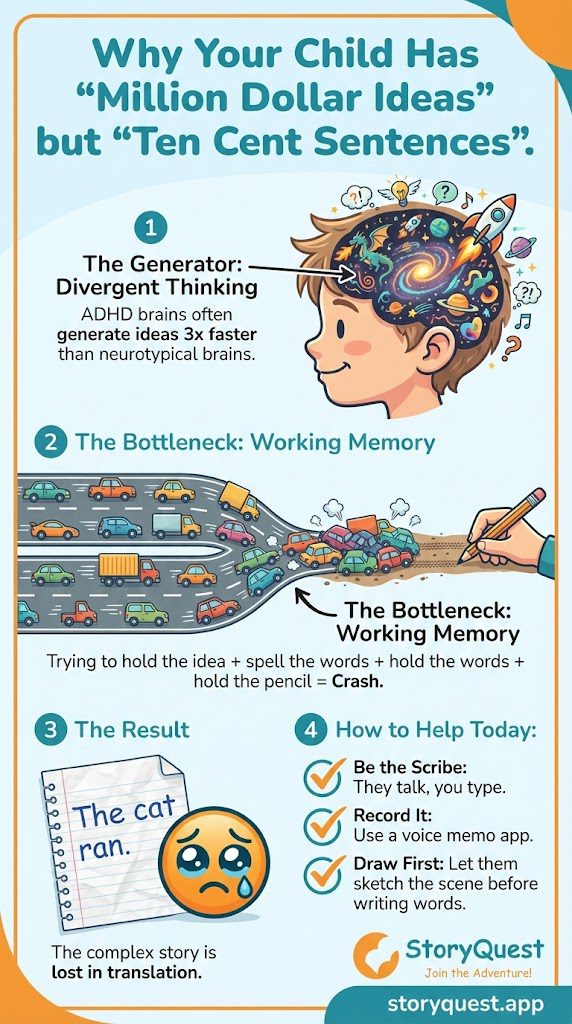
The Bottleneck Effect describes the massive disconnect between an ADHD brain’s high capacity for creative ideas (Divergent Thinking) and its limited capacity to hold those ideas while performing mechanical tasks (Working Memory).
Think of your child’s brain like a high-performance computer. They have a massive hard drive full of incredible ideas, but they are running on limited RAM. When they try to run a “heavy” program like handwriting, the system freezes.
The Science: Divergent Thinking vs. Working Memory
To understand why writing is so painful for ADHD brains, we have to look at two specific cognitive functions:
- Divergent Thinking (The Superpower): Research, such as the 2017 study on Creativity in Children with ADHD, confirms that children with ADHD often score significantly higher on originality and idea fluency. Their brains are designed to generate unique connections and elaborate narratives.
- Working Memory (The Blocker): Conversely, a 2022 study on Executive Functions and Writing Skills highlights that working memory deficits specifically block writing output.
The result? The ideas are flowing like a firehose, but the mechanical process of writing is a narrow straw. The ideas get stuck, leading to frustration, shutdown, and the dreaded “blank page.”
Why Writing is a “Heavy” Task for the ADHD Brain
We often forget how complex the act of writing actually is. For a neurotypical brain, these steps happen automatically. For an ADHD brain, every single one requires conscious, draining effort:
- Idea Generation: “What was my story about?”
- Sentence Formulation: “How do I start?”
- Spelling & Grammar: “Does ‘pirate’ have a ‘y’?”
- Fine Motor Skills: Holding the pencil, forming letters, staying on the line.
- Working Memory: Remembering the end of the sentence while writing the beginning.
By the time the child remembers how to spell the second word, the amazing ending of the sentence has evaporated from their working memory. They aren’t refusing to write; they literally ran out of “RAM.”
The Solution: Remove the Mechanical Load
If the bottleneck is the mechanical act of writing, the solution isn’t to force more handwriting practice—it’s to remove the friction.
Research supports oral storytelling as a bridge. By allowing a child to speak their ideas, you bypass the fine motor and spelling demands, allowing their high-level vocabulary and divergent thinking to flow freely without hitting the working memory wall.
Enter StoryQuest: The Magic Machine for ADHD Brains
This is where StoryQuest pivots from being just a “fun app” to a crucial accessibility tool for your child’s education.
StoryQuest utilizes the power of Voice-to-Text and narrative structure to solve the Bottleneck Effect.
- Bypassing the Block: Your child speaks their story. The app handles the “mechanical load” of capturing the words.
- Externalizing Executive Function: As noted by experts at ImpactADHD, narrative structure helps externalize executive function. StoryQuest provides the framework (the Who, Where, and What) so your child doesn’t have to hold the entire structure in their head at once.
- Validation of Creativity: When a child sees their spoken words turn into a real story—beautifully illustrated and organized—it validates their intelligence. They realize, “I’m not bad at writing. I’m actually a great storyteller.”
Why Kids Learn Best Through Stories
Quick FAQ: Understanding ADHD and Writing
Why do ADHD kids hate writing? ADHD children often hate writing because of the “Bottleneck Effect.” Their creative thinking speed outpaces their working memory and fine motor skills, causing frustration and mental fatigue.
Does storytelling help with ADHD? Yes. Narrative storytelling helps structure chaotic thoughts. Using tools that allow for oral storytelling (speaking instead of writing) removes the barrier of handwriting, allowing children to demonstrate their true verbal ability.
What is the difference between Divergent Thinking and Working Memory? Divergent thinking is the ability to generate multiple unique solutions or ideas (a strength in ADHD). Working memory is the ability to hold and manipulate information in the mind over short periods (often a deficit in ADHD).
Unlock Your Child’s Story Today
Don’t let the blank page hide your child’s brilliance. By understanding the science behind the Bottleneck Effect, you can stop fighting the symptoms and start empowering their strengths.








Leave a comment