
A Voice-First Storytelling Platform That Doesn’t Rely on Screens
StoryQuest is a voice-first storytelling platform designed to support blind and visually impaired children through audio-led, imagination-driven creation.
Children create, hear, and revisit stories using their voice—without relying on visuals or screen-based interaction.
👉 Start storytelling for free
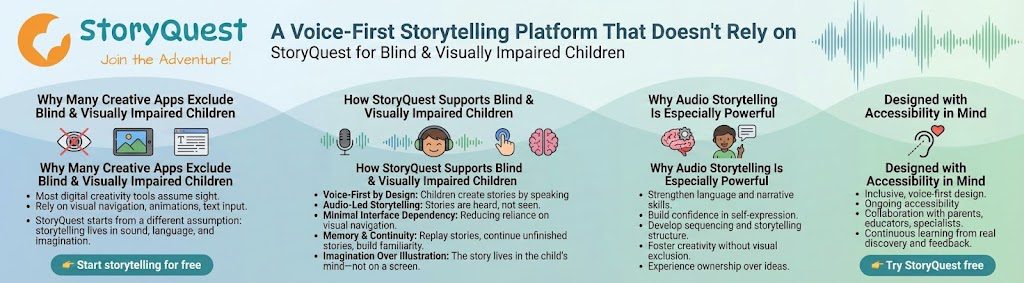
Why Many Creative Apps Exclude Blind & Visually Impaired Children
Most digital creativity tools assume sight.
They rely heavily on:
- visual navigation
- illustrations and animations
- text input and on-screen feedback
As a result, blind and visually impaired children are often excluded from creative digital experiences—not because they lack imagination, but because the tools aren’t designed for them.
StoryQuest starts from a different assumption:
storytelling lives in sound, language, and imagination.
How StoryQuest Supports Blind & Visually Impaired Children
StoryQuest is designed to work without depending on visual input.
Voice-First by Design
Children create stories by speaking naturally.
No reading, typing, or visual interaction required.
Audio-Led Storytelling
Stories are heard, not seen.
Children listen to their stories, continue them, or retell them using voice.
Minimal Interface Dependency
StoryQuest is built to work with assistive technologies and screen readers, reducing reliance on complex visual navigation.
Memory & Continuity
Children can:
- replay stories
- continue unfinished stories
- build familiarity and confidence through repetition
Imagination Over Illustration
The story lives in the child’s mind—not on a screen.
This empowers creativity without visual barriers.
Why Audio Storytelling Is Especially Powerful
For blind and visually impaired children, audio-based storytelling helps to:
- Strengthen language and narrative skills
- Build confidence in self-expression
- Develop sequencing and storytelling structure
- Foster creativity without visual exclusion
- Experience ownership over ideas
Storytelling becomes an active, creative process—not passive consumption.
Who This Is For
StoryQuest supports children who are:
- Blind
- Visually impaired
- Low-vision
- More comfortable with audio than visual interaction
It can be used by:
- Families at home
- Educators and schools
- Accessibility-focused programs and organizations
A diagnosis or label is not required.
Designed with Accessibility in Mind
Accessibility is not an add-on at StoryQuest.
We are committed to:
- Inclusive, voice-first design
- Ongoing accessibility improvements
- Collaboration with parents, educators, and specialists
- Continuous learning from real discovery and feedback
Some accessibility features are already available. Others are actively evolving—with transparency and intention.
What StoryQuest Is Not
To set clear expectations:
- StoryQuest is not a passive audiobook
- StoryQuest is not a visual app with audio added later
- StoryQuest is not a replacement for assistive education tools
It is a creative storytelling platform designed to give children agency, voice, and imagination.
Start Storytelling Without Barriers
Every child deserves access to creativity—regardless of how they see the world.
StoryQuest opens storytelling through sound, language, and imagination. No screen required.
👉 Try StoryQuest free
FAQ — StoryQuest for Blind & Visually Impaired Kids
Is StoryQuest suitable for blind children?
Yes. StoryQuest is designed to work without relying on visuals. Children create and experience stories through voice and audio, making it suitable for blind children.
Does StoryQuest require visual interaction?
No. StoryQuest is voice-first and does not depend on visual navigation or reading. It is designed to minimize reliance on screen-based interaction.
Is StoryQuest an audiobook?
No. StoryQuest is an interactive storytelling platform. Children actively create and shape their own stories rather than listening to pre-recorded content.
Can visually impaired children use StoryQuest independently?
Many children can use StoryQuest independently, especially when paired with assistive technologies. The experience is designed to reduce visual complexity and support audio interaction.
Is StoryQuest compatible with screen readers and assistive tools?
StoryQuest is built with accessibility in mind and aims to work well alongside screen readers and assistive technologies. Accessibility support continues to improve based on real-world use and feedback.
Does StoryQuest replace specialized educational tools?
No. StoryQuest does not replace specialized educational or assistive tools. It complements them by offering a creative, voice-based storytelling experience.
Can StoryQuest be used in schools or accessibility programs?
Yes. StoryQuest can be used by families, educators, schools, and organizations focused on inclusive and accessible learning.